
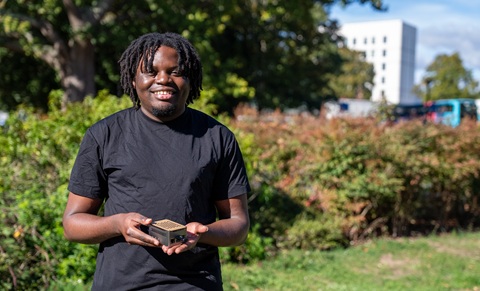
A Southampton student who experienced first-hand the devastating impact of malaria while growing up in Cameroon has invented a novel mosquito-repelling gadget.
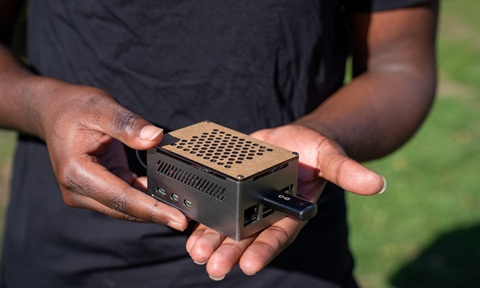
Ulrich Mefenya Tanetsing, who had malaria himself as a child, has created an AI-powered device that detects and repels mosquitoes using sound.
His invention, called ISARS (Intelligent Species-Specific Acoustic Repulsion System), uses the sound of a mosquito's wingbeat to identify species that are most likely to transmit malaria. It uses targeted sound to disrupt the mosquito's navigation, with the frequency continuously adapting rather than relying on a single, repeated tone.
The device does not need any chemicals, internet connection or complex infrastructure, and it is small and low cost, emitting a subtle sound not loud enough to disturb people's sleep, potentially making it suitable for use in homes in remote communities.
Ulrich, 23 and a master's student of biomedical engineering at the University of Southampton, has personal motivation behind the idea.
"Growing up in Cameroon, I saw countless people suffer from and die from malaria, including within my own experience of it," he said. "That personal connection stayed with me."
He came up with the idea after watching a documentary about submarines using acoustic technology to steer whales away from their path.
"It struck me that mosquitoes, like whales, communicate and navigate using sound, so I wondered whether a similar approach could work against them," he said.
Malaria remains a major global health challenge, with hundreds of thousands of deaths recorded every year, predominantly in sub-Saharan Africa. According to the World Health Organisation, 76 per cent of deaths due to malaria in sub-Saharan Africa are children aged under five.
Existing protection methods include insecticide-treated bed nets, chemical sprays and electronic repellents.
"The solutions we currently have to prevent mosquito bites are not ideal because mosquitoes can adapt to insecticides and repeated electronic sounds, chemical sprays can harm people's health, and nets can be hot and uncomfortable to sleep under," explained Ulrich.
"We spend so much money on treatments for malaria, but my solution it to prevent the bites in the first place to reduce the costs of management and treatment," he added.
Ulrich is one of 10 finalists in the national Champion of Champions student innovation competition, organised by business education charity ESBF (Engineers and Scientists in Business Fellowship).
He will pitch his innovation at the Royal Academy of Engineering in London next month for a share of £16,500 prize money and business mentoring.
Clare Old, Student Enterprise Manager at the University of Southampton, said: "Ulrich's work highlights the power of combining technical expertise with entrepreneurial thinking to create innovations with global potential."
Ulrich will also be taking his ISARS prototype to VentureFest South's Festival of Innovation, on Wednesday 18 November at Utilita Bowl, Southampton.


