
The rainforests of northern Australia are home to extraordinary ant colonies. Instead of dwelling in underground burrows, these ants inhabit canopies of trees, dozens of meters above the ground, inside hollow spheres they construct from tree leaves. During the building process, the ants link their bodies together to form living tools, eventually weaving the leaves into nests using silk threads produced by their larvae - hence their name: weaver ants.
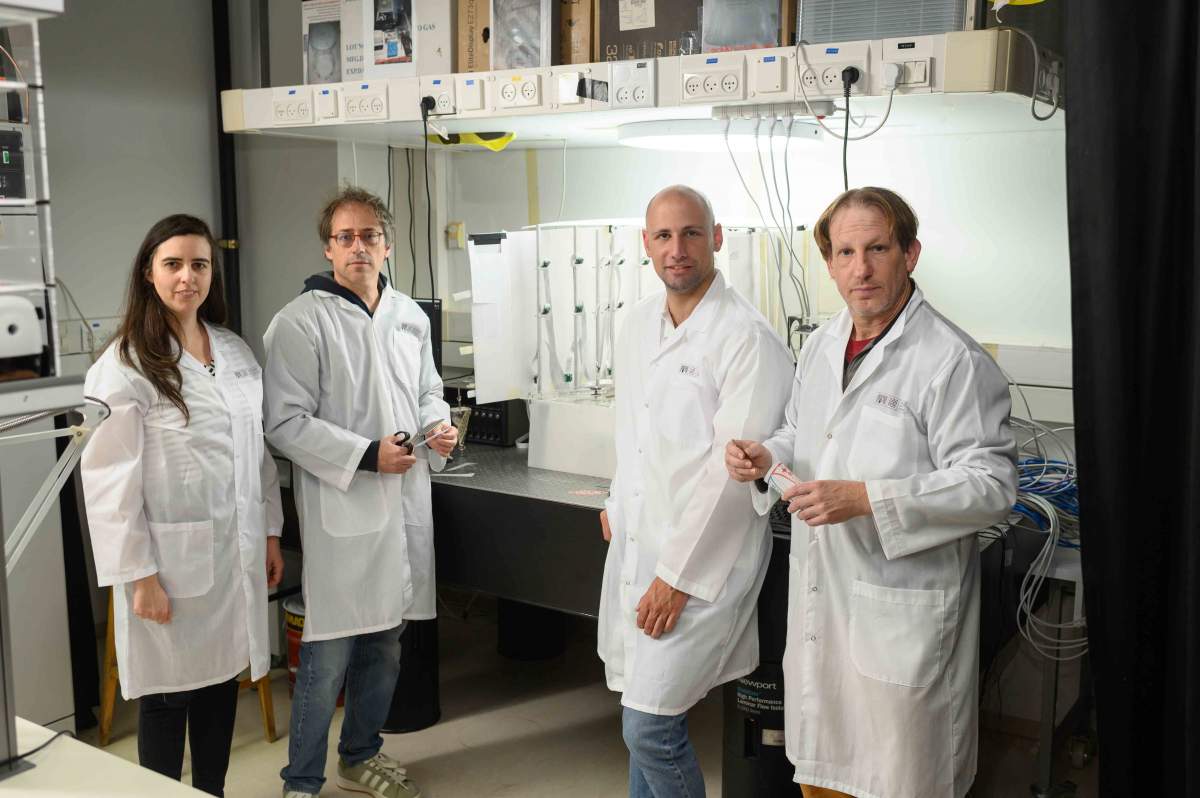
In a new study, published recently in Current Biology, researchers from Prof. Ofer Feinerman 's group at the Weizmann Institute of Science investigated this phenomenon in their lab using an array of 52 synchronized 4K cameras. They observed how the ant colony created and deployed "zippers" and "weights," solving complex problems and repeatedly assembling stable nests without apparent confusion - in a manner that suggests sophisticated cognitive abilities.
To study an ant colony properly, researchers must first find one and then relocate it - intact - to the lab. For this purpose, Feinerman and Dr. Ehud Fonio, both of Weizmann's Physics of Complex Systems Department, traveled to Townsville, Queensland, in northeastern Australia.
""The colony repeatedly overcomes complex challenges, suggesting that advanced cognitive abilities are embedded in its social behavior"
"Each colony of weaver ants in the rainforest may be spread over dozens of nests in the canopies of several very tall trees," Feinerman explains. "Yet there is only one queen, without whom the colony cannot survive for long. Finding her is like locating a single person in a large metropolis. So we focused our search on trees planted in newly developed neighborhoods on the outskirts of the city, where colonies are still young and relatively small, and the treetops are lower."
When threatened, weaver ants bite and release formic acid, so the researchers wore beekeeping suits for protection. On several occasions, local residents who spotted them in their protective gear asked for help eliminating the aggressive ants from their yards, and the search expanded into nearby backyards. One night, the collected ants managed to escape, but the scientists did not give up. The following day they resumed their search and devised creative methods to transport the ants securely.
Back in the lab, a research team led by PhD students Gadi Trocki and Michal Roitman from Feinerman's group designed a camera-monitored arena simulating a branch bearing four artificial leaves. In each experiment, the researchers introduced hundreds of ants into the arena and tracked the construction of the nest.
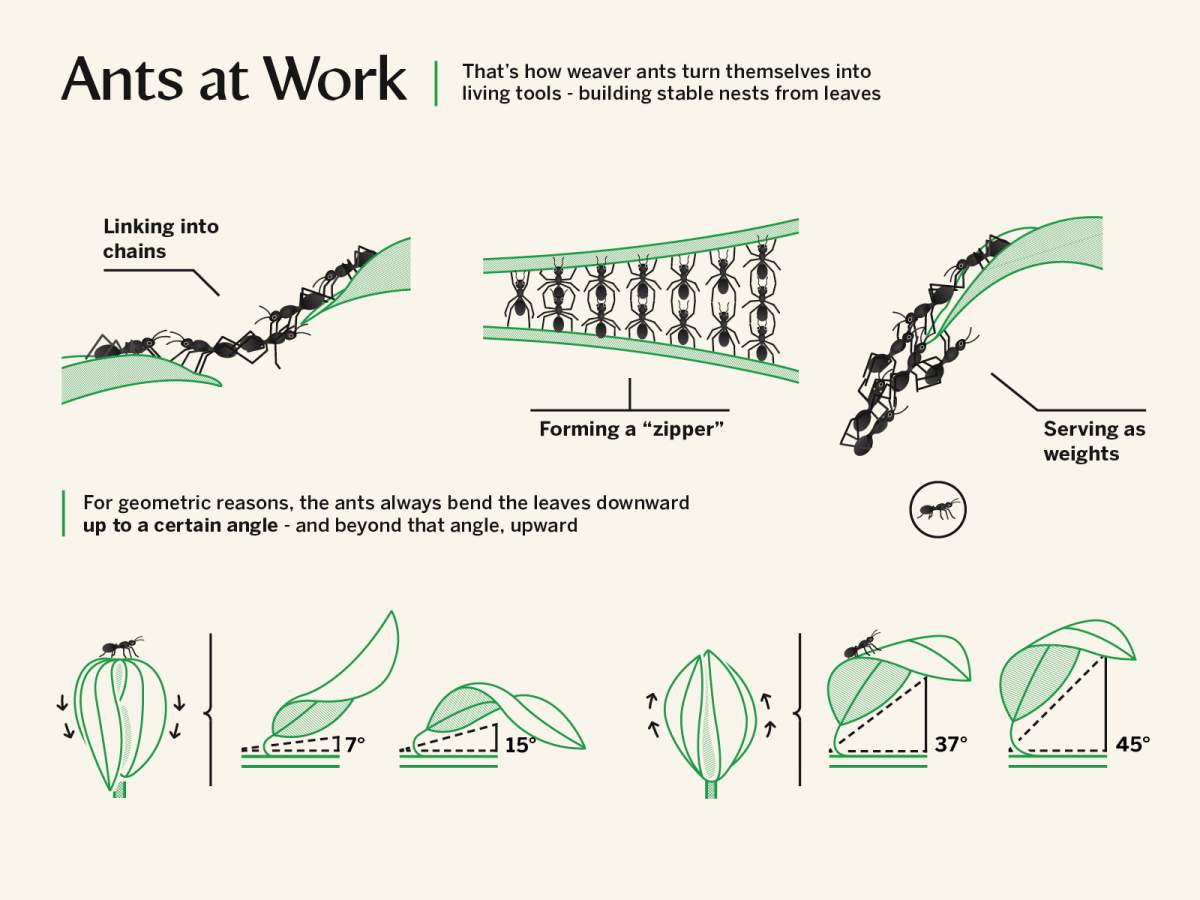
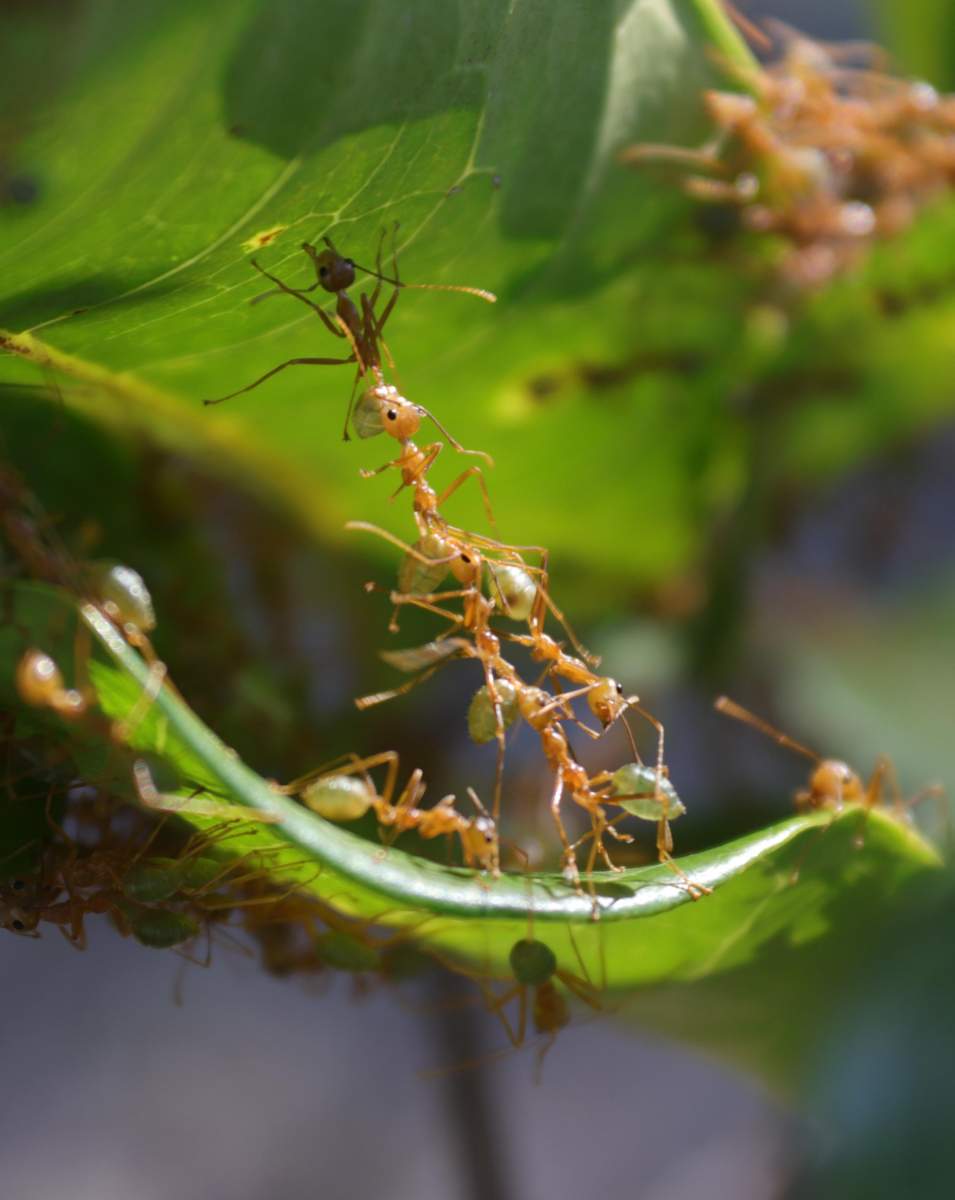
"The colony used two types of tools - zippers and weights," Feinerman explains. "To zip two leaves together, the ants formed chains spanning the gap between the leaves and pulled them toward one another. Initially, chains formed at the base of the leaves near the branch, where the distance between them is shortest. As the leaves drew closer, additional chains formed nearer to the tips, like a living zipper progressively closing. The act of closing not only joined the leaves but also caused them to bend either upward or downward. The 'weights' were chains of ants hanging from the leaf tips, pulling them downward by gravity. Although these abilities are impressive in themselves, we believe that in their natural habitat the colony likely employs an even broader toolkit."
In each nest-building experiment, the researchers varied the initial angle of the leaves - tilting them upward or downward - and examined how this affected construction.
"We found that up to a certain angle, the ants always bent the leaves downward into a spherical structure, and beyond that threshold, they bent them upward, due to geometric constraints," says Feinerman. "At the transition angle, we expected them to become confused, pull different leaves in opposite directions and fail to form a closed sphere. But that didn't happen. Instead, we discovered that the ants always bend one pair of leaves in a particular direction first, and only then zip the remaining leaves to that pair. This ensures that all leaves bend in the same direction."
How they achieve this coordination remains unknown. "It is possible that we are observing collective cognitive abilities," Feinerman says. "One hypothesis is that the ants communicate and coordinate leaf arrangement by secreting and sensing odorous chemical signals called pheromones. Another possibility is that the arrangement emerges from group dynamics: Only after connecting a pair of leaves do the workers stationed there become available to connect adjacent leaves. Still, it may not involve group planning at all, but rather considerations of local efficiency. When attaching an unfolded leaf to a pair that has already been bent, the ants at that junction need to exert less force to complete the bending quickly - and this, in turn, creates a domino effect, with leaves joining one after another. For now, the question remains open."
Science Numbers
A queen weaver ant can lay up to half a million eggs in 3 months - approximately 5,000 per day.
Each nest - comprised of 100 to several hundred leaves - can house up to 50,000 ants.
In the next phase of the study, the researchers sought to understand why the ants consistently construct hollow spherical nests rather than other shapes. To address this question, they employed tools from Gaussian geometry.
Imagine a basketball composed of curved pieces of leather: Each piece is wider at the center and narrower toward the ends, forming an elliptical figure. Leaves have a similar elliptical shape. When the ants zip their edges together, geometric constraints dictate that the resulting closed surface will form a sphere. This geometrically stable configuration provides structural rigidity against compression - a significant advantage in the rainforest, while the hollow interior offers a spacious living environment for the colony. In this case, geometry - rather than collective intention - determines the nest's final shape.
"We have tried trimming and arranging the leaves in ways that make it difficult for the ants to create a closed structure," Feinerman adds. "Yet the colony repeatedly overcomes complex challenges and achieves its collective goal. This suggests that highly developed cognitive capabilities are encoded within their social behavior."
Prof. Ofer Feinerman is the incumbent of the Henry J. Leir Professorial Chair.
The Tom Beck Research Fellow Chair in the Physics of Complex Systems supports a staff scientist in Prof. Feinerman's lab.


