
Trees in urban areas are highly effective in reducing harmful heat exposure and improving outdoor comfort in cities, according to a new study.
Weather measurements in Leeds have shown that many green spaces, such as parks, gardens and forests, were cooler than surrounding urban environments, also known as grey spaces.
Treescapes – areas with tree cover – were around 1.4C cooler on average, compared to nearby built-up streets. During the hottest summer periods, treescapes were up to 5C cooler in the middle of the day.
The study, published in People and Nature, was a collaboration between researchers at the University of Leeds and Leeds Beckett University, as part of Dr Jim Parker's Future of UK Treescapes Fellowship funded by UK Research and Innovation (UKRI).
We need to take the role of trees and green spaces in our towns and cities more seriously – these aren't just nice-to-have, they are critical infrastructure.
Crucially, the findings conclude trees dramatically reduce harmful heat exposure, with treescapes seeing up to 96% fewer hours of such exposure than the nearby grey spaces.
Dr Cat Scott from the University of Leeds School of Earth, Environment, and Sustainability, who was a co-author on the paper, said: "A key part of making our towns and cities more resilient will be to improve people's access to cooler spaces. As our findings suggest, the protection and expansion of urban tree cover is a key strategy for improving public health, thermal comfort, and the climate resilience of our towns and cities.
"We need to take the role of trees and green spaces in our towns and cities more seriously – these aren't just nice-to-have, they are critical infrastructure."
Measuring weather conditions
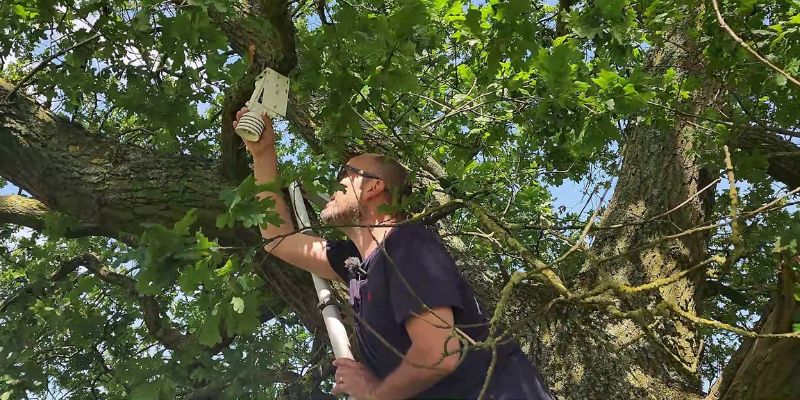
The researchers installed a network of sensors across Leeds, measuring air temperature and humidity every 15 minutes through the summers of 2023 and 2024. The sensors were on busy streets, small city centre parks, larger suburban parks, and different types of treescapes such as larger woodlands or small groups of trees.
One sensor was installed in a mature tree at the University of Leeds Gair Wood site in north Leeds, providing a rural treescape dataset for the study. By comparing conditions across these locations, the researchers were able to explore how temperatures varied during warm summer periods.
The cooling ability of trees is due to the shade they provide and the process of evapotranspiration – where trees take water from below the ground via their roots, transport it through their tissues and out through tiny holes on their leaves. Once at the leaf surface, water can evaporate, which cools down the surrounding air.
Recent heatwaves
Professor Jim McQuaid at the University of Leeds School of Earth, Environment and Sustainability, who co-authored the research, said: "We are already seeing the impacts of climate change on summertime temperatures in the UK. This summer has seen records smashed across the UK, with four heatwaves already on the books this year. We are looking forward to analysing the most recent data from the sensor network which continues to provide a highly detailed map of the temperatures across the city."
In the past few months, the sensors indicated urban woodlands relatively close to the city centre had significantly lower temperatures than the surrounding built-up areas. When Leeds City Centre reached a peak of 34C on 26 June, Batty's Wood in Woodhouse Ridge was over 6C cooler and Fox Wood in Roundhay was 5.5C cooler.
In Headingley, a weather station on a Leeds Beckett University building rooftop saw the temperature reach 32.8C, while just hundreds of meters away, measurements in Church Wood showed it was only 27.3C at the same time.
Dr Jim Parker from Leeds Beckett University, who led the study, concludes: "Our evidence shows that planting and protecting trees is a practical and effective way to make cities safer, healthier and more comfortable, especially as our climate continues to warm."


