
"But the greyhound racing industry is well-regulated".
Like most things that sound too good to be true, it leaves out the messy parts. And when we're talking about living, breathing animals, those "messy parts" matter.
'Reform' and 'self-regulation' do not equal protection for dogs.
In South Australia, there is no truly independent regulator for greyhound racing. Self‑regulation means Greyhound Racing SA is responsible for managing, promoting, and regulating its own industry – including conducting its own investigations and handing down decisions through its own internal hearing panel.
When the same body that profits from racing is also the one policing itself, it raises an obvious question: How can genuine accountability or meaningful reform occur when the only people holding the industry to account are within the industry itself?
The industry says it loves greyhounds, but 'love' does not cage, race or discard when no longer useful or profitable. True love means protection, not profit.
In this series, we'll be diving into common greyhound racing myths that the industry perpetuates.
So, let's start with the biggest myth (the one that the industry doesn't want you to question).
Myth: "The death count in greyhound racing is low."
On paper, the numbers may look small. That's because the only deaths that get publicly reported are the ones that happen on race day, on the track, in front of the on‑course vet. Essentially, when the death cannot be hidden.
But racing injuries don't magically stop causing harm once the dog leaves the track. Many greyhounds suffer catastrophic and major injuries during training, trials, or the race itself – injuries that lead to euthanasia or death later, quietly, out of sight. Those deaths rarely make it into the official tally.
And the injuries themselves? They're not just minor sprains. We're talking about shattered bones, spinal trauma, paralysis, severe muscle tears, heat stress, hypoxic seizures, and exertional acidosis (muscle fibres leaking into blood stream after over-exertion). The kind of injuries that would put a human athlete into months of rehab, if they survived at all.
Between 2021 and 2024, analysis of industry stewards reports showed 373 race fatalities were recorded nationally. 83% of those deaths involved fractures (sometimes multiple fractures). Another 8% were dogs who simply collapsed and died. 1 And that's just what was recorded. For 2025, using the industry's published stewards reports, the Coalition for the Protection of Greyhounds found 2,323 major injuries and 119 on-track deaths reported.
Given that the outcome for a significant number of the dogs who suffered major injuries would have been death or euthanasia, (often, post-race day) it's clear that the 119 deaths recorded on track is only a small portion of the total death numbers.
Many injuries happen at the first turn on the racetrack, where dogs are bunched together at high speed, or in the catching pen, where exhausted dogs collide again. And remember, injuries detected after race day often aren't formally recorded at all.
Even when rehabilitation programs exist, they're limited. Long-term care is expensive, and many injured or behaviourally– challenged dogs never fully recover or become suitable for rehoming, with some spending unacceptably long periods in rehoming facilities. The industry doesn't publish comprehensive data on what happens to these dogs… How many fail rehoming attempts, how many recover, how many don't, how many quietly disappear.
January 2026
South Australian Track Injuries:
132
Major Injuries:
40
Rest In Peace - Charos Fantasy
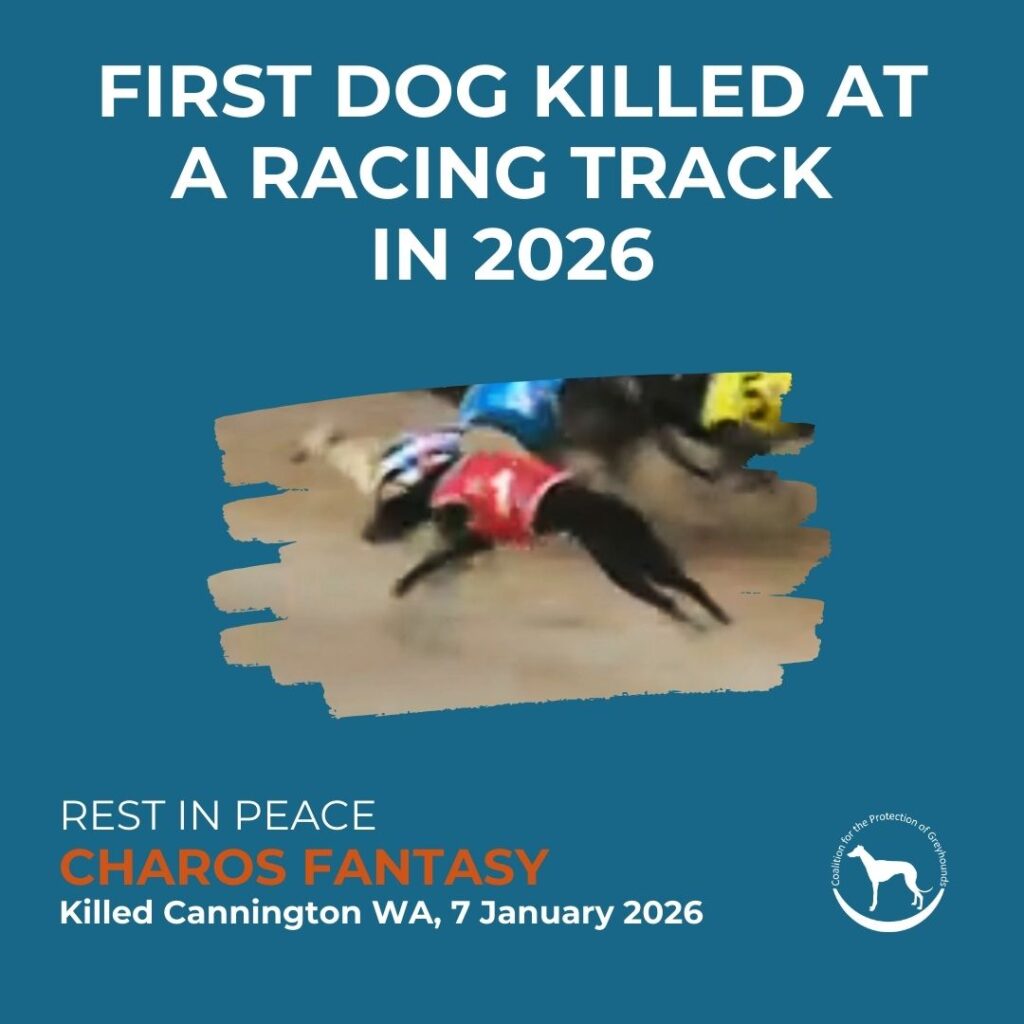
And then there are individual stories that cut through the statistics. On 9 January 2026, 21‑month‑old Charos Fantasy became the first publicly reported greyhound to die from racing.
She suffered an "open severely displaced hock and calcaneal fracture" after hitting the rail and colliding with another dog. She didn't finish the race. She didn't get a second chance. She was euthanised by the track vet, not even two years into her life. You can view the video here, courtesy of the Coalition for the Protection of Greyhounds.
Becoming numb to these dogs' deaths is a slippery slope to acceptance.
Greyhounds deserve better.
In 2023, the report from the independent inquiry into South Australia's greyhound racing industry laid out 87 recommendations to address the governance and grievous animal welfare issues in greyhound racing.
As much as RSPCA South Australia welcomes reform that will genuinely improve the lives of greyhounds in the racing industry, we have serious doubts that SA's greyhound racing industry will clean up its act by the Inquiry deadline of 7 July 2026.
And even if the industry does implement all inquiry recommendations, it's doubtful that these measures will fix the deep‑rooted animal welfare problems that have resulted in thousands of greyhounds being injured or killed over so many years.
If the industry wants to earn the community's trust, it must clearly and consistently demonstrate, with evidence, that every greyhound is afforded good welfare from birth through to the end of their life.
Until that happens, Greyhound Racing SA cannot claim a social license to operate.
Greyhounds deserve better.
If you believe this too, please stand with us.


