
Türkiye has requested permission from the United States to "retransfer" to Ukraine tens of thousands of cluster munition rockets, missiles, and artillery projectiles that have been in Türkiye's stockpiles for decades, Human Rights Watch said today.
These weapons, which contain over 10 million explosive submunitions, were originally produced in part by Türkiye under licenses from the US initiated in 1987. The artillery projectiles that make up the bulk of the proposed deal were removed from US service in 1994, when the howitzers that fired this ammunition were retired from US service.
"Dumping obsolete cluster munitions into a conflict creates a humanitarian liability for civilians that is tragically foreseeable," said Nicole Widdersheim, deputy Washington director at Human Rights Watch. "The impact on civilians of these more than 30-year-old inaccurate and unreliable munitions is what motivated 112 countries to ban the weapon by joining the international Convention on Cluster Munitions."
In addition to selling its entire inventory of 12 M270 multi-barrel launchers, Türkiye's proposed US$256 million deal includes transferring three types of cluster munitions:
- 70 M39 ATACMS ballistic missiles, each containing 950 M74 antipersonnel/anti-materiel submunitions totaling 66,500 individual submunitions.
- 2,524 M26 rockets, each containing 644 M77 dual purpose improved conventional munitions (DPICM) submunitions, for a total of 1,625,456 individual submunitions.
- 47,000 M509A1 203mm artillery projectiles, each containing 180 M42 DPICM submunitions, for a total of 8,460,000 individual submunitions.
In the letter submitted to Congress on August 6, 2026, notifying it of this deal, a senior State Department official notes, "The United States Government is prepared to authorize this transfer…" and adding that Türkiye "seeks to reduce its inventory of older defense articles to focus its financial resources on modernization and sustainment of existing systems."
Additionally, the State Department official wrote, "Ukraine seeks to acquire these systems to bolster its offensive and defense fire support capabilities as it resists the Russian invasion. Ukraine already possesses munitions of the same or essentially similar type."
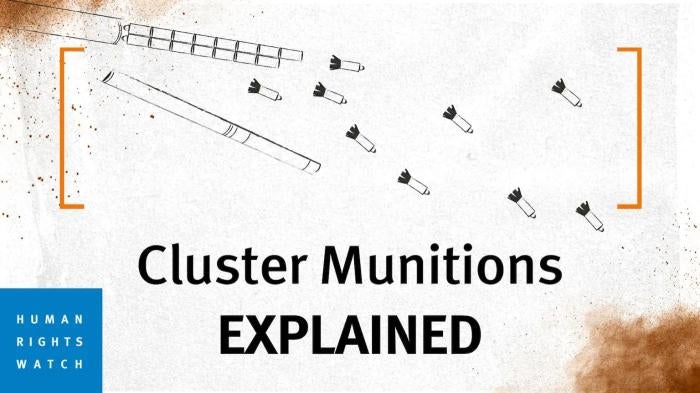
Cluster munitions are inherently indiscriminate as they cannot be targeted with precision and have a history of creating deadly hazards to civilians and communities every time they are used. They cause damage over a very large and imprecise area, and, due to the numbers used and high failure rate, leave behind many unexploded "dud" submunitions that become de facto antipersonnel landmines. It is difficult to reconcile their use with the prohibition on indiscriminate attacks on civilians, which can be a war crime.
While the US has not joined the treaty, an export moratorium has been enacted in the annual Defense Department budget each year since 2009. However, President Joe Biden bypassed the moratorium between July 2023 and October 2024 and concluded at least seven transfers of cluster munitions to Ukraine without disclosing the quantities provided.
As detailed in the "Cluster Munition Monitor Report 2025," the US Foreign Assistance Act facilitates this work-around by allowing the president to make a determination that this type of security assistance is "vital to the security interests of the United States" and notify Congress.
It is not publicly known if the Trump Administration has made a similar determination in this case to sidestep the export moratorium. Congress has the ability to review the transfer and pass a Joint Resolution of Disapproval to block the sale.
"These types of cluster munitions are notorious for their record of not hitting their targets and hurting civilians," Widdersheim said. "They should never be used. Congress can still act to stop this short-sighted and dangerous transfer."


