Key points
- Dr James Manson built his career by deliberately immersing himself in farming systems to bridge crop physiology and real-world decision-making.
- His research on faba beans and cereals clarified how growth during the critical period determines yield - shifting focus from visible symptoms to underlying processes.
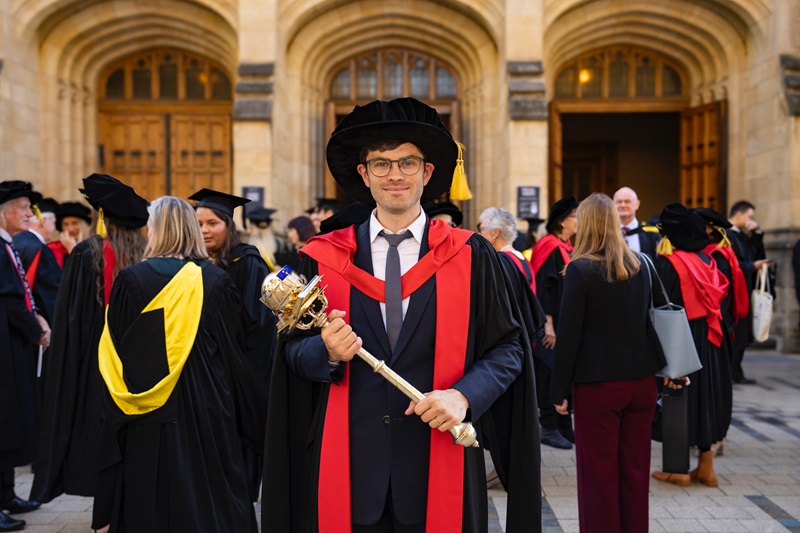
- Named the 2026 Emerging Leader for the southern region by the Grains Research and Development Corporation, Dr Manson exemplifies a new generation of scientists translating complexity into practical insight for Australian grain growers.
It took patience and practice, but Dr James Manson taught himself how to read a field. The faint, parallel lines pressed into the soil became the alphabet of a new language, allowing him to interpret what had happened before he arrived.
"You took a measuring wheel out, you counted the runs, you looked at the spacing and you started to understand the system – how wide the spray boom was, how the header moved, where the grower had started and finished," Dr Manson said.

"That process gave me a real appreciation for the operations of a farm. It was one thing to understand the physical and biological processes of a crop. It was another thing entirely to understand the practical decisions and logistics that made a farm work."
It's a striking image – a scientist reading a paddock like a text, especially when you consider Dr Manson wasn't raised on a farm. He grew up in Chiang Mai, in Thailand, where his parents were working at the time.
"I was very much a city kid. At the end of high school, I had no clue what I wanted to do."
Agriculture was not on his radar, but he counts himself fortunate that an internship with an agricultural development NGO in northern Thailand changed that trajectory.
"It was a bit of everything," Dr Manson said. "There was a lot of tropical horticulture – helping grow food, doing physical labour in the fields, which I loved as a young person. But I was also working as a research technician on experiments, and we did extension work as well – talking to development workers and sometimes visiting villages. It was a real adventure. I did that for a few years and I really loved it."
Looking back, he could see the through-line.
"I realised later that all through school I liked science, I liked being outside and I liked food," Dr Manson said. "I just hadn't connected those dots. In hindsight, agricultural science was an obvious fit. But it didn't occur to me until I had a taste of it."
Grounded in grower reality
After those years in Thailand, Dr Manson returned to Australia and enrolled in a double degree in agricultural science and international development in Melbourne. Study gave him language and theory for what he had experienced in the field. But even as he progressed through university, he remained cautious about drifting too far from practice.
"I had always wanted to be able to speak to practitioners," Dr Manson said. "But I was conscious that I couldn't do that with integrity if I didn't really understand their world. I didn't want to become a researcher who only spoke to other researchers."
He completed an Honours year to keep the option of a PhD open, but hesitated. Instead of moving directly into further study, he took a punt and joined Southern Farming Systems, a grower-led group in south-west Victoria. It meant relocating from Melbourne to regional Victoria and stepping into a farmer-driven research environment.

"I wanted to work on the front lines," Dr Manson said. "I wanted to learn from growers about what the real issues were and what role I could play."
For four years, he ran trials in integrated weed management and pulse agronomy, particularly faba beans. In the process, he quickly learned that credibility had to be earned.
"You would say something and it wouldn't land," he said. "Someone would ask a question you hadn't thought about. That feedback was as valuable as anything. It forced you to sharpen your thinking."
Immersed in paddocks and conversations, deeper questions began to build. The balancing act became clearer: applied problem solving on one side, unanswered scientific questions on the other.
Solving the faba bean puzzle
It was faba beans that sharpened those questions into something urgent.
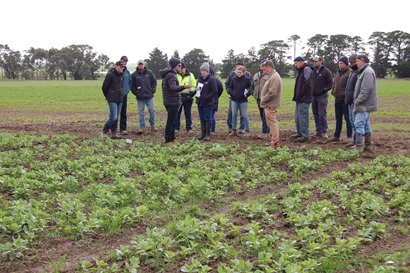
In south-west Victoria, the crop was gaining traction for its nitrogen fixation and role in cereal rotations. But it was unpredictable. Some seasons it yielded strongly. In others, it disappointed – even when conditions looked favourable.
"That ambiguity really bothered me," Dr Manson said. "You would change a variety, a sowing rate or a time of sowing, and it would work one year and not the next. I kept asking why."
Growers were also unsettled by the crop's abundance of flowers, many of which never became pods.
However, Dr Manson's research found that overproducing flowers is actually normal.
"All crops do it. Wheat hides it inside the stem, but it's the same principle. The plant is setting up more potential than it can probably finish, then dials it back as the season progresses."
Yield was instead driven by what happened during the critical period.
"It largely came down to growth during that window from flowering to seed fill," Dr Manson said. "It wasn't about the number of flowers. It was about whether the crop had the resources at the right time."
Through his Grains Research and Development Corporation (GRDC)-funded PhD, he applied cereal physiology theory to a crop that had been comparatively under-researched.
"I suspected faba bean was playing by the same rules as other crops," Dr Manson said. "It just didn't look like it. Once you applied that framework, a lot of the confusion started to resolve."
In 2025, his GRDC-supported project confirmed the importance of whole-crop growth leading into that critical period and clarified how seasonal conditions shaped flowering, pod set and yield. For Dr Manson, it marked a turning point.
"It wasn't like I wanted to do a PhD," he said. "It felt like I needed to do one. I wanted to move beyond just solving the immediate problem and start explaining why things happened."
Critical period benchmarks and leadership
Today, that same systems lens shapes his work in cereals.
As a GRDC Early-Career Postdoctoral Fellow with CSIRO's Resilient Systems team, Dr Manson is leading research across five trial sites in South Australia and Victoria, working with CSIRO researchers Dr Kenton Porker, Dr John Kirkegaard, Dr Therese McBeath, Dr James Hunt and collaborators to define critical period benchmarks in wheat and barley.
"Most of the big management decisions are made early in the season," Dr Manson said. "But most of the yield outcome is determined later, in spring. There is this big gap between the decision and the result."
His work focused on narrowing that gap – identifying what a well-positioned crop looked like mid-season.
"If we could define those benchmarks clearly, we could give growers a better chance of navigating whatever the season threw at them."
The goal was not simply more data, but clearer principles.
"I wanted to distil the complexity," Dr Manson said. "If we could understand the drivers properly, we could help people make better decisions under uncertainty."

That combination – rigorous science paired with deep engagement with growers – was precisely what the GRDC Emerging Leader Award for the southern region sought to recognise.
GRDC Southern Panel Chair Andrew Russell described Dr Manson's contribution to the Australian grains industry as "immense for someone at such an early stage of their career", noting his dedication, discipline and willingness to share expertise.
Therese McBeath, a Research Team Leader with CSIRO's Agriculture and Food research unit, said Dr Manson's trajectory reflected a deliberate commitment to engaging with and understanding the farming system.
"He was a city kid who wanted to work in agriculture, so he kicked off his career in agriculture in a farmer-led grower group to really understand the system," Dr McBeath said. "That investment paid off. He developed into a highly impactful agricultural systems researcher who bridges a deep knowledge of crop physiology and how it can be manipulated to identify best cropping practice."
For Dr Manson, the award was both affirming and motivating.
"At this point, I felt like I had found my groove," he said. "There were times earlier on when I wondered if it had taken too long to get there. So, this recognition was really encouraging. It suggested I was on the right track."
From reading tracks in a paddock to refining yield benchmarks across southern Australia, Dr Manson had learned to move comfortably between field and theory.
And that balance – once a tension he wrestled with – has become his defining strength.