Computer scientist Mariam Basajja's investigated how Uganda can make better use of health data. Her PhD research taught her an unexpected lesson: the biggest obstacles to digital transformation are often not technological.

As Mariam Basajja began exploring digital healthcare, she saw both the power of data and its limitations. Healthcare institutions generate vast amounts of valuable information, but much of it goes underused.
'I saw how powerful data can be in improving healthcare, but also how easily that potential is lost when information is fragmented, inaccessible or poorly managed,' says Basajja. During her PhD research in Leiden, she investigated how health data could improve healthcare in Uganda.
Valuable data trapped in separate systems
Uganda has made significant progress in digital healthcare in recent years. Yet many hospitals, research projects and NGOs still use different systems that do not work well together. As a result, valuable information remains trapped in separate databases or even in paper records.
'Sometimes, two systems may record the same medical concept in completely different ways,' says Basajja. Researchers can spend months trying to make sense of existing datasets, while healthcare institutions collect data that already exists elsewhere because it is difficult to find and reuse.
What is FAIR data?
Data that is FAIR, is:
• Findable
• Accessible
• Interoperable (able to work across different systems)
• Reusable
FAIR does not mean that all data should be made public. It means organising data so that authorised users and computer systems can find, understand and reuse them responsibly.
Making better use of data
Basajja mapped out these challenges and developed a framework for organising data according to the FAIR principles (see box). 'The solution is not always to collect more data. We also need to make sure we can find, understand, share and reuse the data we already have, while protecting privacy and preserving local control.'

This helps keep data useful over the long term and opens the door to new applications, like AI tools that can predict health risks and analyse patterns of disease.
During the COVID-19 pandemic, Basajja worked with the Virus Outbreak Data Network (VODAN) to explore how researchers could use health data across international borders while allowing hospitals and countries to retain control over their sensitive information.
'Technology is only part of the problem'
As a computer scientist in particular, it is tempting to assume that the solution to digital healthcare challenges lies in better software, algorithms or databases. But, as Basajja discovered, technology is often only part of the problem.
'Successful digital transformation depends as much on people as it does on technology.'
'What surprised me most was that the biggest challenges were not necessarily technological.' Cooperation between organisations, good governance, staff capacity and even organisational culture are just as important. 'Successful digital transformation depends as much on people and institutions as it does on technology.'
Innovation is not a one-way street
For Basajja, this also means recognising that solutions that work in one setting will not necessarily succeed in another. Her international academic career has taken her from Uganda to Kenya, the UK and the Netherlands, giving her experience of very different healthcare settings. 'Technology can never be separated from the context in which it is used,' she explains.
A system designed for a European hospital, for example, often assumes a reliable internet connection and specialist IT teams. In a rural clinic in Uganda, these resources cannot always be taken for granted. Solutions therefore need to be designed around local needs and circumstances.
European healthcare systems can also learn from solutions developed in these settings. When resources, internet bandwidth or infrastructure are limited, systems need to be efficient, flexible and focused on what is genuinely needed. This approach is relevant everywhere, especially as healthcare systems face growing pressure to become more sustainable and cost-effective.
'Knowledge can flow in both directions. Different healthcare systems give rise to different kinds of innovation, and we can learn a great deal from one another.'
More than one way to be a scientist
Outside academia, Basajja also brings together different worlds. Alongside her work as a computer scientist, she runs her own make-up line and reaches a large audience through social media.
This combination sometimes surprises people. That is precisely why Basajja believes it is important to show young people, especially young women, that there is no single way to be a scientist.
'You can be serious about science and still be interested in fashion, beauty, entrepreneurship or creativity. These parts of your identity do not have to compete with one another.' Just as with data, innovation often comes from bringing different worlds together.
PhD thesis and defense
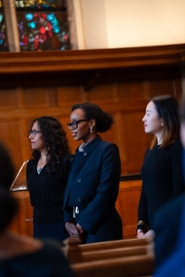
Mariam Basajja defended her PhD thesis, 'Design and implementation of FAIR principles in digital health data in Uganda, Africa', on 8 September at the Academy Building in Leiden. Her supervisors were Fons Verbeek and Katy Wolstencroft (University of Amsterdam).