
UN human rights chief Volker Türk said on Thursday he was appalled by a wave of attacks that have killed civilians across Ukraine over the past four days.
They include a strike on two public buses in Kramatorsk on Thursday, that left at least 30 civilians dead, according to local authorities.
Since Monday, at least 85 civilians have reportedly been killed and 346 injured in Russian strikes, Mr. Türk said, describing the scale and manner of the attacks as "reprehensible".
Plunged into darkness
Long-range strikes on electricity substations and power plants have also left many parts of Ukraine without power. The country already faces emergency and rolling outages, even before colder temperatures and shorter days drive up demand for electricity.
Mr Türk said he was also deeply concerned by reports of Ukrainian attacks that have killed and wounded civilians in occupied territory and in Russia.
"Civilians are strictly protected under the laws of war and may never be attacked," he said, warning that deliberate attacks on civilians could amount to war crimes and that those responsible must be held to account.
235,000 Gazans forced to shelter in 400 flood-prone sites
Hundreds of thousands of Palestinians continue to shelter in flood-prone sites across Gaza.
According to UNRWA , the agency for Palestinian refugees, 235,000 displaced Gazans are being forced to live in 400 unsuitable areas, along with 44,000 still based in unstable buildings - that are more likely to collapse in the winter months.
The UN and its humanitarian partners continue to support Gazans despite ongoing insecurity with people "still being killed and displaced", one year since a fragile ceasefire agreement between Hamas fighters and Israel.
Fourth winter under fire
On Tuesday, the UN brought more fuel into Gaza to help keep basic services running. Aid teams also collected medical and educational supplies and food from the Kerem Shalom crossing in the south of the enclave, as families face a fourth winter in tents and makeshift shelters.
In an appeal for greater access, the UN's top aid coordinator, Tom Fletcher, stressed the need for more funding for fuel "to prevent a dangerous slowdown of healthcare, water provision, rescue operations, debris removal and other critical services".
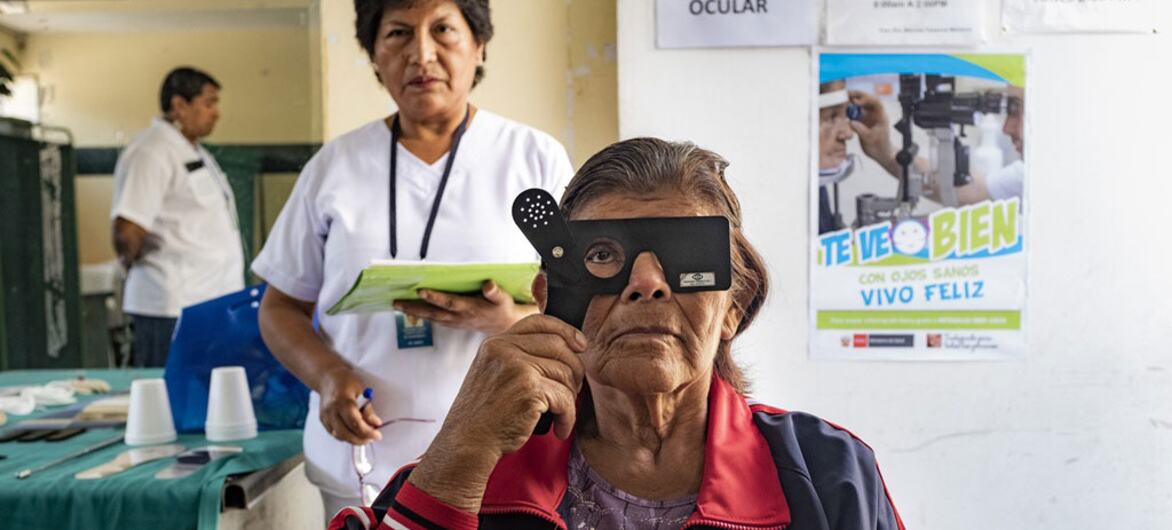
Cheap reading glasses remain key conduit to better quality of life
Poor eyesight impacts an estimated 2.2 billion people, with nearly one in three living in the Southeast Asia.
To mark World Sight Day , the UN World Health Organization ( WHO ) stressed that nearly half of the global burden could be fixed with surgery or a pair of reading glasses.
It noted that young children with severe and uncorrected vision impairment can struggle at school, while adults who can't see well are often linked to lower productivity at work, absenteeism and high rates of depression.
The agency's free app - WHOeyes - helps people gauge how good or bad their eyesight is without having to see a specialist. But it's not a long-term public health solution, said Dr Nilesh Buddha, Officer-in-Charge for WHO in the region.
"WHOeyes mobile app is considered a valid and reliable community-based vision screening tool…But we clearly say that the app is strictly a screening instrument and explicitly does not replace comprehensive professional eye examination."
Far-sighted targets
Across the region, cataracts are the overwhelming cause of blindness and sight problems, along with uncorrected vision impairment and damage to the retina caused by diabetes.
Under global targets supported by WHO, governments have committed to a 40 per cent increase in helping people with so-called "refractive error" issues and a 30 per cent increase in cataract surgery success by 2030.
Progress is being made towards better vision, with trachoma - a leading infectious cause of blindness - now eliminated across Southeast Asia.
But the health agency cautions that many people still struggle to access affordable eyeglasses: especially low-income families, women and older adults.


