
UNSW SMaRT Centre researchers have had published a study revealing multiple research findings around valuable new uses for textile and other wastes as sources of activated carbon for essential "purification" applications.
In its latest published report by Elsevier into creating "activated carbon" from waste textiles, the UNSW Sustainable Materials Research and Technology (SMaRT) Centre says the findings represent an important discovery and opportunity to boost sustainability of global purification and filtration systems, and to reduce the negative environmental impacts of conventional methods of manufacturing activated carbon.
This follows earlier SMaRT research that was also able to successfully and sustainably obtain activated carbon from waste streams such as end-of-life cotton products, wood and plastic components of automotive shredder residue (ASR), waste coffee grounds, and plastic from end-of-life flexible printed circuit boards (FPCB), for a variety of applications including noise attenuation and energy storage systems that rely on non-renewable resources.
SMaRT Centre Director, Professor Veena Sahajwalla, said the new textile waste research findings, via SMaRT's ARC Microrecycling Research Hub, are important and significant because they show far superior sustainability advantages over conventional methods of creating activated carbon used in the countless purification and filtrations system across the world.
"We show it is very possible to not only help ameliorate the growing waste textiles problem being experienced globally, but to reform this waste stream usually destined for landfill into highly valued activated carbon materials that can be used in many purifications systems, such as for water, air, gas, food and beverage, as well as for numerous other crucial industrial applications," she said.
"The research was able to demonstrate a 36% reduction in embodied carbon and over 99% reduction in embodied energy demand relative to conventional coal-derived activated carbon, which has been an essential material created the world over for a wide variety of important and critical purifications systems."
Activated carbon is a form of carbon obtained from natural, non-renewable resources that are specially treated with oxygen and manufactured to create a highly porous structure with an enormous internal surface area, making it an excellent material for filtering and purifying liquids and gases by trapping impurities through a process called adsorption.
A lifecycle assessment study was undertaken as part of this latest research and overall, the findings add to the momentum to develop SMaRT's innovative microrecycling technologies and processes that tackle "hard to recycle" waste streams, where waste materials destined for landfill are effectively and efficiently recovered and reformed into feedstock for remanufacturing to help create a circular economy. The thermal transformation process developed as part of this and earlier research into obtaining activated carbon from hard to recycle wastes is a novel approach to help deliver greater sustainability in the textiles and waste processing industries, while deepening the scientific understanding of how to tailor the physicochemical properties of activated carbon for specific environmental applications.
This research – undertaken under SMaRT's Australian Research Council Industrial Transformation Research Hub into Microrecycling - aspires to provide sustainable and effective solutions for mitigating pollution associated with textile and other wastes to reduce industrial emissions and to develop small-scale manufacturing of valuable materials recovered and reformed from complex wastes.
Background and challenges
The increasing volume of post-consumer textile waste presents a substantial environmental challenge due to the complexity of recycling mixed and blended textile waste. Effective recycling necessitates precise sorting of textiles by material composition. However, current technologies remain limited in their ability to achieve this.
Natural fibres are typically recycled through mechanical processes such as shredding, blending, combing, and re-spinning into yarn, while synthetic textiles are generally processed into plastic pellets for reuse. The inefficiency in fibre separation results in significant quantities of textile waste being directed to landfill, where natural fibres require centuries to degrade, and synthetic fibres persist indefinitely, contributing to microplastic pollution and the leaching of hazardous substances.
This accumulation exacerbates landfill constraints and poses considerable ecological risks, particularly through microplastic contamination in aquatic ecosystems.
Scientific contribution
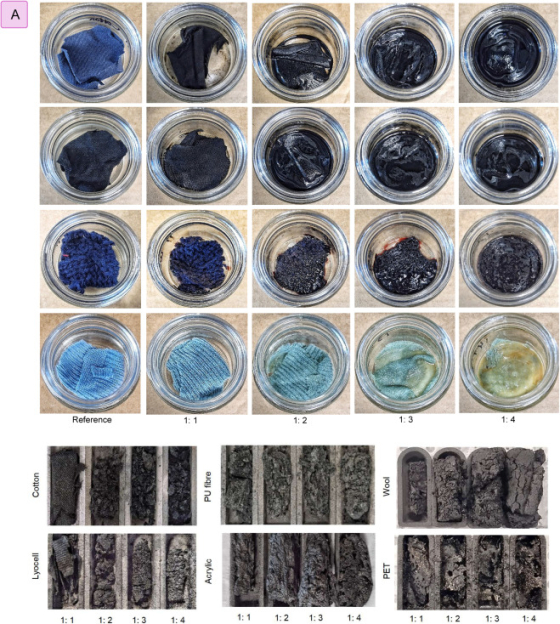
Our study proposes a scalable approach to upcycling end-of-life mixed textiles into high-performance activated carbon (AC) with tunable porosity (500–2300 m²/g) while minimising the need for material sorting. To assess the feasibility of this approach, we systematically investigated the carbonisation and activation behaviour of 14 common textile types, including cotton, polyester, jute, wool, acrylic, lyocell, viscose, nylon, linen, leather, bamboo, polyurethane, and blended fabrics such as polyester-cotton and polyester-polypropylene.
The AC production process involved H₃PO₄ impregnation, thermal transformation, activation, water scrubbing, and drying, with key processing parameters—including impregnation ratio, activation temperature, and activation protocol (one-step vs. two-step)—systematically optimised.
By modulating these parameters, we achieved precise control over surface area and micro-/mesopore distribution, tailoring AC properties for specific applications such as water and air purification. Our findings indicate that 11 of the 14 textile types are suitable for AC production, whereas polyurethane, polypropylene, and leather exhibited suboptimal performance. Notably, these unsuitable materials possess distinct physical characteristics, enabling efficient pre-sorting prior to conversion.
Sustainability assessment
A comprehensive Life Cycle Assessment (LCA) was conducted to evaluate the environmental impacts of textile-derived AC in comparison to conventional coal-based AC. The results demonstrate that textile-derived AC exhibits superior environmental performance across seven key impact categories: global warming potential, ozone depletion, smog formation, acidification, non-carcinogenic toxicity, respiratory effects, and fossil fuel depletion.
Alignment with the United Nations Sustainable Development Goals (SDGs)
Our research contributes to multiple United Nations SDGs, including:
- SDG 6 (Clean Water and Sanitation): Yields a functional material capable of effectively removing organic contaminants, dyes, and volatile organic compounds (VOCs), contributing to improved water and air purification.
- SDG 9 (Industry, Innovation, and Infrastructure): Supports sustainable industrial practices by providing an alternative to conventional activated carbon production, which is often resource-intensive and environmentally detrimental.
- SDG 11 (Sustainable Cities and Communities): Directly enhancing water and air purification systems and efficiency, while simultaneously reducing waste landfill disposal.
- SDG 12 (Responsible Consumption and Production): Promotes circular economy principles by transforming mixed and blended textile waste into a high-value product, reducing landfill dependency and fostering sustainable material use.
- SDG 13 (Climate Action): Demonstrates a substantial reduction in environmental impact compared to coal-derived activated carbon, as evidenced by our LCA findings.
- SDG 14 (Life Below Water): Reduces the environmental burden of microplastic pollution from synthetic textile waste, mitigating the adverse impact on marine ecosystems and biodiversity.
Textile and other waste background
The accelerating growth of the global population has led to an unprecedented expansion of the textile industry, which is essential for meeting basic human needs. As of 2024, the global textile market was valued at USD 1983.92 billion and is projected to reach USD 3047.3 billion by 2028, with a compound annual growth rate (CAGR) of 7.4 % . This growth is largely driven by advancements in manufacturing technologies that have enabled the mass production of inexpensive garments. Simultaneously, the fashion industry's fast-paced trend cycles encourage frequent consumption, resulting in significant overproduction and waste generation.
Globally, textile waste is estimated at 92 million tonnes annually and is projected to increase by 45 %, reaching 134 million tonnes by 2030 . This growing volume of post-consumer textile waste poses serious environmental concerns, including greenhouse gas emissions, microfiber pollution, and contamination of land and water ecosystems . There is an urgent need for scalable and sustainable strategies to divert these materials from landfill and transform them into value-added products within a circular economy framework.
A variety of textile recycling technologies have been explored to date. Mechanical recycling, one of the oldest and most cost-effective methods, involves physical deconstruction (e.g., shredding, carding) of textiles for re-spinning into yarn. However, this method is limited in its ability to handle post-consumer waste, as blended and degraded fibres often leads to reduced fibre length and results in lower-quality, weaker products . Chemical recycling techniques such as glycolysis, enzymatic hydrolysis, and alcoholysis have been employed to depolymerise complex textile fibres into monomers or chemical feedstocks . While these methods show promise, they are frequently constrained by narrow feedstock compatibility, extended reaction times, and challenges in scalability or hazardous reagent use.
Statistically, Australia is one of the most wasteful developed nations, second only to the United States of America in terms of per capita plastic bags consumption. On average, each Australian consumes over 24kg of plastic and uses over 230 plastic bags every year. In 2020, only 13% of the plastic waste was actually recycled and 84% went into landfills, with a lot of it ending up in waterways and the oceans. The 2021 The National Plastics Plan also says over 1 million tonnes of single-use plastics goes straight to landfill and about 130,000 tonnes of plastic leaches into Australian waterways and oceans every year. This is equivalent to 1,280 kilograms of plastic being dumped every hour in Australia's ocean.
Figures from the Department of Climate Change, Energy, the Environment and Water reveal that Australia is the second highest consumer of textiles per person in the world, after the United States of America, and that each Australian consumes an average of 27 kilograms of new clothing per year and disposes an average 23 kilograms of clothing to landfill each year, or 93 per cent of the textile waste we generate. The Global Methane Initiative estimates that solid waste emissions made up 11% of all global emissions. While there are still bigger industries that emit more CO2, waste emissions mainly come from methane – a greenhouse gas that's 84 times more potent than carbon dioxide over a twenty-year period. This gas is released as materials slowly decompose anaerobically in the landfill. The main culprit of this is organic waste – food, paper, and other natural materials – that can't properly break down without oxygen. While methane does evaporate quicker in the atmosphere than CO2, it does a lot of damage in the shorter term according to Method Recycling.
Australian Bureau of Statistics' latest waste estimate figures show the Australian economy domestically generated 539,000 tonnes of e-waste in 2019, with more than 50% going to landfill and only 17.4% being claimed as recycled but much of this goes offshore where outcomes are unknown, yet it is classified as 'recycled'. Current Australian traditional recycling facilities are limited to pre-processing or partial mechanical processing which can separate, dismantle or shred only. There are limited decentralised technologies for the effective isolation of the valuable metal alloys, REEs (rare earth elements) and critical metals contained in e-waste.
The future
It is hoped the research will lead to the development of pilot then industrial scale technology/ies to produce activated carbon from waste, adding to the suite of SMaRT's various MICROfactorieTMand other technologies, the latest being a commercially operated Plastics MICROfactorieTM module, with a Green Ceramics MICROfactorieTM module operating in Nowra in regional NSW and a Green Aluminium MICROfactorieTM module under construction in Taree NSW, and various demonstration MICROfactoriesTM operating at the UNSW SMaRT Centre.
Acknowledgements


