
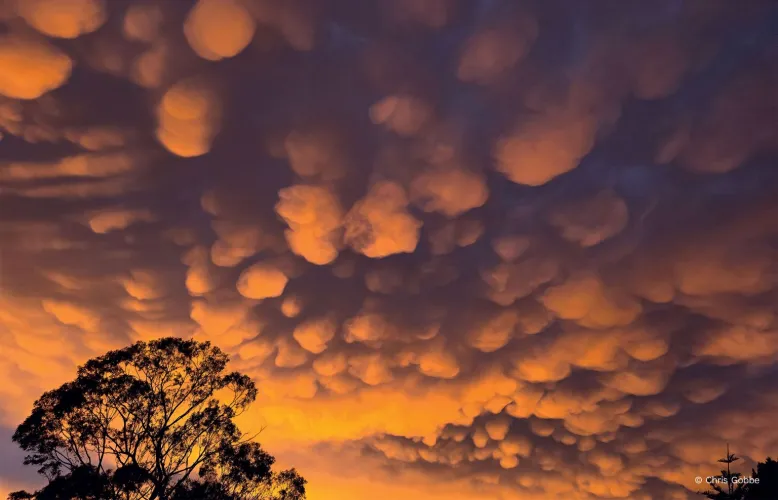
Mammatus clouds, Wentworth Falls, New South Wales. Credit: Chris Gobbe.

Photographer Chris Gobbe. Credit: Chris Gobbe.
An early wake up proved fortuitous for Chris Gobbe when the colours of a morning sunrise caught his eye from his bedroom window.
"I went outside and the sky was lit up with this beautiful sunrise," he said.
"If my wife hadn't gone to work that day, I probably wouldn't have woken up, and would have missed the whole thing, cause it's all over in 5 minutes.
"You've got to be around to see it."
The early-morning cloud formation that Chris photographed were the distinctive rounded pouches of mammatus clouds and is featured as the February image in the 2026 Australian Weather Calendar.
Mammatus clouds viewed during the day appear grey or white but at sunrise the low angle leads to a reflection of orange and red shades, creating the deep tones captured by Chris.
While most clouds develop from upwards motion, mammatus clouds form as cool air sinks from the higher parts of a cumulonimbus thunderstorm cloud.
Mammatus are typically associated with severe weather, indicating turbulence, and can be accompanied by showers, lightning and occasional hail.
As a former flight nurse, this is something Chris knows all too well.
"I used to be a flight nurse with NSW Air Ambulance and I used to fly around a lot, so I'd see those clouds, and they were pretty terrifying, because flying near thunderstorms was not a pleasant experience," he said.
He admitted he much prefers to view them from terra firma.
Chris' interest in weather developed when he was a child growing up on a farm at Megalong Valley in the Blue Mountains.
When he was around 9 years old, a tornado hit the property.
"We had a tornado come through in the middle of the night once and it left a trail of destruction for about a kilometre," he said.
"It ripped the carport out of the front yard and kept going through these huge gum trees, and you could follow the line of destruction for about a kilometre."
It sparked a lifelong interest in all things weather.
"You get a beautiful sunny day and there's nothing to worry about," he said.
"But occasionally, these thunderstorms just as appear out of the middle of nowhere and just create this incredible destruction."
It was also during his childhood that Chris gained an interest in photography.
The acclaimed photographer Douglass Baglin lived next door and would take photos of Chris and his family working on the farm.
He learned much about taking photos from Douglass Baglin during that time, with the adage to always take multiple photos from different angles of the same scene sticking in his mind throughout his life.
"The key to successful photography is luck, and by taking a lot of photos there's a good chance you'll get a good one," he said.
The Bureau's 2027 Australian Weather Calendar national photo competition is currently open for submissions until March 31.
For the full terms and conditions of entry, and to submit a photo, visit: http://www.bom.gov.au/calendar/contest/


