
Fulfilling UConn's land-grant mission is providing real-world job skills for CAHNR students
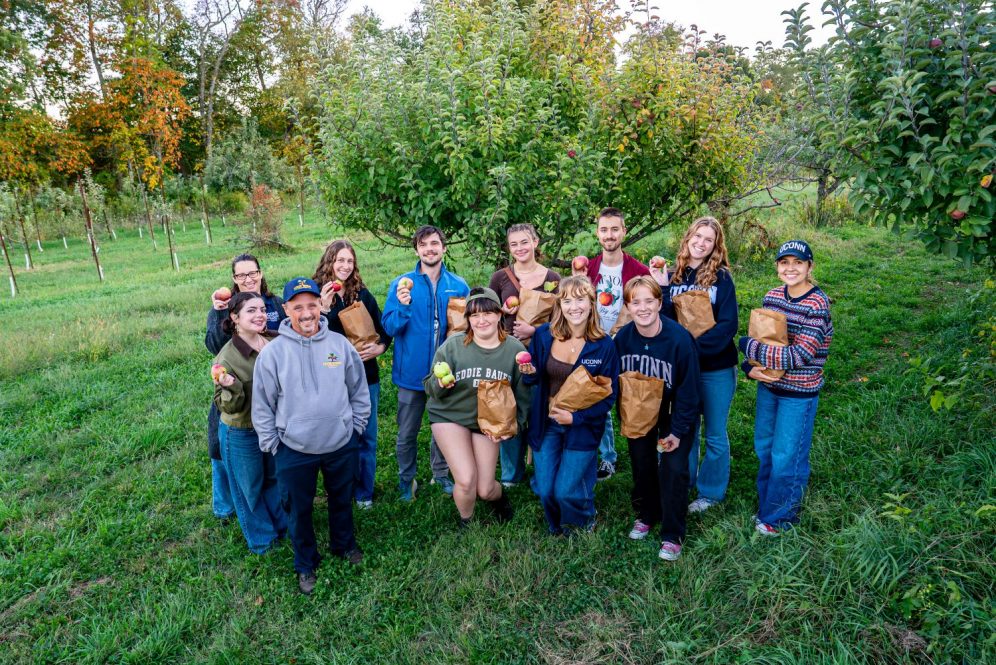
Cristina Connolly and undergraduates in the student club of the Department of Agricultural and Resource Economics (ARE) in the College of Agriculture, Health and Natural Resources (CAHNR), take a tour of West Green Farm LLC dba Ledge Stone Orchards led by owner Steve Preli in Lebanon, CT. Oct. 1, 2025.
The Department of Agricultural and Resource Economics (ARE) in the College of Agriculture, Health and Natural Resources (CAHNR) is committed to providing students with experience working with real economic cases and clients.
ARE is an applied economics department. This means that students learn both the foundational skills offered by an economics degree, as well as the opportunity to apply that learning to the pressing problems businesses and society face today.
The ARE program consists of two majors: environmental and natural resource economics and economics of sustainable development and management. The department also offers an accelerated degree option allowing students to complete both their bachelor's and master's degree in five years.
"All of these degree options are very applied, which distinguishes us," says Emma Bojinova, associate professor in residence and director of undergraduate studies for ARE. "Throughout our curriculum, we have lots of active learning. Students will not just learn the tools, the theory, the principles, the concepts, but they'll apply them to real problems."
The ARE program offers both larger introductory-level courses, open to students throughout the University, as well as smaller upper-level courses. The majority, 90%, of ARE courses are taught by faculty.
In "Market Planning and Survey Research in the Food Industry" (ARE 4205) taught by Cristina Connolly, assistant professor, students collaborate with local agribusinesses. They develop a business plan to address the clients' goals and concerns, and they then present it to the actual clients at the end of the semester. The businesses often directly implement these suggestions.
"As a land-grant university, we have a mission to support our community, and I like that it goes both ways with our educational opportunities for students," Connolly says.
One business that participated in the course was Ledge Stone Orchard, formerly West Green Farm, in Lebanon. The students not only helped them develop a comprehensive marketing plan - they also suggested a new logo that the business is now using.
Jacob Timchak '26 (CAHNR) was involved in the project.
"[The farmer] was really grateful and happy that we were interested and involved," Timchak says. "That was really rewarding to see and hear, because in college classes, a lot of what we learn can seem very far away from the real world. It was nice to have an assignment where we worked to help a real person with a real business."
Courses like this help students understand how the skills they learn in other classes function in the real world, preparing them for the job market.
"The biggest goal is to provide students with the analytical tools [they need] in order to address actual problems, debate solutions, and devise potential interventions," Connolly says. "It's really about providing them with that tool kit."
This semester Brian LaFauci, adjunct instructor, launched a new course, "Sustainable Business Planning" (ARE 4215). The course teaches students how to turn an idea into a practical, fundable business plan. The most promising projects will be eligible for seed funding provided by Farm Credit East. The course focuses not only on economic sustainability, but specifically crafting business plans that protect the environment.
"With the classes available in the department, you can have this really nice bandwidth," LaFauci says. "Students come out of [this program] with experience in the basics of economics, in the basics of business, and in whatever other discipline they're in, and that makes them very nimble."
LaFauci's company, Won Strategy, received the Providence Business News' 2025 Diversity Equity & Inclusion Award for Education, which recognized the innovative nature of this course.
The ARE program also has a relationship with Farm Credit East, a regional financial cooperative that serves farmers, commercial fishermen, forest product producers and agribusinesses.
Through the one-credit Farm Credit fellows seminar, students support the evaluation of grant applications and conduct site visits to farms.
The ARE program offers nine classes that incorporate data analysis using real data. In one course, "Price Analysis and Futures Trading" (ARE 3225), students use a simulation to buy and sell commodities like oil.
"As an economist, it's almost impossible not to work with data when you start a job," Bojinova says. "Our goal is to prepare students so that when they go on the job they can start working with data, they can analyze, they can critically think, and even be a little bit more creative."
ARE offers summer opportunities as well. Faculty members including LaFauci have involved students in projects such as gathering and organizing financial resources available to farmers in the region.
Outside the classroom, several students in the ARE program, including Timchak, have been involved in the Food Distribution Research Society (FDRS) Student Food Marketing Challenge. UConn has taken home two wins so far.
"It definitely gives me a leg-up [in the job market]," Timchak says, "I have this long experience in a competitive setting where I'm doing well because I have excellent advising and excellent support."


