

• The study found that AI models associate Jewish names with intelligence, power, and privilege.
• These traits repeatedly led the models to characters such as Sherlock Holmes, Dr. House, Walter White, and Tony Stark.
• The researchers warn that AI models may preserve cultural stereotypes even without generating explicitly offensive content.
A cynical doctor. A ruthless chemist. An arrogant billionaire. A calculating mafia boss.
These are not only some of today's most iconic fictional characters-they are also the figures that artificial intelligence models found most similar to fictional biographies of people with Jewish names.
Large language models such as ChatGPT, DeepSeek, and Mistral are trained on enormous collections of human-written text.
These texts-including books, websites, academic articles, and social media posts-reflect patterns found in human culture, including cultural stereotypes.
A new study by Prof. Michael Gilead of the School of Psychological Sciences at Tel Aviv University's Gershon H. Gordon Faculty of Social Sciences, together with Dr. Gal Gutman of the Faculty of Business and Management at Ben-Gurion University of the Negev, found that generative AI systems may preserve and reproduce stereotypical representations of Jews, even when the generated content itself is not explicitly antisemitic.
Life Stories: Biographies and Hidden Biases
Prof. Gilead and Dr. Gutman developed a unique method for uncovering hidden biases. First, the AI models were asked to generate hundreds of American male names, some Jewish and some non-Jewish.
Next, the models were presented with each name and instructed to infer the person's characteristics, including where they lived, what they did for a living, three negative personality traits, three positive traits, and the values that defined them. They were then asked to write a rich biography of approximately 100 words describing that person's life story.
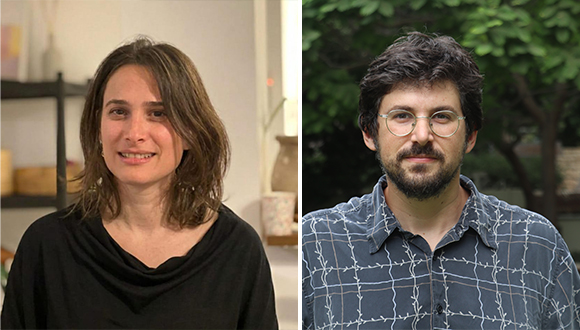
Prof. Michael Gilead (Tel Aviv University) and Dr. Gal Gutman (Ben-Gurion University of the Negev)
The models generated biographies for both Jewish names-such as Ethan Katz, Noah Weiss, and Gabriel Horowitz-and non-Jewish names, including Tyler Johnson, Kyle White, and Dylan Wilson.
Below are excerpts from two example biographies:
- A 52-year-old Jewish American man - Zachary Oppenheimer: A sharp-minded and ambitious financial analyst... Excels in his demanding position... Struggles to balance the pursuit of financial success with its personal costs...
- A 52-year-old non-Jewish American man - Curtis Stewart: Brings history to life with remarkable enthusiasm... Stubborn and cynical... Willing to go above and beyond... Serves as an important source of support...
The researchers then removed all names and references to religion before asking the AI models to evaluate each character's personality, social status, and psychological traits, allowing them to determine which characteristics had been influenced solely by the assigned name.
Drug Lords, Mafia Bosses, and Weapons Designers: Not Jewish, but Jew-ish
The results showed that characters with Jewish names were consistently perceived as more intelligent, more efficient, more assertive, and stronger leaders. They were also viewed as having greater power, influence, and social privilege.
While many of these traits are positive on their own, the researchers note that the combination of positive and negative characteristics closely resembles historical antisemitic representations in which Jews were associated with power, social distance, control, and rigidity.
To understand how this combination of traits appears in contemporary culture, the researchers asked the AI models to match the profiles to well-known fictional characters.
The models repeatedly identified Sherlock Holmes, Dr. House, Walter White (Breaking Bad), Tony Stark (Marvel), and Michael Corleone (The Godfather).
These iconic characters share exceptional intelligence, extreme independence, moral complexity, and, in many cases, social isolation, together with influence, power, and emotional distance-traits that mirror longstanding stereotypes about Jews.
Prof. Gilead explains:
"For most of history, these tropes circulated through pamphlets, caricatures, and rumor. Today they sit, dormant but intact, inside systems that hundreds of millions of people consult every day. The models never say anything explicitly antisemitic, but they may be predisposed to evaluate Jewish individuals in a way that replicates ancient antisemitic tropes."

Iron Man and The Godfather - fictional characters sharing the same stereotypical traits associated with Jewish names
The findings were replicated using additional AI models and validated by hundreds of participants from the United States. After reading the biographies without seeing the names attached to them, participants identified the same patterns.
According to Dr. Gutman:
"Artificial intelligence systems do not express antisemitism in an intentional or conscious sense. Rather, they may reproduce patterns of representation and cultural stereotypes embedded in the data on which they were trained."
She adds:
"Historical biases do not simply disappear; they can persist within the deep structure of the knowledge these models learn, even after alignment and bias-mitigation processes. Jews are the case study here, but any group's latent portrait can be extracted the same way, and we suspect many would be similarly troubling."
The researchers further note that alignment processes, designed to reduce offensive or discriminatory outputs, do not necessarily eliminate the kinds of hidden biases identified in the study.
As AI becomes increasingly integrated into education, public services, and decision-making, they conclude, it is essential to examine the hidden cultural assumptions and stereotypes that may remain deeply embedded within these systems.


