
A promising new mushroom-based strategy may help with remediation efforts in Connecticut communities
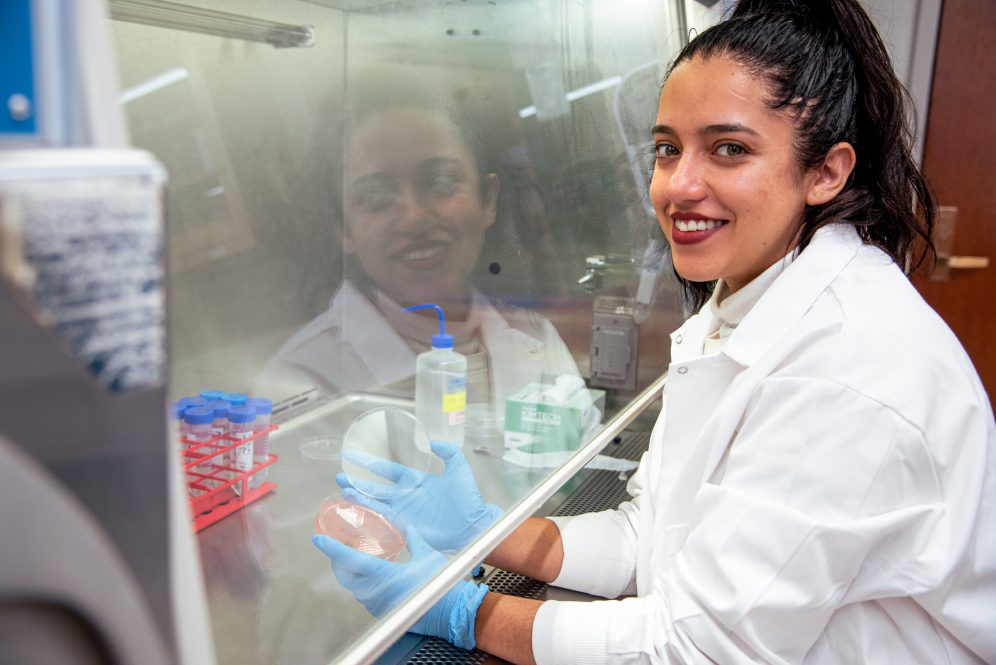
Goyes working in a lab. (Jason Sheldon/UConn Photo)
Brownfields, or abandoned and contaminated former industrial sites, pose many challenges for cleanup and redevelopment efforts. For example, common remediation methods can amount to the onerous task of relocating tons of soil and debris. However, in a new project, Department of Plant Science and Landscape Architecture researchers including Ph.D. student Paulette Goyes and assistant professor Mia Maltz are exploring if bioremediation using mushrooms is a viable strategy for cleaning up contaminated soil at brownfield sites in Connecticut.
"Fungi have been noted for their capacity to degrade hazardous compounds or mobilize them," says Goyes. "We are interested in analyzing where the fungi move these hazardous compounds and what's happening, for example, how the fungi interact with the microbial communities with these pollutants."
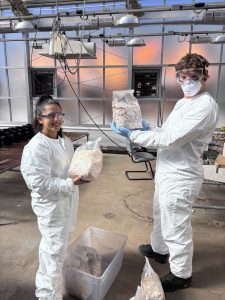
Maltz explains that some species of mushrooms can also hyperaccumulate metals or make the compounds less bioavailable, or able to enter the food web. Therefore, the right mushroom in the right context can help simplify cleanup efforts. This project explores a way to reduce the hazardous waste burden and ideally treat the soil in place and eliminate the need to dig up the contaminated soil and dump it at a hazardous waste facility.
In a previous study focused on a brownfield site in California, Maltz says they found that mushrooms helped decrease polycyclic aromatic hydrocarbons (PAH) levels, but before deploying this promising fungal amendment strategy here, they need to understand how mesic conditions in Connecticut might lead to different outcomes.
"That location in California has a very dry climate. Here in Connecticut, we have a lot more rain and we're not sure how these water events are going to affect the mycelial process. Is it going to amplify the mycelial growth, and then they're going to be even more effective, or are these high-water events leaching pollutants out of the soil faster than the mushrooms can mobilize it? We're checking that in this more humid environment," says Maltz.
The current project, funded with the help of an Office of Sustainability Environmental and Social Sustainability Grant (ESSG), focuses on a location in Collinsville at the site of a former ax factory. The factory was active until the 1960s and over the course of its operation, industrial processes introduced very high quantities of lead into the soil that now need to be remediated before any new development projects can begin.
For the initial, laboratory-based phase of the study, Goyes says they collected soil samples from the site that they inoculated with fungi.
"We characterized what fungi were in some of the high lead sites. We decided to use two different types of mushrooms, the native tiger sawgill, Lentinus tigrinus, and a common oyster mushroom Pleurotus ostreatus that have historically been known as bioremediators," says Maltz.
Following the experimental phase, Goyes is now analyzing the data from the samples, including details about organopollutants like PAHs and PCBs with the help of the UConn Center of Environmental Sciences and Engineering (CESE), and genetic details with help from the Center for Genome Innovation (CGI). Goyes is also analyzing the physical properties of the soil, including pH, organic matter content, and soil aggregates as these qualities can impact how the metals move within the soil.
"If we use fungi, are we doing a good thing rather than mobilizing and remobilizing what was already in the soil? Metals have a behavior of small particles where they can move toward the surface, and they don't travel a lot in the soil, because the organic matter or other properties of the soil, they have this behavior of getting attached to the soil," says Goyes. "Their movement requires biological activity, for example, or physical movement for them to be displaced, remobilized, or turned into more reactive species."
It is important to understand how these mushrooms impact the bioavailability and mobility of the lead, Maltz explains, because they also need to understand what happens when it rains, and whether the lead leaches out into waterways or if it stays in the soil, and how the addition of mushrooms or mushroom compost impacts these processes.
They are also investigating how these two species of mushrooms accumulate lead.
"If the heavy metals are extracted by the mushrooms and are in the fruit body of the mushroom, that mushroom then becomes hazardous waste," says Goyes. "We don't want it to go through the food chain, so that poses another management question."
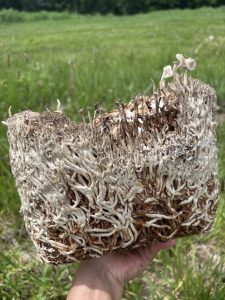
If the mushrooms accumulate heavy metals in their biomass, Maltz says, there is an opportunity to harvest and concentrate the biomass via anaerobic digestion to reduce the footprint of the hazardous waste at the site.
"So far, all treatments have increased soil pH, perhaps leading to less bioavailable lead species. Lead mobilization was significatively higher in the compost treatment, overpassing the mushroom treatments. The implications of these mobilizations need to be further scrutinized through bioavailability analyses," says Goyes.
This remediation method reduces industrial waste in other innovative ways, Maltz explains, since they were able to use mushroom mycelium that was a waste product from a food production company.
"It is very circular in terms of industrial ecology. We were able to use a byproduct of one industry to try to clean up an environmental issue," says Maltz.
Maltz and Goyes are planning to work on similar projects with other groups like the Hartford Land Bank to help with brownfield cleanup efforts at municipal sites in Hartford by reducing the amount of dig and dump needed for those efforts.
Goyes recently presented on this work in Portland, Oregon, at the Mycological Society of America meeting, and will present in Quito, Ecuador, at the Latin American Mycological Congress. The researchers plan to write a grant to restore the site in Collinsville using the treatment that was most successful in the experiment.
"I think the community is really excited about the idea," says Maltz. "They would have liked us to jump in and just start with the field experiment right away, but we wanted to do more of a controlled experiment to see what the mechanisms are, how is it working, and what are some of the risks associated with using these mycotechnologies."


