
For over 100 years, the National Museum has housed a large collection of inscribed tablets from the earliest civilisations of the Middle East - many over 4,000 years old and written in languages that are now extinct. The tablets have led a quiet existence, but now researchers have deciphered them and discovered fascinating texts about magic, kings and good old-fashioned bureaucracy.
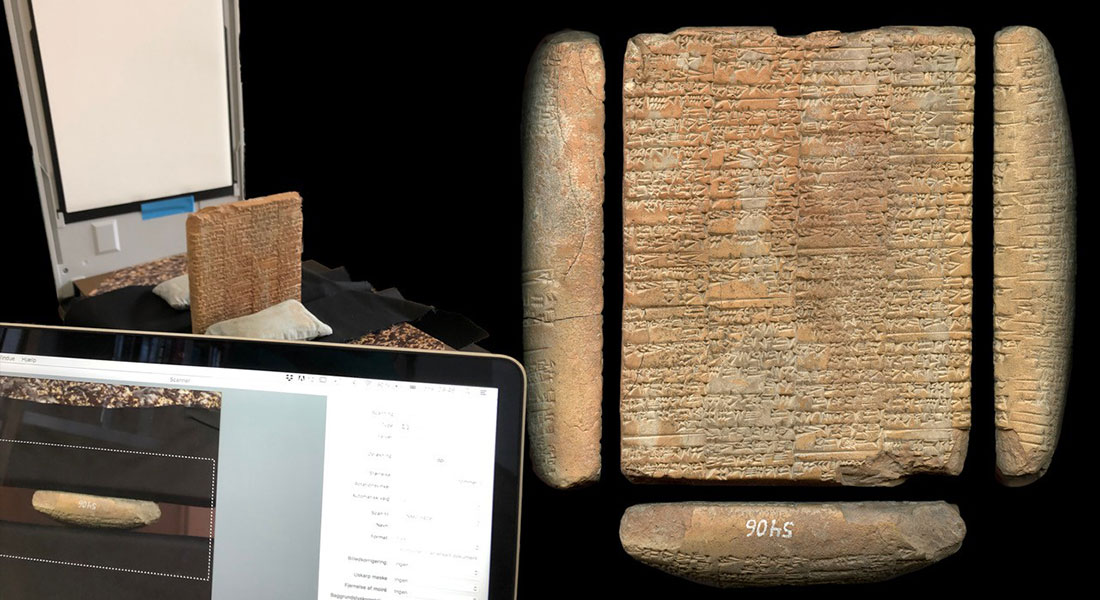
Around 5,200 years ago, people from ancient cultures in Iraq and Syria began carving characters onto clay tablets. This new system of communication gradually made it possible to develop advanced urban societies with complex administrative systems.
Over the course of 100 years, the National Museum has built up a large collection of these early historical sources, written in cuneiform script in languages long since extinct. The collection has not been studied in recent times, but now researchers from the museum and the University of Copenhagen have, for the first time, analysed, identified and digitised all the ancient texts in the project 'Hidden Treasures: The National Museum's Cuneiform Collection'.
No to witches in Hama
The texts on the clay tablets were written in cuneiform script in now-extinct languages such as Sumerian and Akkadian.
The writing was pressed into the clay tablets as small wedges - hence the name cuneiform. It consists of standardised images or symbols, which originally resembled Egyptian hieroglyphs, and which can represent whole words and sounds.
When the researchers began to examine the collection more closely, it turned out that it contained a wide variety of texts, ranging from accounts and letters to medical treatments and magical incantations.
A small group of texts originate from the Syrian city of Hama, which was studied by a Danish expedition in the 1930s. In 720 BC, the city was destroyed and plundered by Assyrian warriors, who took the spoils back to their capital, Assur, in what is now Iraq. In their haste, however, they left behind some of the clay tablets, which are now housed at the National Museum of Denmark.
- The texts in the collection that originate from Hama are almost 3,000 years old and deal with medical treatments and magical incantations. They had been left behind in the remains of what we believe must have been a large temple library. All other texts were gone, explains Assyriologist Troels Pank Arbøll, who has been part of the Hidden Treasures project.
According to him, the Hama texts are entirely unique, as virtually no other cuneiform texts on these subjects have been found from the same region during this period. And one text in particular caught his attention:
- One of the clay tablets turned out to contain a so-called anti-witchcraft ritual, which was of enormous importance to the royal authority in Assyria because it had the remarkable ability to ward off misfortunes - such as political instability - that might befall a king, says Troels Pank Arbøll
The ritual, which took a whole night, involved the burning of various small figures made of wax and clay, while an exorcist recited a series of fixed incantations. Given the ritual's central role in Assyria, the researchers were also surprised to find this particular text so far from the capital of the Assyrian Empire and the rich literary cultures of Babylonia. Hama was after all far out on the periphery of these regions.
Regnal lists, letters and bureaucracy
Assyria was an ancient kingdom situated on the River Tigris in the fertile region of what is now northern Iraq. Assyria was named after the city of Assur, which lay approximately 100 km south of the Iraqi city of Mosul. Assyria is one of the oldest advanced civilisations, and the kingdom's history spans from around 2000 to 612 BC.
Among the collection, researchers have discovered a copy of a very famous regnal list, which describes both mythical and historical kings.
It is an important political document that lists kings dating back to before the Noah and the Flood. The specific tablet found at the National Museum is a school text, and it mentions kings who reigned at the end of the 3rd millennium BC. Other copies also mention the legendary King Gilgamesh, whom some may know from the famous Epic of Gilgamesh.
- That makes this regnal list one of the few relics we have that suggests Gilgamesh may have actually existed. We had no idea we had a copy of that list here in Denmark. It is quite spectacular, says Troels Pank Arbøll.
Another group of texts in the collection originates from the Danish excavations at Tell Shemshara in 1957 in what is now northern Iraq. The texts from Tell Shemshara consist of a correspondence between a local chieftain and an Assyrian king from around 1800 BC, and a series of administrative documents which, along with many others of their kind from various other periods, were a significant part of the reason why cuneiform was originally invented.
- A great many of the cuneiform tablets we have today bear witness to a highly developed bureaucracy. There was a need to keep track of the advanced societies that were being built, and we have found a large number of cuneiform tablets containing practical information, such as accounts and lists of goods and personnel. It is therefore not surprising that one of the tablets in the National Museum's collection contains something as commonplace as a very old receipt for beer, concludes Troels Pank Arbøll.
Hidden Treasures: The National Museum's Cuneiform Collection is led by Nicole Brisch (University of Hamburg) and Anne Haslund Hansen (National Museum), and the project is supported by the Carlsberg Foundation, the Augustinus Foundation and the Edubba Foundation.
About the cuneiform tablets at the National Museum
The National Museum's collection of cuneiform tablets illustrates Denmark's active role in the exploration of the Middle East's cultural heritage. Several of the texts in the collection are unique amongst the thousands of texts available to specialists worldwide.
A significant part of the National Museum's collection was donated to the museum in 1939 by Thorkild Jacobsen, the first graduate in Assyriology from the University of Copenhagen, who helped lay many of the foundations for the modern discipline.
The National Museum's collection comprises a wide variety of texts, some of which are more than 4,500 years old. The content of the texts includes both everyday economic documents and private letters, as well as texts with religious, literary or magical/medical content.
Scholarly research into these early societies really took off in the 19th century, when cuneiform script was deciphered and the first archaeological excavations were undertaken.


