
With NASA's Artemis II mission sending astronauts to the Moon for the first time in more than 50 years, millions of people around the world have looked up at the night sky in wonder.
For Australia, the mission also highlights the role local science and engineering play in international space exploration. 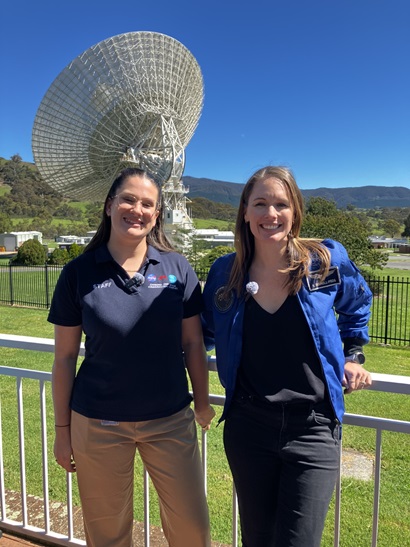
Australian researchers and engineers are contributing across areas such as communications, robotics and mission-support technologies that will enable future lunar exploration.
Just as importantly, the Artemis program is helping to inspire a new wave of Australians to see science, technology, engineering and maths (STEM) as something they can be part of too.
This is being referred to as the 'Artemis Generation'.
What is the Artemis Generation?
The Artemis Generation isn't defined by age, rather by mindset.
This generation recognises that space exploration is something that Australians can contribute to – whether in labs, workshops, classrooms or mission control rooms.
Katherine Bennell-Pegg, the first astronaut to be trained under the Australian flag, said the Artemis program highlights both continuity and progress in Australia's contribution to space missions.
"It's really exciting to see the Artemis program underway, with humans returning to the Moon for the first time in over half a century," said Katherine.
"As Australians, we can look up and know that, just like with the previous Apollo missions, we're playing a critical role in supporting this mission with our facilities, expertise and technologies.
"Australia is also developing a lunar rover which is expected to go to the Moon in 2030, made locally and involving more than ten universities and many Australian companies."
Technology is also being designed to study the Moon's subsurface, guide robotic landers and enable teams on Earth to communicate directly with missions in space.
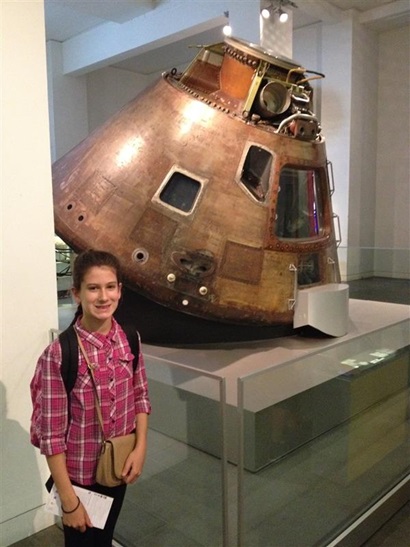
For students and early-career researchers watching the Artemis II mission, the message is that there are diverse pathways into STEM.
"Beyond exploration of the Moon, what's going to come from the mission is a whole new generation of young people who realise that there's a role for them if they want to be at the forefront of human endeavour," Katherine explained.
"The work being done now will help shape where science and exploration go next."
Why space exploration matters on Earth
Although space exploration takes us to places beyond Earth, its benefits are strongly connected to everyday life.
Technologies developed for missions like Artemis II contribute to advances in areas such as robotics, remote operations, materials science and energy systems – fields that underpin Australian industries and communities.
CSIRO Education Officer Rhianna Lyons said space has a way of reconnecting people with the science itself.
"Space gives us a shared reference point. It reminds people that science isn't just about theory, it's problem solving, teamwork and curiosity in action," she said.
For Rhianna, that connection is personal and challenges a common belief that you must be naturally good at maths or science to pursue a career in STEM.
"I didn't pass most of my Year 11 and 12 maths assignments, and now I have a degree in astrophysics," Rhianna said. 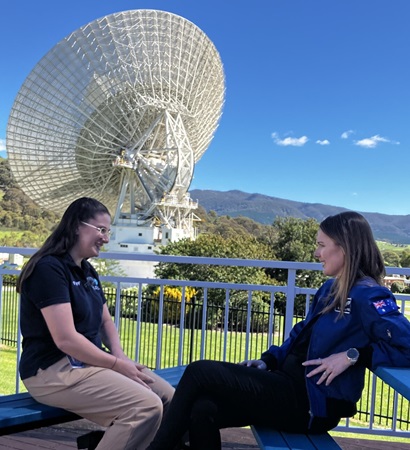
"I've always loved space, but it wasn't until I saw how maths could be applied to real-world problems and in a way that helped me to better understand the Universe that everything changed."
Katherine didn't arrive at university knowing how to code or use tools.
"I studied engineering and physics without really knowing what engineering was, just because it had 'space' in the title. I'd never written a line of code or used a drill. But engineering gave me a toolkit to turn curiosity into reality and to make what was once impossible, possible," she said.
Her advice to young people is simple: stay curious, try things and don't compare yourself to others.
"See STEM as a way to solve problems that matter to you. Purpose makes the hard work worth it."


