
Signed in 1976, the Friendship and Cooperation Treaty is a historic agreement - the first of its kind for both Australia and Japan.
It has strengthened ties across political, economic, trade, commercial, social and cultural fields helping to establish Japan as one of Australia's most important partners in the Asia-Pacific region.
The Friendship and Cooperation Treaty emphasises a shared commitment to regional prosperity in the Asia-Pacific and has paved the way for deep collaboration in education and research, including through:
- joint research projects
- student exchange programs
- joint double degree programs
- scholarships and fellowships
- study tours.
The Friendship and Cooperation Treaty has paved the way for researchers like Dr Kentaro Somiya and his research students to advance our understanding of gravitational waves - tiny ripples in gravity made when massive stars or black holes collide.
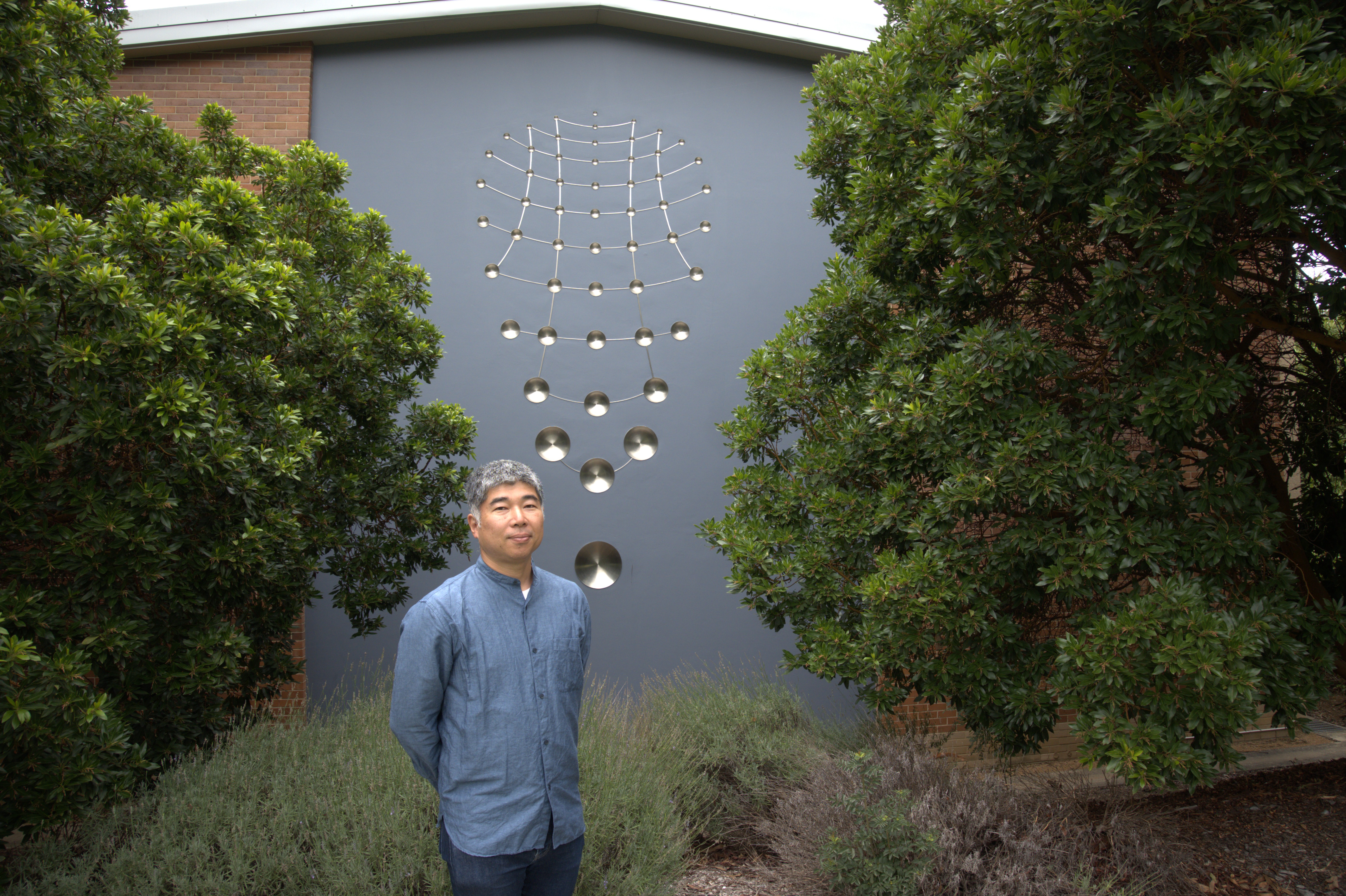
Dr Kentaro Somiya at the Australian National University
Working with the Centre for Gravitational Astrophysics at the Australian National University, Dr Somiya is helping improve the sensitivity of laser-based detectors, allowing scientists to observe deeper into space and further back in time, than ever before. His research will help to improve how faint signals are detected. His research also explores ideas at the frontier of physics, including quantum technology for future detectors that could change how we explore the universe.
When very heavy stars or black holes crash into each other, they make tiny ripples of gravity. These ripples travel across the universe and eventually reach Earth. These ripples are called gravitational waves, and they can be observed using a laser interferometer. The better the sensitivity of the interferometer, the further we can observe. I have been studying how to improve the sensitivity," Dr Somiya said.
This research is made possible through the ASPIRE program, which supports collaboration between Australian and Japanese researchers.
The Friendship and Cooperation Treaty partnership has improved education and research collaboration, shared knowledge more widely, and strengthened support for early career researchers across Australia and Japan - inspiring discovery from Earth, all the way to the edge of the universe.


