
As the first crewed lunar mission in 50 years takes four astronauts further from Earth than humans have ever travelled before, Australia will play a crucial role in keeping them connected with ground control.
CSIRO, Australia's national science agency, is continuing its long and proud history supporting space exploration, dating back to the 1960s.
CSIRO will use its spacecraft communication and tracking capability to support NASA's Orion spacecraft on its 10-day mission around the Moon.
Artemis II is the first crewed lunar mission in 50 years, and while this time it is flying past the Moon, it will confirm the spacecraft's systems operate as designed, laying the groundwork for a future lunar landing in the Artemis program.
Helping NASA keep in touch
CSIRO has operated and managed NASA's Canberra Deep Space Communication Complex (CDSCC) since 2010. The station is one of three that make up NASA's Deep Space Network, responsible for providing around-the-clock contact with more than 40 spacecraft exploring the Solar System and beyond.
CSIRO Education Officer Rhianna Lyons is based at the CDSCC where she helps visitors discover more about how NASA keeps in touch with their spacecraft and rovers.
"Everyone is really excited about the upcoming Artemis II mission – the first human lunar mission since 1972. All the operators, technicians, engineers and various support teams have been preparing for the mission for several years," Rhianna said.
"Something people don't realise is the teams that operate the three complexes in the Deep Space Network operate the entire network when it's their shift.
"So, when our CSIRO team is working, they operate antennas near Canberra, Goldstone in California, and Madrid in Spain to communicate with Artemis II and all the other spacecraft the Deep Space Stations support."

From distant galaxies to nearby spacecraft
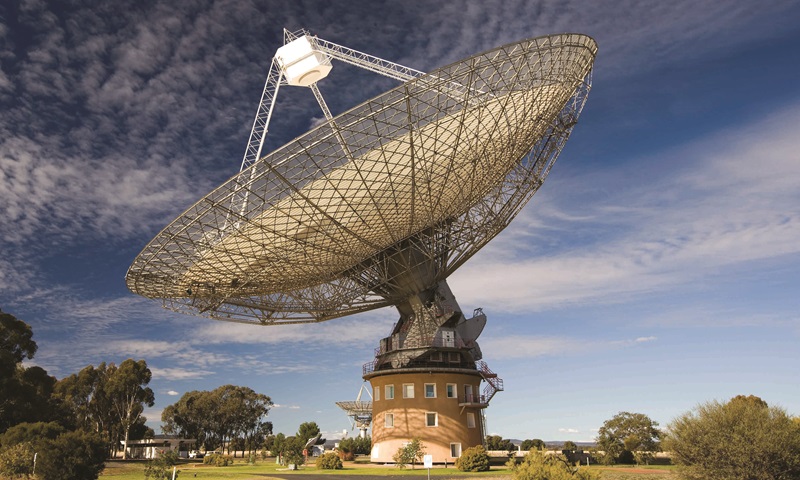
It is likely that when people think of CSIRO and spacecraft tracking, Murriyang, CSIRO's Parkes radio telescope, comes to mind – thanks in part to its starring role on the big screen in the movie 'The Dish'.
Most of Murriyang's time is actually spent enabling astronomers to study the Universe, collecting radio light from pulsars, fast radio bursts and far distant galaxies. Every so often though it turns its focus much closer to home and assists space missions.
CSIRO astronomer John Sarkissian supports radio astronomers and space mission teams alike in collecting valuable data using Murriyang.
"Murriyang will be passively tracking Artemis II as part of Intuitive Machines' ground station network, demonstrating the network's capabilities for future missions," John said.
"Artemis II will be the first crewed mission Murriyang has supported since Apollo 17, 54 years ago, which is very exciting.
"It is amazing to think as a six-year-old, I was watching Neil Armstrong walk on the Moon and now I'm part of this global mission inspiring a new generation to look up and consider careers in space."
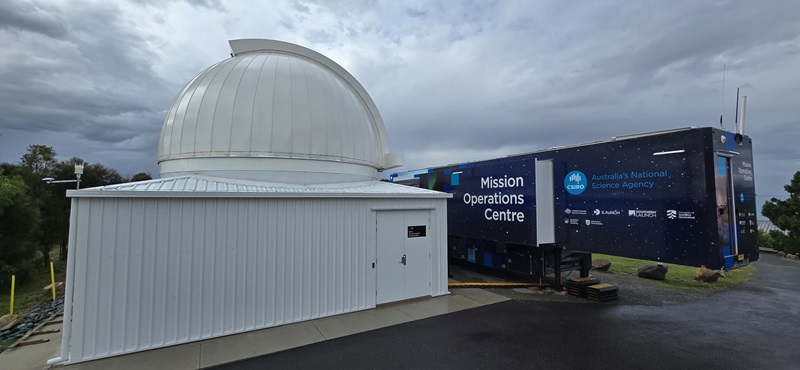
A mobile control room supporting ANU's optical communication demonstration
CSIRO's mobile mission operations centre is also taking a support role in Artemis II. The space facility is purpose-built to support remote mission operations from anywhere in Australia. It can be driven to the desired location and set up in a matter of hours, providing a sophisticated mission control centre where and when it's required.
After successfully completing its commissioning trials, the facility is supporting ANU's Quantum Optical Ground Station.
New capability demonstrations are an important part of the Artemis II mission. NASA is flying an optical communications system (using lasers) aboard the Orion spacecraft. While radio communications remain the primary channel for staying in touch with the spacecraft, demonstrating laser communications will inform future exploration missions.
The ANU ground station is not equipped with a control room so the team will be working from CSIRO's mobile mission operations centre during the mission.
CSIRO engineer Craig James helped train the ANU team to run the mobile mission operations centre.
"Seeing astronauts fly past the Moon again is incredible, but it's just as exciting to see our mobile mission operations centre step up and support its first full mission," Craig said.
"Being able to position the mobile mission operations centre directly beside the ground station has simplified team and technology coordination, and its quiet, comfortable interior provides the team with a focused workspace away from the noise of servers and laser equipment."
As Artemis II carries astronauts around the Moon for the first time in half a century, it also marks a milestone for the global teams working behind the scenes to make human space voyages possible.
From deep space antennas near Canberra, to Murriyang at Parkes, and a mobile mission control centre supporting next-generation communications, CSIRO is playing a quiet but critical role in keeping this historic mission connected.
It's a reminder that getting humans back to the Moon is a global endeavour, and that Australia is part of making it happen.


