
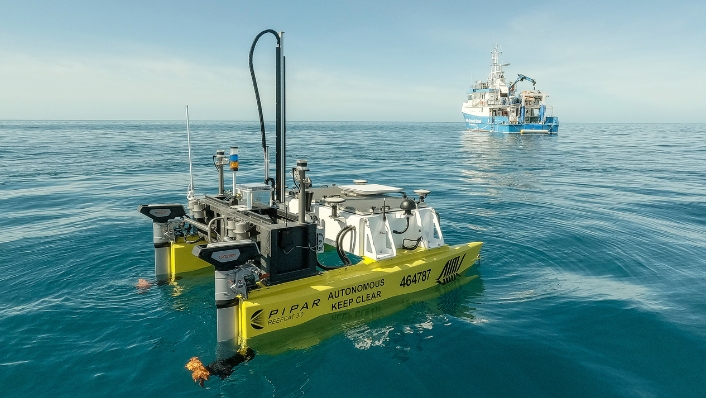
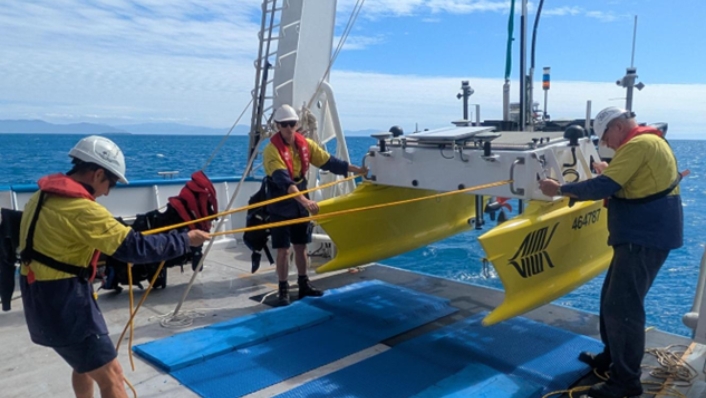
AIMS' new ReefCat class autonomous vessel helped scientists pinpoint the optimal locations to deploy baby corals on reefs near Cairns as part of this summer's mammoth Pilot Deployment Program .
The purpose-built mid-sized autonomous surface vehicle (ASV) is believed to be a world-first.
It can support a wide range of scientific payloads with multiple safety systems including obstacle avoidance, high bandwidth communication capacity and energy efficiency within a compact 3m length that can fit on an AIMS research vessel deck.
AIMS Technology Transformation Engineering Manager Shaun Barlow said during the September mission, the ReefCat surveyed 10 sites at Moore, Agincourt and Arlington Reefs.
"The images were fed into a machine-learning model which allowed us to geolocate the optimal places for coral seeding, with a high degree of accuracy, over a large expanse," he said. Reef Restoration and Adaptation Program (RRAP) Project Engineer Benjamin Moshirian said the trip highlighted the synergy that could be achieved between scientists and robots.
"Using the ASV in conjunction with the diving team broadens the scale of what we can achieve on a trip," he said.
"The ReefCat is like an extra team member, meticulously taking care of the routine data collection and freeing the science team to focus on innovative work."
The autonomous catamaran was designed and built by Brisbane-based company Pipar Automation in collaboration with AIMS engineers.
It's a 'just right' ASV: larger and more sophisticated than most off-the-shelf ASVs, but not as a large as full-sized vessels that had been converted into autonomous vehicles.
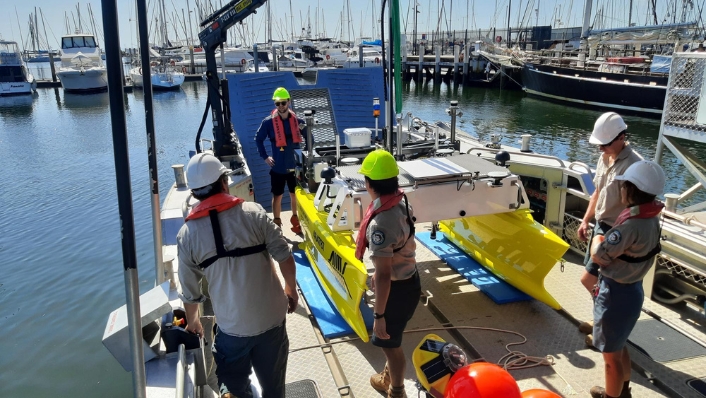
Uses
AIMS Technology Transformation Research Team Leader Melanie Olsen said the ReefCat ASV could run autonomously for at least 10 hours at a time, at daytime or night.
"This ASV can navigate a variety of trajectories, including covering an entire reef in a 'mow-the-lawn' pattern carrying cameras or a sonar system for mapping the ocean floor," she said.
"We can attach a towed platform or winch to measure profiles throughout the water column like temperature and salinity.
"It can also be used like a mooring - staying in one place with instruments taking measurements."
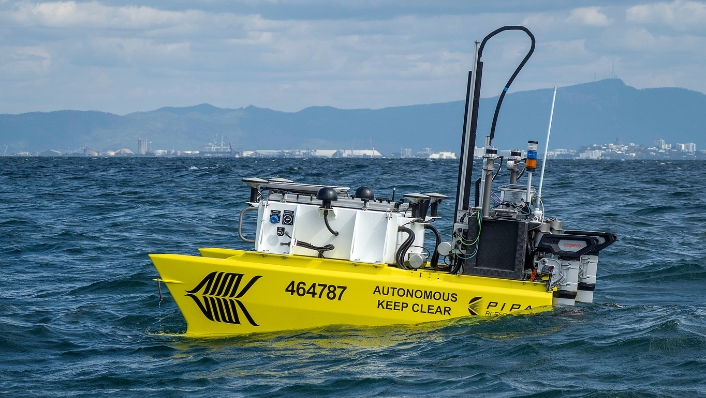
An ASV fleet
Ms Olsen said ReefCat was part of AIMS' approach to scale operations to deliver AIMS Strategy 2040 .
As the ReefCat fleet expands, AIMS would see exponential benefits, with one operator able to oversee multiple ReefCat missions simultaneously.
"The ASV enables new horizons in our future monitoring methods, delivering research and knowledge to manage, protect, and steward Australia's tropical marine ecosystems," she said.
"As Australia's regulatory framework evolves, in the future we will be able to launch the ASVs from land to undertake a mission offshore and return."
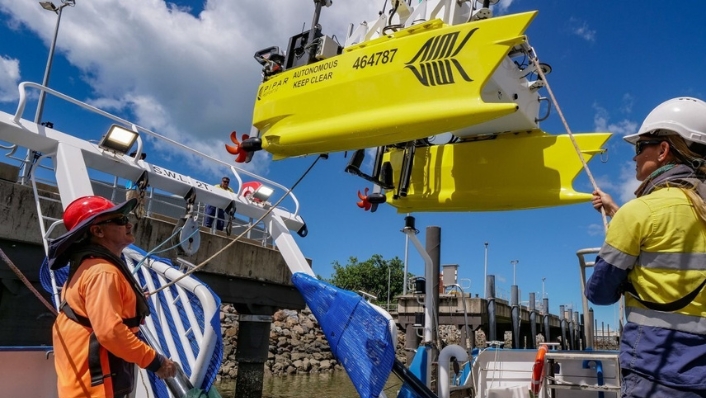
A unique design challenge
Pipar Automation Senior Principal Engineer Russ Morrison said it was a design challenge to deliver the demanding requirements.
"It's a uniquely capable ASV in terms of performance, operational flexibility and reliability," he said.
"We reduced its length from an original 4.2m to 3m, to ensure it could fit on the deck of an AIMS research vessel, without reducing its functional capability.
"As far as we are aware, there is nothing else in the world that comes close in terms of capability.
"It is fully electric with a big battery capacity, and it's jam-packed with instrumentation designed specifically for AIMS payloads, including some with quite a high drag.
"It has four to five times the power you would normally find in boats of that size. It's like a tractor; it goes slowly but has a lot of power and battery capacity."
Mr Morrison said it is "digitally very busy" with many back-up systems for both data collection and vessel operation.
"It has multiple communications links, including Starlink, and it can be communicated with in real time, providing live measurement data from the mission, from anywhere in the world, provided there is internet access," he said.
"It has integrated collision avoidance systems, including an above-water system using multi-beam lidars, and an under-water system using sonar scanners.
"The structure is manufactured from carbon fibre composites, so it is a very robust and light at 450kg, 100kg of which is the battery.
"It has a high-performance thermal management system, to ensure it can effectively operate in tropical waters, with high ambient temperatures and solar radiation.
"Designing it has been an extremely challenging, iterative process, but also very rewarding.
"Delivery of this uniquely capable ASV has been a great team effort, reflecting the close collaboration between AIMS and Pipar throughout the whole of the project."


