
Both of this year's winning books ask young readers to confront challenging topics, a task for which literature is particularly well-suited
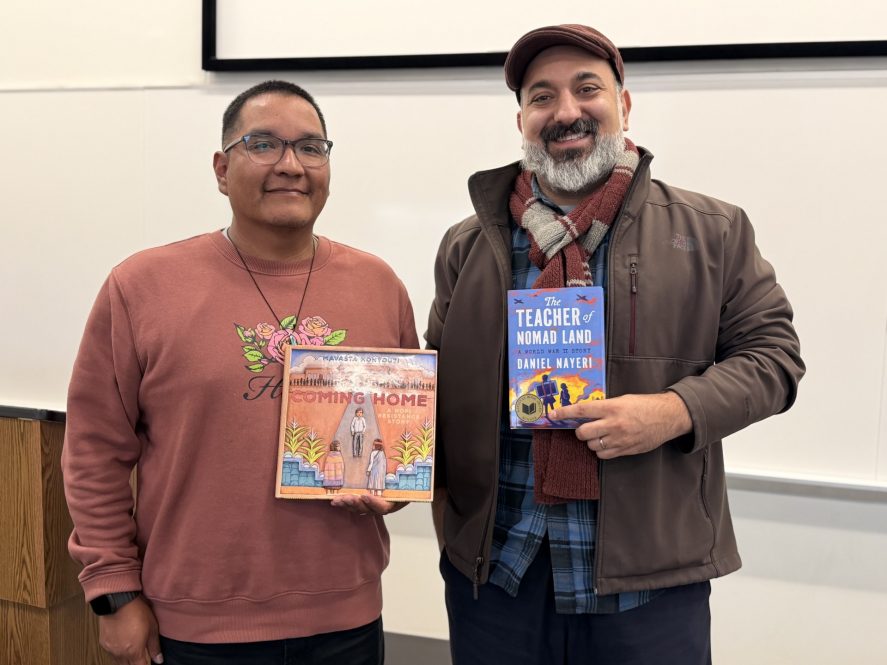
Authors Bryant Mavasta Honyouti and Daniel Nayeri with their 2026 Malka Penn Award winning children's books at UConn Hartford on November 12, 2026. (Jaclyn Severance/UConn Photo)
When Bryant Mavasta Honyouti was a boy, he didn't love working in his grandfather's cornfield. He thought it was hot, and dusty, and boring.
But his grandfather would bury a watermelon in the sand, where it would stay cool even under the Arizona sun. At lunchtime, his grandfather would dig up the melon, crack it on the tailgate of his white pickup truck, and use his thumbnail - he kept it long and sharp - to slice the melon in half. They'd eat it together, a memory that Honyouti carries with him to this day.
His grandfather passed away when he was in high school, but now - grown, married, a father, and a teacher - Honyouti still works that same field, continuing a cycle that he hopes to pass to his children one day.
"It's still hot, it's still dusty, it's still hard work," Honyouti says, "but I appreciate it every year."
On a decidedly not hot, dreary and damp Thursday morning in Hartford, Honyouti shared the story of his grandfather - "My kwa'a," he calls his grandfather in Hopi - with an enthusiastic audience of third graders from Betances Learning Lab Magnet School, who peppered him with questions about his family, his Hopi language and culture, and his art.
Honyouti is a third-generation skilled Hopi Katsina carver, and his detailed wood carvings have garnered him accolades.
But it was the combination of his art and his storytelling that brought him to Connecticut in November. His debut children's book, "Coming Home: A Hopi Resistance Story" is one of two winners of the 2026 Malka Penn Award for Human Rights in Children's Literature, presented by The Dodd Center at UConn.
The Malka Penn Award is given to the authors of outstanding children's books addressing human rights issues or themes, such as discrimination, equity, poverty, justice, war, peace, slavery, or freedom.
Named in honor of author Michele Palmer - who writes under the pseudonym Malka Penn - the award recognizes works of fiction, non-fiction, poetry, memoir, or biography written for children from preschool to high school.
"I believe stories help us understand one another in ways that facts alone sometimes cannot," says Nana Amos, director of community outreach and engagement for The Dodd Center at UConn. "They invite us into someone else's world, help us see experiences we may not know, and remind us of the things we share. That is what makes the Malka Penn Award so meaningful. We are recognizing books that give voice to important histories and experiences, especially those that children may not otherwise encounter."
Special consideration for the award is given to stories about individuals who have been affected by social injustices and who, by confronting those injustices, have made a difference in their lives or the lives of others.
In "Coming Home," Honyouti tells the story of his grandfather's childhood - forced to leave his family and home to go to a residential boarding school, like many Native American children in the late 19th and early 20th centuries.
The book, which took Honyouti four years to create and is presented in both English and Hopi, features 16 original woodcarving illustrations detailing his grandfather's time at the boarding school, where he was forced to cut his hair, change his name, and stop speaking his native Hopi.
"The kids would speak in secret," Honyouti told the third graders. "They would have to whisper, because they didn't want to get in trouble."
The story, he said, reminds us that learning how to get through hard times makes you stronger.
"I felt like it was a story that needed to be told," Honyouti says. "I wanted to do something that I think would make him proud. At the end of the book, I made a picture of him. He's standing in his cornfield, and he's holding corn in his hand to take home to feed his family. And I think that's where he was happy. I thanked him for allowing me to share his story."
Later that same gray Thursday in Hartford, Honyouti joined the author Daniel Nayeri - also a winner of the 2026 Malka Penn Award - for a conversation with first-generation UConn students at UConn Hartford.
"Somehow, we both wrote books about coming home," says Nayeri, who is currently the author of 25 books, with his next book scheduled to publish in 2027.
This year's Malka Penn Award recognized Nayeri's young-adult offering, "The Teacher of Nomad Land: A World War II Story," which was also honored with the 2025 National Book Award for Young People's Literature.
In this fictional account, orphaned siblings Babak and Sana - fearing they will be separated - devise a plan to find the Bakhtiari nomads as they trek across the Zagros Mountains of Iran, a wooden chalkboard strapped to Babak's back, to take over his father job as a teacher.
On their journey, the siblings encounter a Jewish boy hiding from a Nazi spy, and the three set out on a race for survival, in a neutral country occupied by British forces on one side and Soviet on the other.
Though fictional, Nayeri says, the story is based on true accounts from Iran during the Anglo-Soviet Invasion - an area impacted by the war but often forgotten as stories from the time period focus on the European front.
An Iranian-American, Nayeri fled Iran as a refugee with his family before settling in the United States when he was 8 years old.
"I think about Iran a lot," says Nayeri - who, like Honyouti, wrote his first book about his own life and family. "I'm not allowed back, but it is a place in my heart."
Both of this year's winning books ask young readers to confront challenging topics, a task for which literature is particularly well-suited, notes Amos.
"Through stories, young people can develop empathy, ask questions, and begin to see the world a little differently," she says. "And when we make room for those stories, we create more opportunities for understanding, connection, and a stronger sense of belonging."
And children, says Nayeri, have the same deep and complicated interior lives as adults - they're just not yet armed with language.
"In some ways, the whole point of a story about a difficult topic is to build a toolkit for the young reader without the trauma of first-hand experience, so that when, as life will, those crises come into their lives, they are better equipped than characters they're reading about," says Nayeri. "I don't know how else one could equip a young person without stories."
Both Honyouti and Nayeri were presented with their Malka Penn Awards at a ceremony at the Hartford Public Library in the evening on Nov. 12.
The Dodd Center for Human Rights is home to robust academic programs and innovative external engagement in human rights, including the Gladstein Family Human Rights Institute, the University Archives and Special Collections, and the Center for Judaic Studies and Contemporary Jewish Life.


