Clinical placements in Central Australia have commenced for seven medical students from Flinders University's Northern Territory Medical Program.
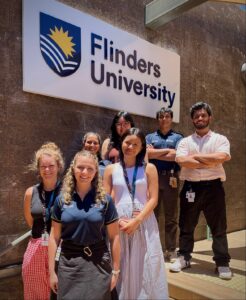
This group of third-year students, part of a cohort of 36 medical students, is supported by a unique training model that combines university teaching with strong Aboriginal community leadership.
Patrick Torres, from the Utopia community in the Sandover region, works as an Aboriginal Cultural Coordinator at Alice Springs Hospital.
In partnership with Dr Wakinya Tabart, Senior Lecturer at Flinders in Alice Springs, he has led cultural education sessions for the new student cohort, to highlight the importance of early engagement with Aboriginal Liaison Officers during hospital admissions.
Dr Tabart, who has worked as a GP with the Central Australian Aboriginal Congress for 21 years, echoes Mr Torres's key message: "Early engagement is key to preventing patients taking their own leave from hospital and reducing the risk of serious adverse outcomes."
Students Tiana James and Sophie L'Estrange are proud Aboriginal women who have chosen to undertake their placement and studies in Alice Springs for the next 12 months.
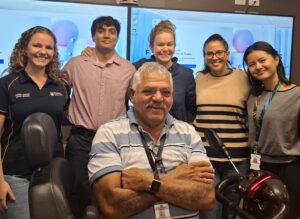
"As a Kalkatunga / Wiradjuri woman, I appreciate the importance of these sessions early in my placement, and that they help me acknowledge the Country I am working on, to pass safely and lightly throughout my time here," says Ms L'Estrange.
Ms James says her cultural identity as a Darkinjung woman strongly shapes her commitment to community-centred care.
"I am particularly interested in placements such as this in Central Australia, which allow me to better understand how health services can work alongside communities, rather than just deliver care," she says.
Associate Professor Emma Kennedy AM says the clinical placement program is delivering on a commitment to building a strong local medical workforce.

"Flinders University has been running the Northern Territory Medical Program since 2011 with a strong focus on creating an essential pathway into medicine for Northern Territorians," says Associate Professor Kennedy.
"With 251 graduates, 90 per cent of whom are Territorians, the Northern Territory Medical Program is doing exactly this.
"The program employs local staff and partners to work closely with Aboriginal community leaders, to ensure our students are trained in culturally responsive, community-connected care."
This year, four of 10 new interns at Alice Springs Hospital are graduates of the Flinders University program, including two who grew up locally.
"This is a significant achievement for the Territory workforce and community, and something we are all proud of," says Associate Professor Kennedy.