
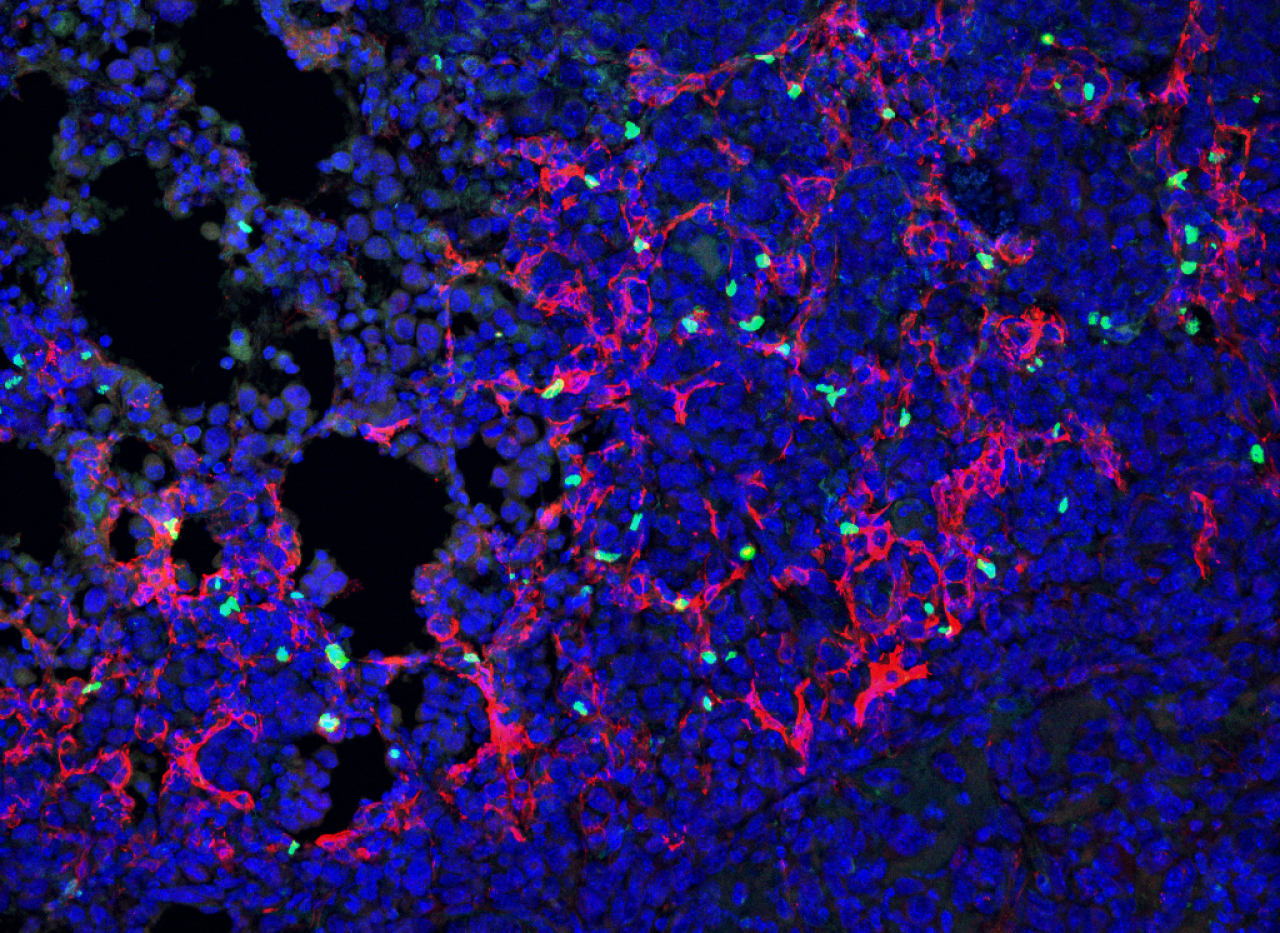
Uncovering how the newly identified fibroblast cells in the lung protect cancer was a tough task. The breakthrough came after graduate student Olivia Ringham spent hours examining images of the cells around lung tumors. "I remember being in the microscope room with my slides of all my different cancer models, looking around, and then I just saw this striking pattern of regulatory T cells sitting amidst the fibroblasts, and I was like, 'that's interesting,'" Ringham recalls. Image courtesy of Olivia Ringham / Columbia University Vagelos College of Physicians and Surgeons.
Researchers at Columbia University have discovered a new type of cell that protects lung cancers from attacks by the immune system. The work, published in the current issue of Nature Immunology, illuminates a previously unknown capability of lung tumors and suggests a new strategy for targeting the disease, which remains the leading cause of cancer-related death in the United States.
The new cells were discovered as part of a wider project to understand the roles of fibroblasts-seemingly normal cells often found around solid tumors. "In the past five or ten years, a lot of research has shown these fibroblasts are helping the cancer and their activity is linked to patient outcomes," says Olivia Ringham, a graduate student at Columbia's Vagelos College of Physicians and Surgeons and lead investigator on the project.
"Much of the earlier work on these cancer-associated fibroblasts has focused on pancreatic cancer, but little is known about the cells in lung cancer," says Nicholas Arpaia, associate professor of microbiology and immunology, senior author of the study, and Ringham's adviser.
Cell-by-cell analysis
Ringham found the new cells while examining all fibroblasts from a mouse model of lung cancer with a technique called single cell transcriptomic profiling. "Single cell transcriptomics has really had a huge development on the field over the last decade," says Ringham. "It's a great way to find previously unknown cell types and understand what those cells do."
The analysis revealed previously unknown fibroblasts that expressed a gene called CHL1, which is not normally found on fibroblasts in healthy lungs.
Ringham and Arpaia eventually learned that the newly identified fibroblasts promote lung cancer by recruiting a population of regulatory T cells to the border of the tumor. Regulatory T cells usually protect the lung by keeping the immune system in check. "There are all these different environmental antigens that come into your lung at any given moment," says Ringham. Without regulatory T cells to keep the system balanced, every breath would trigger a strong inflammatory response.
But in the setting of lung cancer, the immunosuppression created by the regulatory T cells only serves to protect the tumor.
With the help of colleagues at Columbia and the University of Toronto, Ringham and Arpaia learned that the fibroblasts recruit the regulatory T cells to the cancer with a signaling protein called CXCL9. Blocking this signaling system in the mice, by inactivating the relevant genes for it, reduces the accumulation of regulatory T cells and permits an immune response that attacks the tumor.
The findings imply that recruiting immunosuppressive T cells is a key survival strategy for lung tumors that protects them from elimination by the immune system.
Human lung cancer
The same fibroblasts also exist in human lung cancers, where they appear to recruit regulatory T cells and impact patient outcomes. Using tumor specimens and patient data from Columbia's extensive tissue bank, Ringham found that patients whose tumors had more CHL1 fibroblasts also had reduced immune responses against their cancers and lower progression-free survival rates.
Targeting the regulatory T cells drawn in by the fibroblasts could unleash the immune system and be a promising strategy against lung cancer, Arpaia says.
Because they don't appear in normal lungs, the new CHL1 fibroblasts may also be a potential target. "Where do these cells come from? How are they formed?" asks Ringham. "If we could stop that transformation, it could provide a great benefit."


