
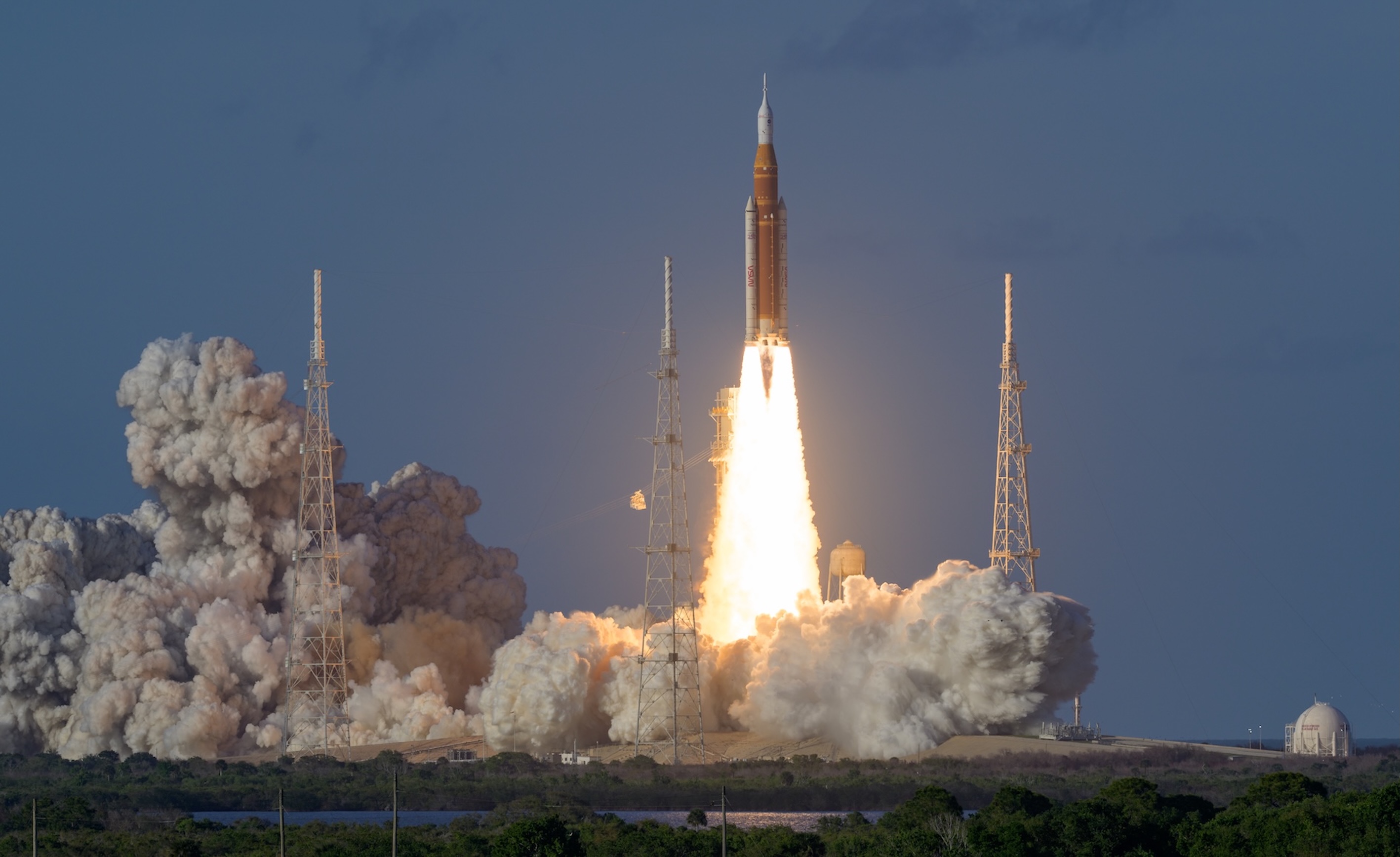
Four astronauts set off for the Moon on the Artemis II mission on 2 April. They are carrying Timepix chip chips developped at CERN in their spacecraft. (Image: NASA/Bill Ingalls)
At 00:35 CEST today, the Artemis II mission successfully launched, marking the first human journey to the Moon since 1972. During their ten-day journey aboard the Orion spacecraft, the four astronauts are expected to receive tens of millisieverts of radiation, more than ten times what most people experience in an entire year on Earth. Understanding and managing this exposure is essential if humans are to continue to explore space safely.
This is precisely the role of the six Timepix chips on board Artemis II. Developed at CERN, they have been deployed through a collaboration with ADVACAM, a CERN partner specialising in photon-counting imaging technologies. The chips form part of NASA's Hybrid Electronic Radiation Assessor (HERA) system, which is designed to monitor the radiation environment inside the Orion spacecraft. The system will measure the composition, intensity and energy of incoming particles in real time, helping scientists to assess the radiation exposure of both crew members and onboard electronics.
Unlike low Earth orbit missions, such as those to the International Space Station, Artemis II will travel beyond the protection of Earth's geomagnetic field. During the journey, astronauts will pass through the Van Allen radiation belts, regions of trapped charged particles that increase their overall radiation exposure significantly. They will also face higher levels of galactic cosmic rays and solar particle events, highly energetic radiation that can affect both human health and sensitive electronic systems. In such environments, real-time radiation monitoring and characterisation and real-time response are essential, particularly in the case of sudden radiation events, such as coronal mass ejections, which can rapidly increase exposure.
Timepix detectors were developed by the CERN-hosted Medipix2 Collaboration, which designs hybrid pixel detector technologies for imaging and radiation measurement. Based on hybrid pixel detectors, a technology originally created for particle physics experiments, the Timepix detectors are closely related to the detectors used in the Large Hadron Collider to track particles produced in high-energy collisions. Over time, the technology has been adapted for space applications through contributions from multiple partners. For Artemis II, Timepix-based systems have been implemented in collaboration with ADVACAM and will contribute to radiation measurements during the mission.

At the core of the Timepix technology, each chip consists of a matrix of pixels capable of detecting individual particles and measuring the energy they deposit. Combined with the characteristic shapes of the tracks left in the sensor, this allows different types of radiation to be identified. Despite their small size, the detectors provide detailed spatial and energy information, making them well-suited to the mixed-field radiation environment of space.
This is not the first time that Timepix has gone into space. Timepix technology has been used in space for over a decade. First deployed on the International Space Station in 2012, it has since supported radiation studies in orbit and is now integrated into instruments such as HERA for exploration-class missions.
As humanity makes its return to the Moon and prepares to travel further into deep space, understanding radiation exposure becomes increasingly important. Data collected by the Timepix chips during the Artemis II mission will provide new insights into the radiation environment beyond Earth's orbit and its impact on both spacecraft systems and the health of the crew. These measurements will help to refine radiation models, evaluate shielding strategies and improve risk assessment for future missions.


