
Leaders from the Department of the Air Force Portfolio Acquisition Executive for Command, Control, Communications and Battle Management doubled down on the importance of acquisition transformation within the DAF Battle Network framework during a panel at the Air and Space Forces Association's Warfare Symposium, Feb. 24, highlighting the department's focus on maturing architecture and delivering capability at operational speed.
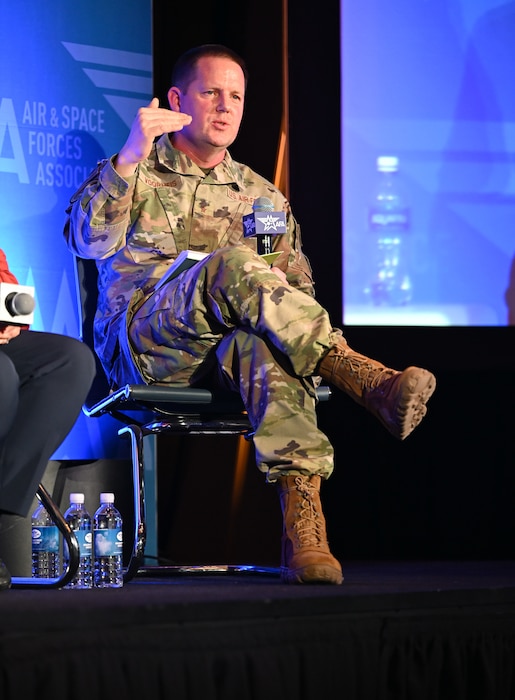
Brig. Gen. Jason Voorheis, C3BM PAE, and Dr. Bryan Tipton, chief of Architecture and Engineering for C3BM, represented the office on the panel, outlining how the PAE has evolved from concept to execution in building an integrated, resilient battle network for the joint force. Shannon Pallone, U.S. Space Force Program Executive Officer for Battle Management Command, Control, Communications, and Space Intelligence, and Taylor Herron, Palantir Technologies executive, also spoke on the panel moderated by Heather Penney, director of Studies and Research for AFA's Mitchell Institute for Aerospace Studies.
Voorheis emphasized that the joint force will not win a future war using a single platform, but with a system of systems, highlighting the importance of the DAF Battle Network in the joint framework. The conversation traced the implementation of the acquisition transformation from program executive officers to empowered, mission-focused PAEs being the central mechanism for streamlining decision making and aligning accountability with mission outcomes.
C3BM was among the first five PEO-to-PAE transitions announced by the Air Force on Jan. 8.
"What we're seeing is this idea that acquisition really is a warfighting function," Voorheis said. "This sense of urgency to our business that we really need to be on a wartime footing puts a priority on the ability to actually field capabilities incrementally over time, driving alignment between resourcing requirements and acquisition so that we have the stable funding and stable requirements that allow us together to fuel that capability that's most prioritized by the service and driven by the mission threads."
Central to "fight tonight" capabilities is building a common data layer that enables interoperability across platforms, coalition and industry partners. By establishing a common data layer and open interfaces, the DAF can more rapidly incorporate emerging technologies and scale them across the joint force. This approach aligns with the Department of War's broader push to streamline acquisition and deliver relevant capability on timelines that match the pace of modern conflict.
"In five years, I want to see us evolve at the same pace as technology," Pallone said. "We spend a lot of time trying to decide when we're going to dig out of tech debt. As a joint force, we need to get to the point where we're on a common enough baseline that we're able to evolve as we go."
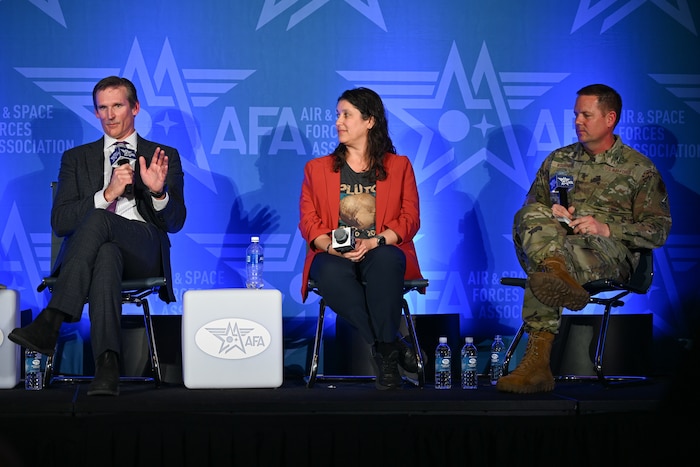
Rather than a single system, leaders described the DAF Battle Network as an evolving architecture, and one that is continuously refined through operational feedback, experimentation and incremental fielding.
"We're always in exercises," Tipton said. "We're always looking at how am I taking our data and making sure it's being spread not just to the joint force, but to our allies and coalition partners, so that we can fight as one team. The two keys for that are 'can I share that data, and do I have the right communication networks to actually move that data along?' I think if we solve the data and transport problem first, that'll be the most critical piece to being able to fight as one team."
Voorheis and Tipton reinforced that the ultimate objective for the DAF Battle Network remains clear: connect the joint force in a way that enables faster, better-informed decisions in contested environments, delivering combat decision advantage today while building the foundation for tomorrow's fight.


