
InFocus: Queer and Disabled Story by PWDA member Bridg
InFocus: Queer & Disabled is a digital storytelling campaign led by PWDA, centring the voices and lived experiences of LGBTQIA+ people with disability.
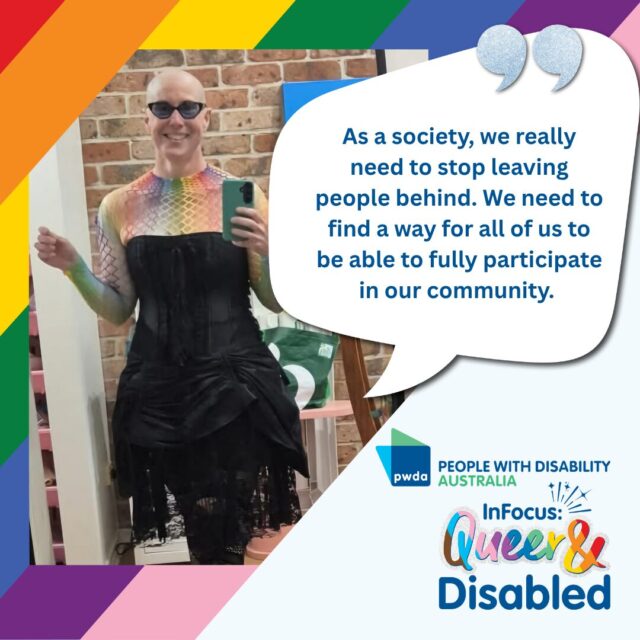
Hi, my friends call me Bridg. I live in a small town on the Mid North coast of NSW. I'm 48 years old. I identify as Queer and Disabled. I always suspected I was a little different. I wondered why I struggled with everyday tasks others didn't. It became particularly apparent when puberty hit. The miracle of being a woman. It was no miracle for me. It was a curse. I couldn't understand how my friends seemed to breeze through it. (From Grade 5) I fantasied about a time when I could have a hysterectomy and end the curse.
I felt weak, for not being able to handle a basic biological function. Growing up I was no stranger to pain. I became used to pushing through. Even so, I had my first admission to hospital for severe pelvic pain at age 14. It was not until I was 21 that I finally got a diagnosis. 7 years to get a diagnosis of endometriosis (and I was lucky; back then, the average time for diagnosis was 11 years).
I was in university studying Business and Law on scholarship when things changed. I'd thought my time of the month was bad. This was something else. This was 24/7. This was something I couldn't push through.
Having health problems was bad enough. I could tell you about the hell that it is to be trapped in a body where you are never pain free. When you spend hours silently screaming inside your head, hoping… praying to either pass out or for the pain to kill you. That wasn't the worst of it.
What was unbearable was how I was treated by the medical professionals I went to for help. What hurt was that friends and family moved on without me. Part of me understands that the world keeps spinning. Life goes on, but that is extremely hard to watch as your world crumbles. As a society, we really need to stop leaving people behind. We need to find a way for all of us to be able to fully participate in our community.
For me my world had fallen apart. I was desperate to get back to my double degree. To work in my chosen profession. To watch, time and again, the doctor's eyes go from engaged and interested to disinterested upon hearing that I was now on a Disability Support Pension. To be told '…you're just one of those women…' somehow not worthy of being treated. Things became very dark and I wanted to check out. I fought my way out of that darkness. I have continued to fight that black dog every step of way. I eventually accepted they couldn't fix me. My only goal was to find a treatment that made it bearable.
A lot has happened in the decades since. I have come across barrier after barrier to getting treatment. I have gone undiagnosed for treatable conditions. I have been misdiagnosed. I have been refused treatment. And worse…
I'm telling you this, because it is time for things to change. No one should have to go through what I did. It needs to change because at some point every one of us is going to need medical treatment. If you think this couldn't happen to you? If you think I didn't try hard enough to get better. You are mistaken.
Nearly every treatment that I am now on has been available the entire time. It took 25 years. I now know that I am not weak. It has taken a lot of fight to keep going. Finally, I am getting back some of what I lost so long ago. Receiving timely, appropriate medical treatment should be a basic human right. We think we have that right in Australia, but in actuality we don't.
Since starting to receive the treatment I need for my multiple health-based disabilities, I have been able to make new friends. I'm getting involved in community. I volunteer at my local Neighbourhood Centre. I've been a Patient Advocate at the Drug Law Reform Summit in 2024. I'm even able to work a few hours as a Consultant Patient Advocate on a Governance Committee for Ethical Human Medical Research.
The personal cost to me of not getting treatment was almost too high. I know what I've achieved since I've gotten the help that was so long denied me. I know it costs the taxpayer a lot to assist someone like me. I do wonder if people consider what they miss out on when the systems meant to help people deny someone like me treatment. Every Aussie deserve access to timely and appropriate medical care… even Queer Disabled Australians.
Find more InFocus: Queer and Disabled stories:


