
As Ebola continues to spread in the Democratic Republic of the Congo (DRC), more resources are needed to fight the disease and feed patients and families, UN agencies said on Friday.
"If we lift the foot off the pedal, the virus will resurge very quickly, will continue to spread to newly affected areas and pose a threat for the country, the region and the world at large," warned Dr. Catherine Smallwood, World Health Organization ( WHO ) incident manager in the DRC.
The country remains the epicentre of an outbreak of Ebola Bundibugyo virus disease that was officially declared in mid-May. It began in the volatile eastern region and has now spread to eight provinces, the latest being Nord-Ubangi in the northwest.
There have been 9,765 cases to date and nearly half - 4,727 - have died. Additionally, 30,000 contacts are being monitored each day over a three-week period.
A smaller outbreak in Uganda was officially declared over in August, while cases have also been confirmed in Kenya, Nigeria and France.
Lives and livelihoods lost
In the DRC, "we're seeing an incredible permanent burden and loss of livelihoods in those families that are affected", said Dr. Smallwood, speaking from the eastern city of Bunia to journalists in Geneva.
At nearly six months in, the outbreak "is occurring in an area that is geographically vast and moving into ever hard to reach locations and remote locations", she noted. Some places can take several days to reach by boat or motorcycle and are inaccessible by car or plane.
The crisis continues to unfold amid ongoing conflict, hunger and displacement, and the World Food Programme ( WFP ) is working to ensure that families get enough to eat. The UN agency is also building Ebola treatment centres, among other operations.
Feeding hungry families
WFP's Representative in the DRC David Stevenson shared stories of the people who depend on its support.
One woman, Francine Birungi Amoti, lost a child to Ebola and is raising her six surviving children and a baby entrusted to her care. She is unable to attend to her fields due to violence.
"For Francine, food assistance means being able to feed the children in her care when reaching her fields could cost her life," he said, speaking from the capital Kinshasa.
"This is what a crisis on top of a crisis looks like: disease and bereavement, compounded by insecurity and hunger."
Concerns and challenges
Dr. Smallwood also pointed to another concern as the number of people dying from Ebola outside recognised treatment centres "remains a big flag of late detection of cases at the community level".
The past week has seen a decline in the number of people dying in the community or outside Ebola treatment centres which indicates that actions to increase early detection and quick referral to care have been working.
However, WHO understands that in some parts of eastern DRC, "patients are visiting between two to five different health facilities before they're referred to Ebola treatment centres", representing "a really, really big challenge".
Beds for patients
Dr. Smallwood said there have been significant improvements in the quality of care provided at Ebola treatment centres. WHO had set a target of 3,000 beds across affected areas and currently over 2,000 are available.
She also highlighted the positive fact that 2,600 people in the DRC have survived Ebola. Clinics are being opened where they can access care, including to monitor presence of the virus and any related conditions that may arise, as well as psychosocial support.
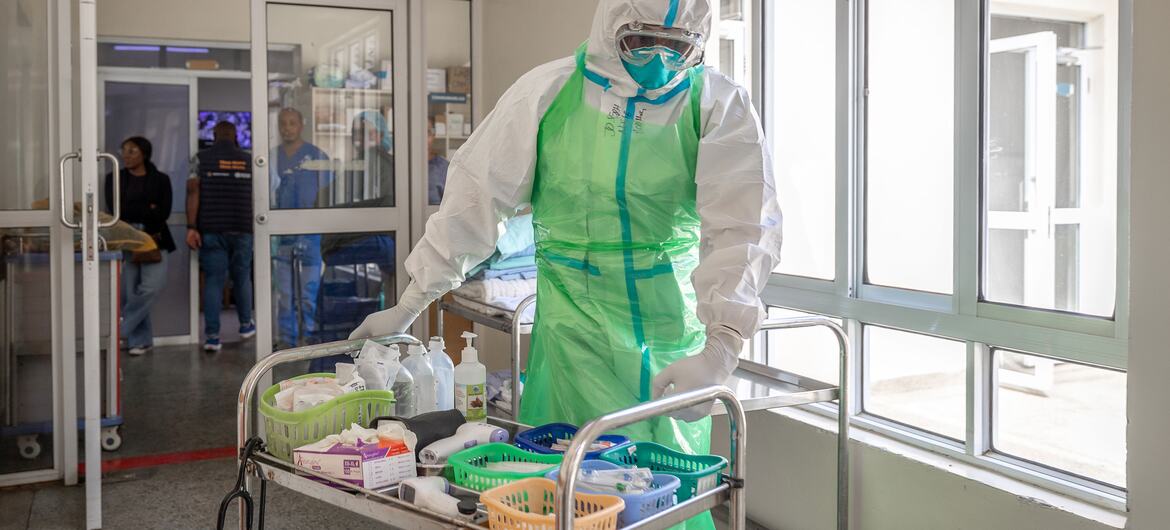
Update from Kenya
There is also good news on the Ebola front in Kenya following the country's first case and fatality earlier this month - a Kenyan man who had been working in the DRC before flying back to Nairobi via Uganda.
More than 100 contacts were identified, some of whom will complete their 21-day quarantine on Sunday and will be heading home to their families.
WHO representative in Kenya Dr. Neema Rusibamayila Kimambo welcomed the development.
"I think their sacrifice has been important in ensuring that the community is protected and that we don't have community spread today," she told UN News.
Listen to the full interview here.
Support, not stigma
She stressed that these people should not be stigmatised as being released from quarantine does not mean that they had Ebola, only that they had contact with someone who did.
With Ebola now confirmed in four African countries, Dr. Kimambo underscored that governments must remain vigilant.
"Africa is very interconnected and nobody is safe until everyone is safe," she said. "So, as long as we have Ebola in DRC at the scale that it is, or in any other country, it means that we are not safe. Therefore, the key message is preparedness."


