Providing balanced, future-focused policy advice is a key motivation for the Government's Chief Scientific Adviser at the newly established Department for Business, Innovation, Science and Technology.
Speaking to staff at the University of Leeds, Professor Chris Johnson discussed his interest in public service and the role of ethics in engineering.
He also outlined his journey into science from his degrees to a fellowship at Nasa and his leadership roles at Glasgow University and Queens University, Belfast.
"Science advice is about being fair and focused, ensuring that we are delivering capability for future generations," said Professor Chris Johnson.
"It is about delivering science advice that creates a legacy. By collaborating and communicating with central government to ensure strategically relevant investments benefit society both economically and socially."
In his role, Professor Johnson provides scientific and technical advice on the department's policy areas by engaging with the scientific research community and advocating for regions across the UK.
It is about delivering science advice that creates a legacy.
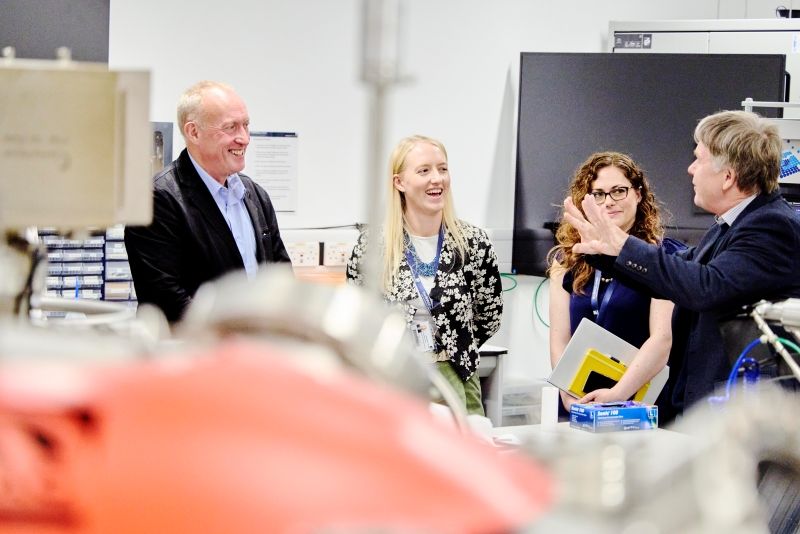
The visit also included a tour of the Bragg Centre for Materials Research, where Professor Johnson saw the X-ray Diffraction Facility and the Tescan Tensor in the Leeds Electron Microscopy and Spectroscopy Facility.
Professor Nick Plant, Pro-Vice-Chancellor: Research and Innovation, said: "Through our research and innovation at Leeds, we are ensuring that our emerging technologies and interdisciplinary expertise deliver impact across policy, public services, the economy and society.
"By creating this opportunity to speak with Professor Johnson, we showcased the vital role that research and innovation at Leeds plays in supporting the region's innovation ambitions, informing the evolving devolution agenda and delivering impact for people, places and future generations."
Professor Johnson also visited Nexus, the University's innovation hub. Here, he met with the team behind Atlas Endoscopy, a clinical-stage start-up and University of Leeds spin-out company that is creating an advanced robotic colonoscopy system.
He later attended a session on enabling science to clinical translation at Nexus, which highlighted examples of disease understanding, diagnosis, treatment and technology.