
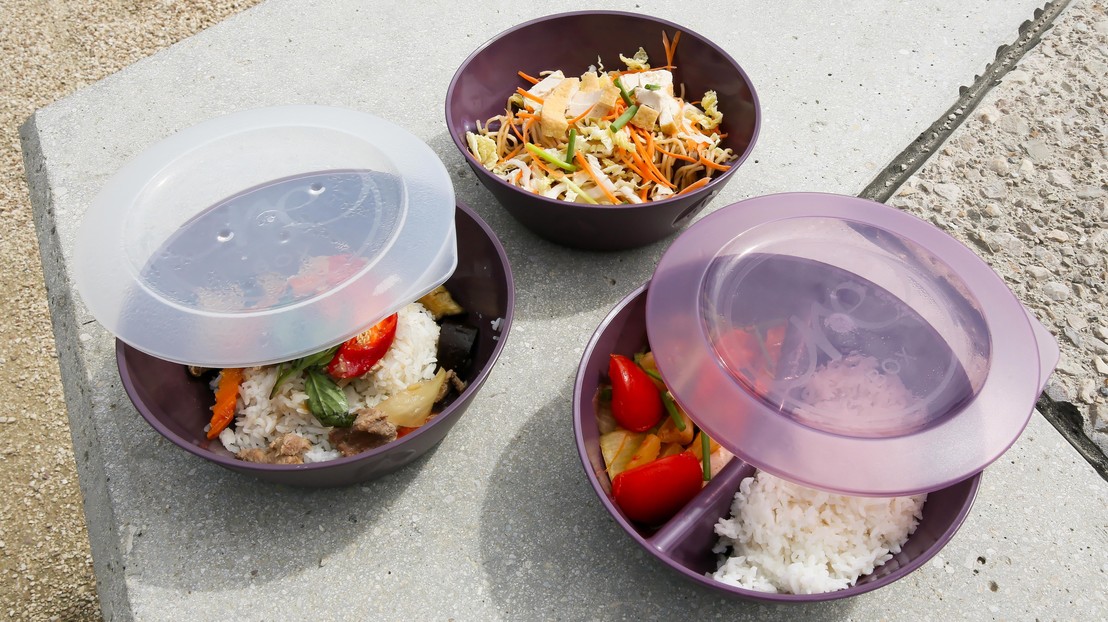
2025 EPFL/Alain Herzog CC-BY-SA 4.0
This week, EPFL is hosting Sustainability Week, with a public open house on Saturday, March 7. How EPFL has halved its volume of incinerable waste over the past ten years? We spoke with two of the people who are helping to change our habits - and our campuses - one bin at a time.
To address the problem of plastic pollution, EPFL has introduced a broad policy to reduce our use of disposable items and sort waste as thoroughly as possible. These efforts are being steered by our Sustainability Unit, which is on a mission to reduce our environmental footprint and incorporate responsible practices into all our activities: teaching, research, innovation, and campus life in general.
Aurore Nembrini, EPFL's sustainable operations manager, is one of the people at the Unit working towards this goal. "We're implementing concrete solutions in the areas of food services, energy, waste management and IT," she says. "The biggest challenge relates to the equipment we purchase, which alone accounts for over half of the School's carbon emissions."
The Sustainability Unit carried out an in-depth study in 2015 to characterize the waste produced at the Lausanne campus. "When we opened up the trash bins to analyze their contents, we saw just how much of our waste comes from food packaging - disposable plastic wrappers and Styrofoam, for example - especially in connection with food trucks," says Nembrini. "That prompted us to run a pilot project involving reusable containers, which was extended to the entire Lausanne campus in 2018." The campus was one of the first in French-speaking Switzerland to make returnable containers mandatory for takeout meals, through an initiative carried out with reCIRCLE, whose networks now include the University of Lausanne and several Swiss restaurants. This has cut the volume of incinerable waste at the campus by 35% to 40%.
At the same time, EPFL replaced individual trash cans with EcoPoint recycling bins for sorting PET, paper, aluminum cans and glass. This led to a 13-fold increase in the amount of aluminum collected between 2014 and 2024. PET collection remained stable, as it was already widespread and consumer habits have shifted in favor of water bottles.
Other types of waste are handled at our School's central waste collection center - the only one of its kind. "The center is open to all EPFL community members 24/7," says Stephen Poplineau, who manages the center. "It's becoming a social space of sorts, where people strike up a conversation and make new acquaintances."
We're implementing concrete solutions in the areas of food services, energy, waste management and IT. The biggest challenge relates to the equipment we purchase, which alone accounts for over half of the School's carbon emissions.
Poplineau spearheaded efforts to expand the types of waste treated at the center, which now handles over 42 waste streams, including metals, electronic components, non-PET plastic and commonly recycled materials. Strict procedures are in place to treat the waste from research labs, in particular chemical and biological substances; this form of waste accounts for over 16% of the total volume handled at the center. Since 2013, the amount of incinerable waste produced at EPFL has dropped by 49%, while the number of people at our School has increased by 37%. What's more, we've achieved an impressive 73% recycling rate - well above the national average of 52%.
When it comes to plastic in particular, "it's a huge battle we've been fighting for a long time," says Poplineau. "In Switzerland, only PET is really recycled effectively. Here at our waste collection center, we group together the other kinds of plastic, but it's not easy to sort them since there are 126 different types of polymers! So we work with local partners, including the City of Lausanne, to do that."
The waste collection center also serves as a reuse center where researchers and students can leave used supplies and equipment that may still be of value to others. Poplineau and Nembrini are both encouraged by the progress that's been made, but they acknowledge there is still a long road ahead. The challenge now relates less to improving the recycling process and more to reducing the amount of waste that's created in the first place. For plastic in particular, the best way to help the planet is to eliminate it at the source.
Zero Emission Group (ZEG) is a student club with around 50 members, including students from EPFL, working to shrink our campuses' carbon footprint and raise awareness about sustainability. One of their initiatives is "Plast it Back", which aims to give new life to the huge amount of single-use plastic waste from research labs - pipette tips, petri dishes, sterile packing and other disposable items that, even when disposed of properly, are rarely recycled.
The students' idea is to collect some of this used plastic, grind it, melt it and then mold it into sheets that can be used to make trophies for university sports competitions. "The waste from just one research lab is already more than we can process," says Gaëlle Verdon, a student involved in Plast it Back. "That's a little discouraging, but it also makes me want to do something about it."
This motivation is felt by the entire project team. "I see it as a way to make my own little contribution," says Christophe Hideki Michaud-Lavoie, who managed the technical aspects of the project. "And if it encourages other people to get involved, even better!"
"Plast it Back" may be a small initiative but it has big goals that are underpinned by ZEG's philosophy: by learning and testing new ideas, they can show that it is indeed possible to make a tangible impact.
Between 5 and 7 March 2026, EPFL will host a day of sustainability-focused scientific activities plus a series of similarly themed public events. The initiative will take stock of existing efforts and chart future steps, both on campus and in research.


