Providing better protection for firefighting crews during bushfire outbreaks has been a huge focus of Justin Leonard's career.
And last week, he saw this legacy reach a major milestone.
The CSIRO Bushfire Adaptation Research Leader witnessed the fit out of Victoria's Country Fire Authority (CFA) ultra-light tankers with a foam based crew protection system. These small vehicles are the last of the CFA fleet to be fitted.
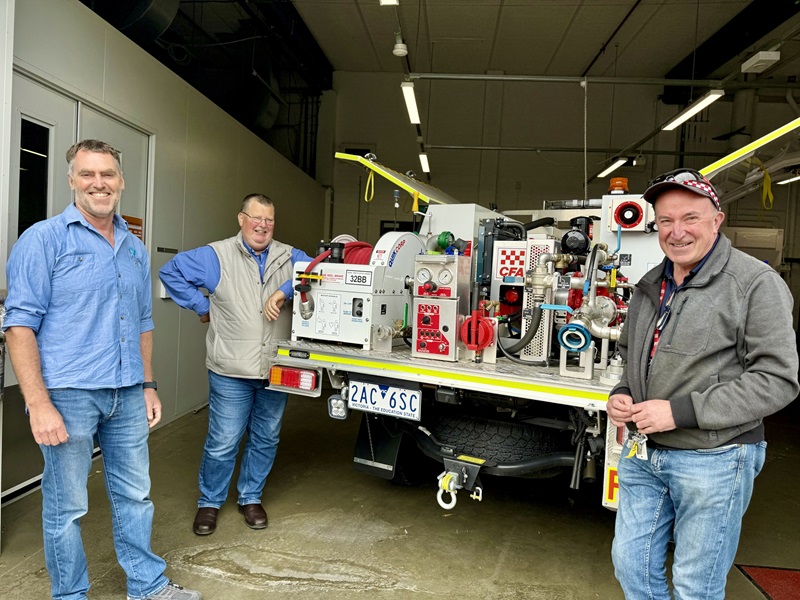
The fire agency will now have full crew protection for the majority of active bushfire fighting vehicle across Victoria. Many other states have followed this approach and copy the same systems with support from CFA.
Justin has been working with the CFA in Victoria to better protect their fleet for 24 years.
He demonstrated the burnover protection system using a large fire tanker in front of King Charles last year when his majesty visited the National Bushfire Behaviour Research Laboratory in Canberra .
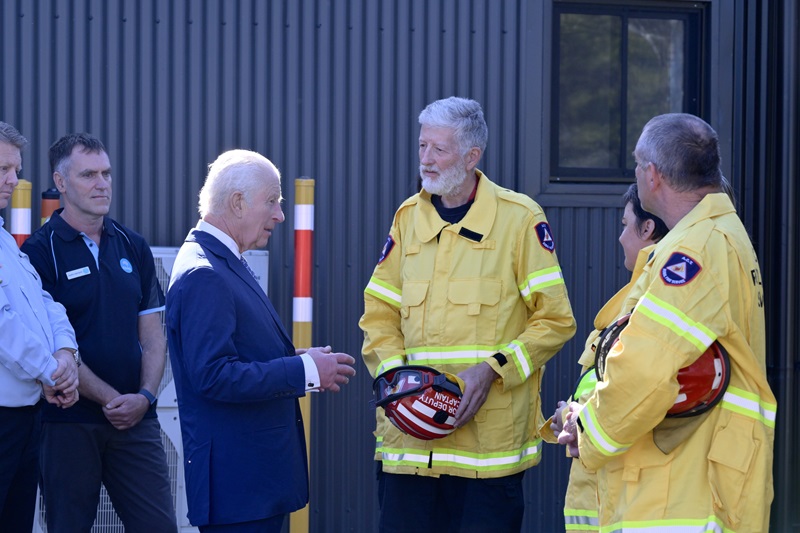
The large tanker that was used for that demonstration during the King's visit used water spray nozzles over the cabin to protect crews.
However, this doesn't work for the smaller ultra-light tankers because the amount of water needed is too much and makes the vehicle too operationally restrictive. Instead, Justin said a foam system was the best solution for the smaller ultra-light Country Fire Authority tankers. The foam system uses the vehicle's onboard water and only adds about 60kg to each vehicle.
Protection system put to the test
The effectiveness of the cabin protection systems was put to the test during the fire outbreak of 2009. During the Black Saturday fires in Victoria, eight fire trucks were impacted by fire and all their crews emerged safely with no loss of life. These protection systems continued to provide crews with increased safety in subsequent fires including the more recent 2019–2020 bushfires .
The foam bushfire protection system for the ultralight tankers has been 10 years in the making. CSIRO performed six separate ultralight tanker test burns at the NSW RFS site in Mogo. For these test burns a bushfire is simulated and vehicle tested under extreme conditions, with a focus on saving the lives of those in the cabin. Here is a run-though of the system – a short training video for CFA firefighters .

Justin said that burnover protection systems for the larger tankers have now been rolled out in nearly every state and territory in Australia and CFA and his team are sharing their learnings with fire agencies in France and America.
"Protecting lives and the environment as we deal with more severe and frequent bushfires is an important process for us to get right under climate change," he said during the King's visit in November last year.
Seasonal bushfire outlook
Meanwhile AFAC, the National Council for fire and emergency services, has released its seasonal outlook for the summer - Seasonal Bushfire Outlook for Summer 2025-26 .
The Outlook for summer 2025 identifies an increased risk of fire for parts of Victoria, western and southern Western Australia and parts of central northern New South Wales.
Long term rainfall deficiencies persist over parts of southern South Australia, Victoria, Tasmania and western WA, with abundant surface fuels evident in parts of WA and northern and central western NSW.
As the summer progresses, vegetation under prolonged hot dry spells will not take long to dry, leading to the increased risk of bushfire. This is particularly the case in Victoria where current green grass growth is likely to return a highly flammable state in January.
The Seasonal Bushfire Outlook combines expert analysis of bushfire fuels, past rainfall, temperature, and climate outlooks from fire agencies across Australia and is prepared by the Bureau of Meteorology.
While we can expect an increase in the risk of high fire danger days this season, bushfires still require elevated fire weather and ignition sources to occur.
CSIRO has been delivering science and technology to reduce the impact of fire on Australia's people, environment, infrastructure and economy for more than 70 years.
However, CSIRO is not an operational or emergency fire agency. For emergency advice during bushfire outbreaks, such as evacuations and bushfire status updates, residents should refer to their relevant State fire agency.