
In front of a simple tent in Gaza that offers no protection from the cold or the heat, in a crowded camp where tents lack privacy and basic services, Umm Ahmad sat down to speak to UN News about her life in Gaza before the war and what it has become now.
Dire conditions in Gaza marked by continuing violence, rodent infestations and the spread of infectious disease, are being made worse by blockages preventing essential medical supplies from entering the enclave.
'I feel like I'm in prison'
Umm Ahmad lives with her family in a camp in western Gaza City, where she arrived after a journey of displacement that forced the family to move four times - after being displaced from Jabalia in the north.
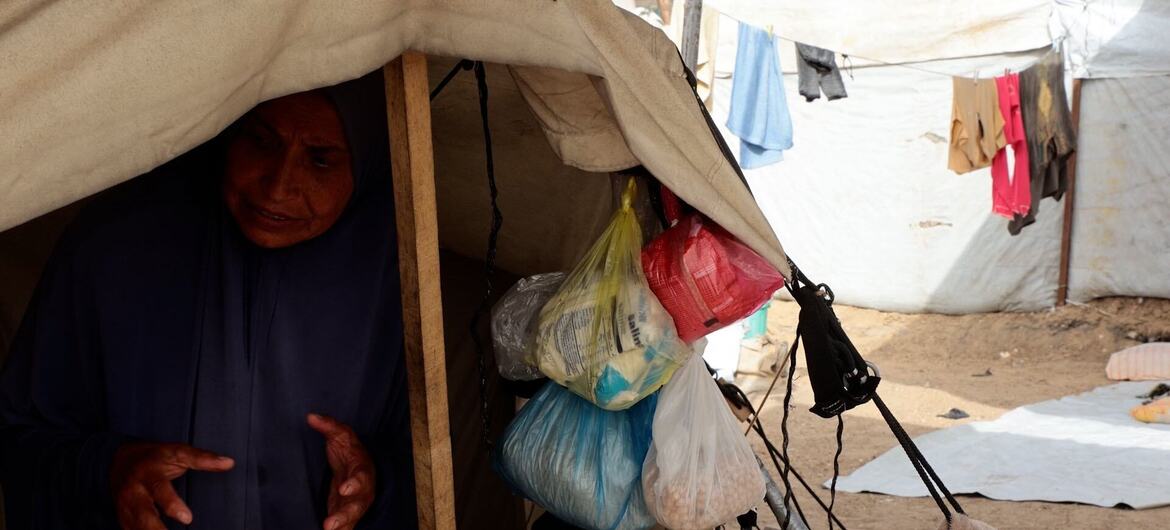
"This tent broke our backs; we can't even stand up in it. I feel like I'm in prison," she says, entering her flimsy makeshift home.
Pointing to a bag of bread hanging at the entrance to the tent, she told our correspondent: "We hang food so that it is away from mice. Mice and rodents sleep among us in the tent. This is more difficult suffering than the war itself."
Water scarcity
In a narrow corridor between the tents, Umm Ahmad stands in front of a small counter on which a bowl of soap and water has been placed for washing dishes and cups. Due to scarcity, families rely on storing water manually in plastic containers in quantities that do not meet daily needs.
"There is very little water, when it is available we can clean it. The possibilities are limited, as you can see, and the situation is disgusting. This is the life in tents."
UN partners on the ground report that access to water remains a major challenge, with three out of four families relying on truck deliveries. Humanitarian partners are delivering around 24,000 cubic metres of water this way every day through approximately 2,000 distribution points.
However, those deliveries depend on generators and machinery that are at risk of breaking down due to shortages of maintenance and repair supplies. Humanitarian organisations continue to stress that essential supplies must urgently be allowed into Gaza to prevent the collapse of critical equipment.
Life turned to rubble
Sitting on a small plastic barrel, Umm Ahmad recalls the spacious home and the life she once had: "We used to live in a five-storey house equipped with all the necessities of life, with apartments for our children to get married in, but it was destroyed by the war.
"We had everything, we were living in luxury and suddenly our lives were turned upside down and we are living in tents. This is our fourth displacement; we have been on the streets for three years now."
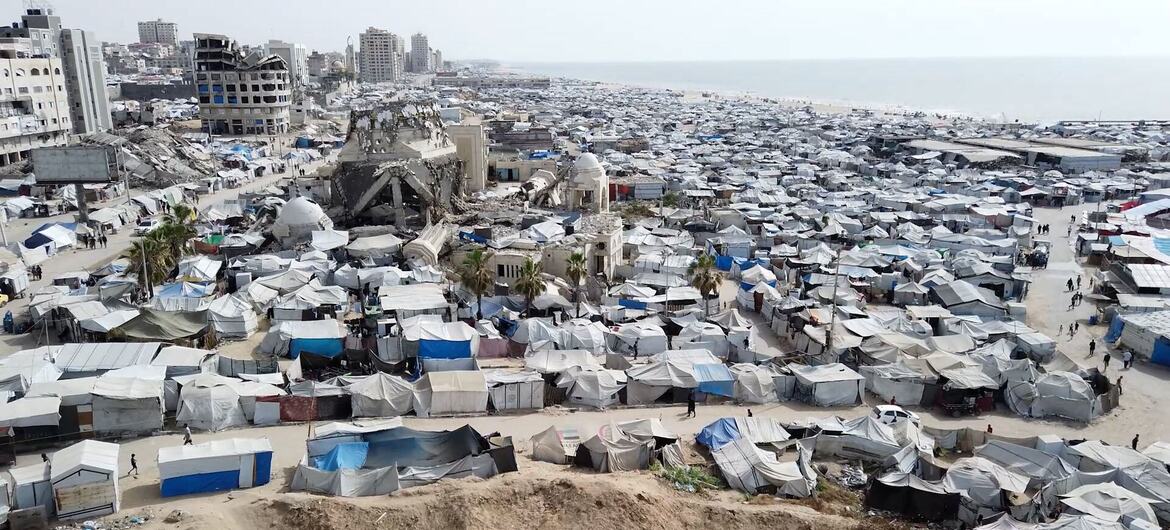
More than two-and-a-half years after Hamas attacked communities in southern Israel leading to a massive counter-offensive, the cloth tents scattered across Gaza are no longer merely temporary shelters for displaced people, but have become a prolonged daily reality for hundreds of thousands of Palestinians.
'Life of humiliation'
Overcome with frustration and sadness, she tells our correspondent: "No matter what I tell you, I can't describe what life is like in tents. In the winter, the tent was flooded with rain every day and the wind blew it. We re-erected it, and we couldn't dry our clothes or mattresses.
"In the summer, the suffering is even more severe due to mice, other rodents and insects. It's a life of humiliation; I can't take it anymore."
When our reporter asked her about privacy in the tents, Umm Ahmad said, "There is no privacy. We all crowd together in the tent. Now two of my sons are getting married, we are trying to pitch two tents for them, but the space is not enough. You can't imagine what we're experiencing. Bathrooms and sanitation are another matter."
The health situation in the enclave is devastating. 22 attacks on healthcare have been reported in Gaza this year and barely half of the hospitals are partially functional, while not a single hospital can be considered fully operational.
Umm Ahmad smiled only when her two grandchildren approached her and she began to comfort them. Where once there was space and plenty, life in the camp is a constant struggle to secure even the most basic necessities.


