
Like many people in the war-ravaged Gaza Strip, Ahmed Al-Omari is preparing for another winter of bitter cold and rain that threatens to cause flooding as families struggle to survive in tattered tents and damaged buildings.
He is racing against time, working with other young men to fill sacks that once held World Food Programme ( WFP ) flour with sand to protect their makeshift shelters from the rain.
"These are flour sacks that we used to retrieve from the jaws of death, so that we could eat," he told UN News, referring to the dangers of aid distribution in the Gaza Strip, where civilians have been killed while trying to obtain assistance.
"Now, they have become sacks that we fill with sand to act as barriers against rainwater," he explained. "We flood every year and we have put these sacks in place in the hope that, somehow, rainwater will not get inside."
Two million need better shelter
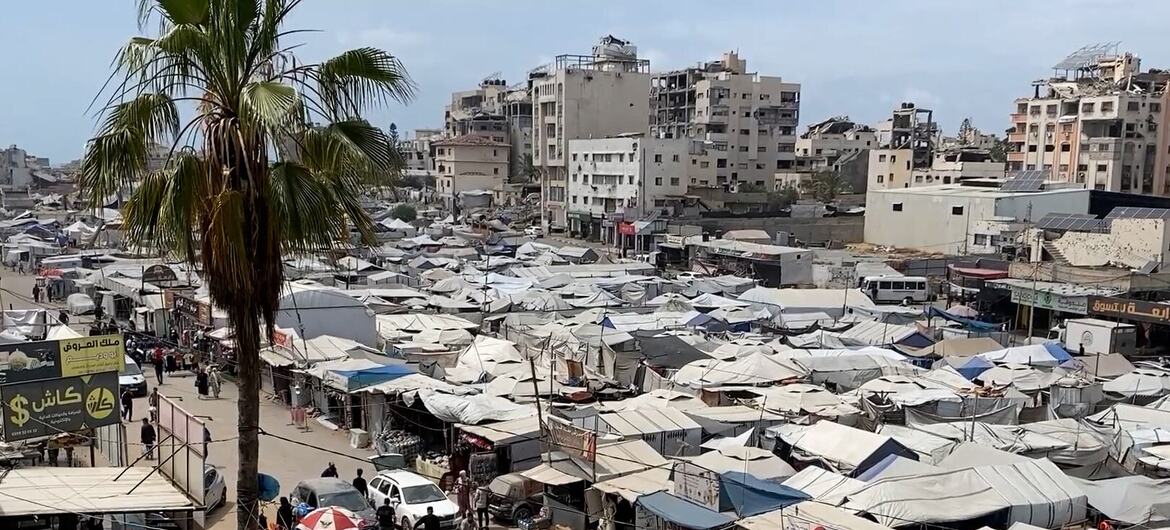
Around two million people in Gaza still need shelter assistance, according to the International Organization for Migration ( IOM ). Rain has already begun and an intensifying El Niño threatens more in the coming months.
Right now, agencies were working to get as much shelter material into the Strip as possible before winter, Karl Baker, IOM's regional crisis coordinator for Gaza, said from Amman, Jordan.
"We know that the rains have already begun and that the volume of goods that we have to get into Gaza is not going to meet the demands of the population," he said.
Funding shortages that began to decline in January have hampered preparations, Mr. Baker said.
"The funding has come a little later in the year. It is now arriving, but it's not at the scale needed to support what we estimate is 1.8 to 1.9 million people needing some sort of shelter assistance," he said.
Shipping routes disrupted
The continuing regional conflict is also disrupting supply chains. IOM relies on suppliers in countries including China, India and Pakistan, with goods routed through Jordan, Egypt and Israel before reaching Gaza.
"The other point, of course, is that the regional conflict seems to be only growing. That disrupts trade routes," Mr. Baker said.
As long as the global shipping is disrupted, it will delay the volume or the timing for goods to reach Gaza, he added.
Tents that last six months
Quality is another concern. In other emergencies, Mr. Baker said, IOM could provide more durable transitional shelter, such as plywood and relief housing units.
In Gaza, tents typically last only about six months. With people constantly displaced, they are often destroyed or left behind when families flee at short notice.
"Constantly moving a tent or a temporary structure has caused, I would say, a lack of quality for what is currently inside of Gaza," he said. "The quality needs to be enhanced with either more durable items or more goods, which currently help with temporary solutions."
An impossible choice
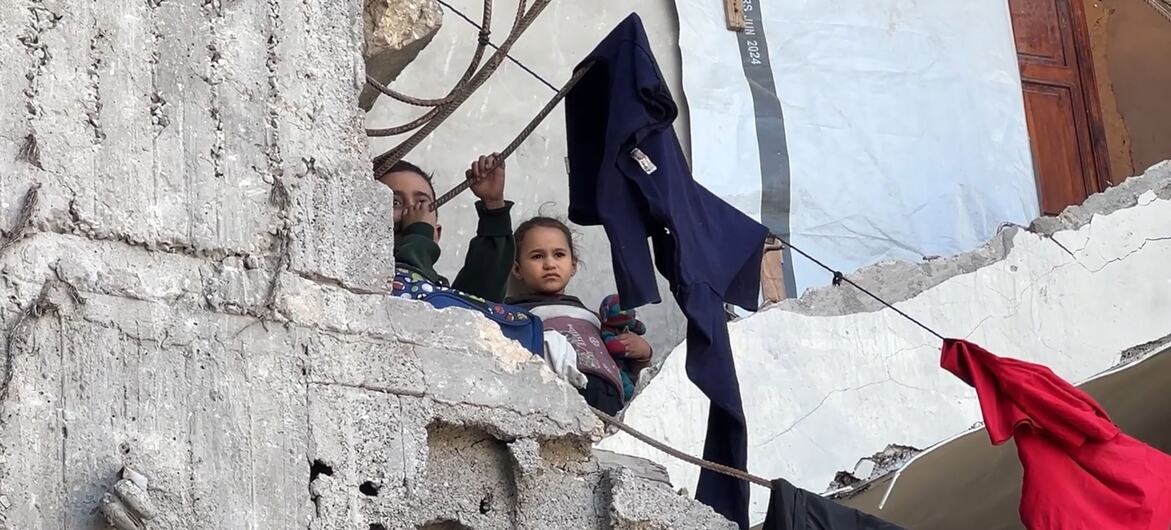
More than 4,000 buildings, many of them home to thousands of residents, are reportedly at risk of collapse.
Briefing the UN Security Council , Ramiz Alakbarov, acting Special Coordinator for the Middle East Peace Process, said the UN was working with local communities to evacuate people from unsafe buildings. With no alternatives, many had little choice but to seek shelter in tents.
Recalling a recent visit to Gaza, he described the impossible decisions facing families: leave the homes they had returned to or stay in buildings at risk of collapse.
Living space is also shrinking. Only around 30 per cent of Gaza is now accessible to most people, IOM's Mr. Baker said.
Conditions in displacement sites continue to deteriorate, humanitarian assessments show, with many exposed to flooding and few alternative places to go.
'New experiment'
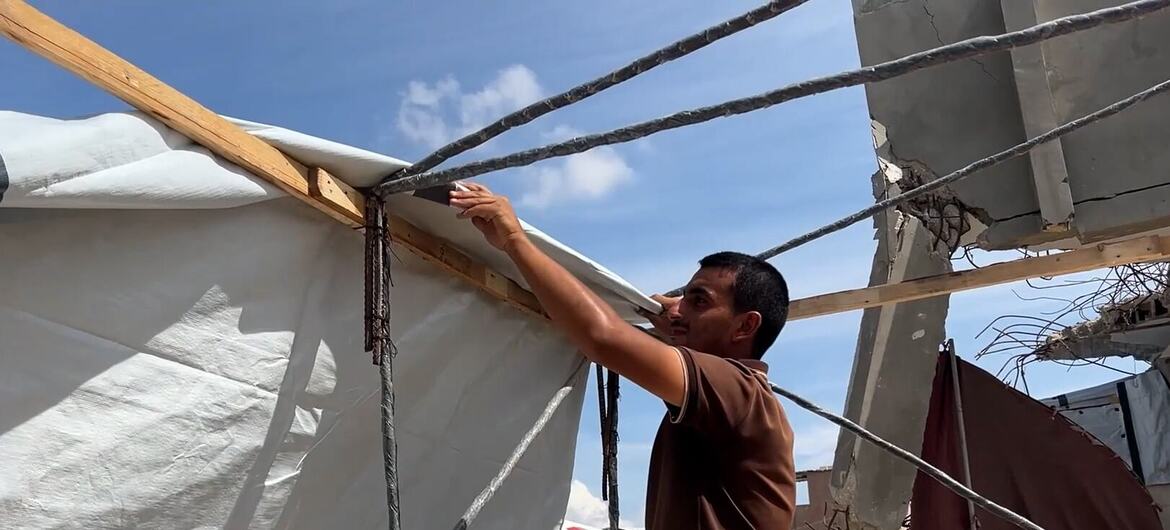
In Khan Younis, in southern Gaza, families are salvaging materials from the rubble. Displaced from Rafah, Mohammed Barhoum and his sons are using metal rods recovered from the wreckage to try to strengthen their shelter.
It is risky work amid unstable debris and explosive remnants of war.
"Every year during the winter, this area floods because of heavy rainfall," Mr. Barhoum said. "This year, we decided to reinforce our tents using metal rods. It is a new experiment, and we will see how it goes. We hope the situation will be better than it was last time."
Durable materials blocked
Most of the durable shelter materials IOM would normally use in emergencies fall under Israel's dual-use restrictions, which date back to 2008.
They include roofing sheets, cement for floors and stronger walls to withstand the wind - items that could make shelters more resistant to winter, but are often deemed a security concern.
Mr. Baker said IOM was in repeated contact with the Israeli authorities to negotiate their entry.
"It is an everyday occurrence, five times per day, as we try to negotiate or we try to make sure that we have actually either understood what their concern is and trying to adjust whatever that might be," he said.
"From our perspective, we must continue to advocate for more durable items to get in."


