
WMO joined global discussions on AI for early warnings at events in Brussels and India, focusing on standards, trust and cooperation to strengthen disaster preparedness.
The World Meteorological Organization (WMO) is strengthening international cooperation on the use of artificial intelligence (AI) to improve early warning systems and disaster preparedness through a series of global meetings and initiatives. These discussions brought together governments, United Nations agencies, researchers and private sector partners to examine how AI can support disaster risk reduction while maintaining trust in official forecasts and warnings.
Building trust and standards for AI
On 11 December 2025, WMO took part in the ITU-T Workshop on Resilience to Natural Hazards through AI Solutions in Brussels, jointly organized by the International Telecommunication Union (ITU) and the European Commission's Directorate-General for European Civil Protection and Humanitarian Aid Operations (DG ECHO). The workshop brought together civil protection authorities, European Union institutions, United Nations agencies, researchers and private companies to discuss how AI can support disaster preparedness and early warning systems.
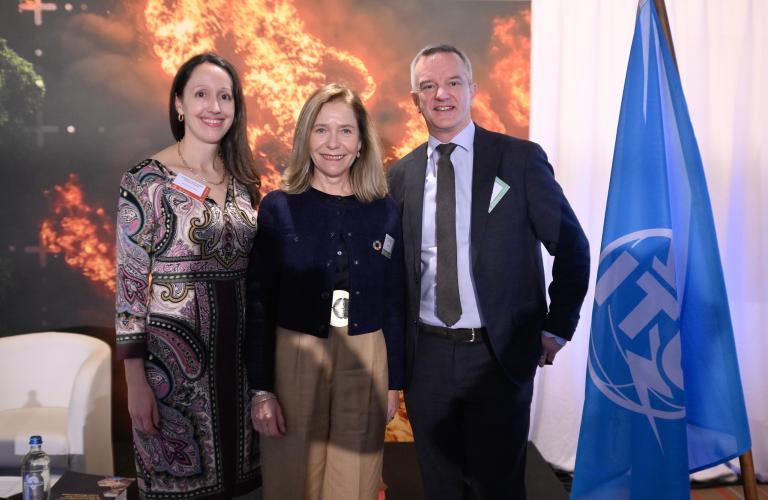
During the event, WMO Secretary-General Celeste Saulo emphasized the importance of ensuring that standards for integrating AI are grounded in sound science, transparency and equity. She also called for strengthened collective efforts to support the most vulnerable communities, so that they can effectively adopt, adapt and sustain early warning systems.
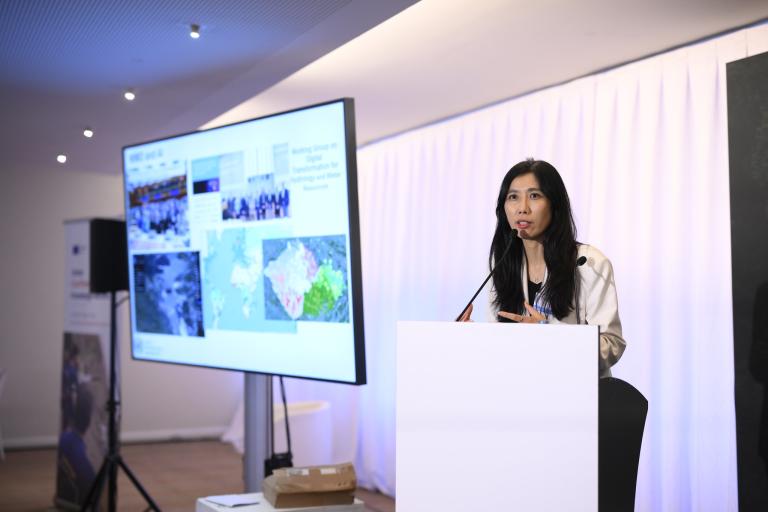
Véronique Bouchet, Senior Director of the WMO Department of Science, Services and Capacity Development (SSCD) highlighted how AI is already improving forecasting and hazard monitoring by making predictions faster and more affordable. She stressed that the National Meteorological and Hydrological Services (NMHSs) must remain the trusted and authoritative source of forecasts and warnings and that scaling AI in disaster risk management will depend on closer cooperation between public and private partners.
Image 2: Dr Véronique Bouchet, Senior Director, Senior Director, SSCD, WMO, during the interactive high-level panel on "Building Capacity on AI for Disaster Preparedness".
WMO also organized an interactive exercise during the workshop, moderated by Dr Hwirin Kim, Chief of the WMO Hydrological Modelling and Forecasting Section (HMF), which highlighted the importance of trust, collaboration and information sharing between stakeholders within the early warning system value chain.
The workshop was followed on 12 December by the third meeting of the Global Initiative on Resilience to Natural Hazards through AI Solutions , led by ITU. As a founding member of this initiative, WMO supports efforts to develop international standards and governance frameworks that ensure trustworthy, safe and interoperable AI applications in weather, climate, and hydrological services.
Using AI to manage water-related risks
The AI Impact Summit India , held in New Delhi from 16 to 21 February 2026, provided another platform to advance global discussions on the use of AI for climate resilience and disaster risk reduction. Climate-related risks and early warning systems featured prominently in the agenda.
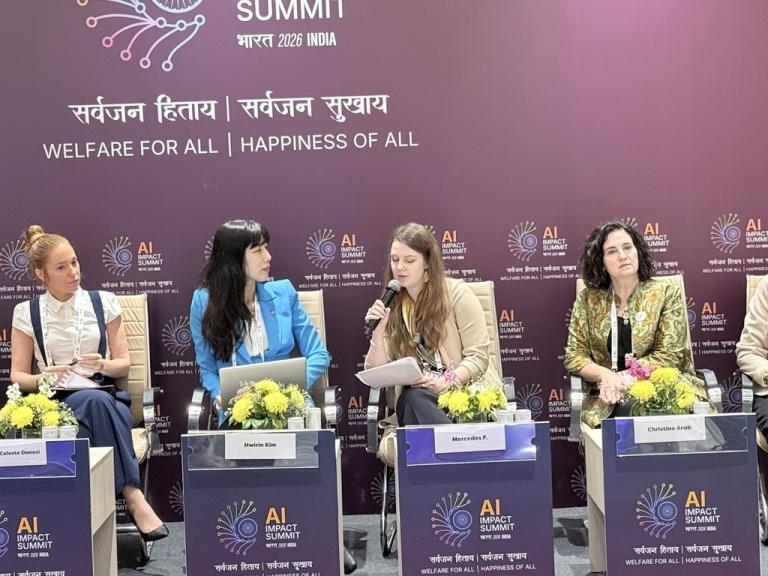
WMO contributed to discussions on how data sharing and AI collaboration can support public good, particularly in water management. The organization's global frameworks and data exchange systems form the backbone of international cooperation in weather, climate and hydrological information.
These efforts align with the United Nations Early Warnings for All Initiative , which brings together partners across sectors to strengthen disaster resilience. Integrating AI into existing observation and forecasting systems can help NMHSs strengthen response to disasters such as floods, droughts and broader water resources issues.
The discussions highlighted that AI can strengthen early warning systems and disaster preparedness, but only if supported by strong partnerships and trusted institutions. WMO plays a central role by setting standards, enabling data exchange and supporting Members in integrating AI and other technologies into operational forecasting while reinforcing the role of NMHSs as the authoritative source of early warnings.


