From aid convoys in conflict zones to passenger jets and cargo ships far out at sea, safe journeys depend on GPS, satellite navigation and old-fashioned radio transmissions. But these signals are increasingly being blocked or faked - and civilians are paying the price.
Those signals travel through the electromagnetic spectrum, which also underpins modern military operations and has become a battleground in its own right.
The more we rely on these technologies, the more exposed we are to interference, manipulation and disruption, Federico Mantellassi, a researcher in the Security and Technology Programme at the UN Institute for Disarmament Research (UNIDIR) has told UN News.
Jamming and spoofing
The two main threats are jamming, which blocks signals, and spoofing, which feeds systems false ones.
UNIDIR estimates suggest GPS spoofing in civil aviation rose by 500 per cent between January and August 2024, affecting hundreds of flights.
In early 2026, the crisis in the Middle East saw the highest concentration of maritime jamming on record.
Mr. Mantellassi recently moderated a session on these disruptions and what they mean for peace and security at UNIDIR's 2026 Innovations Dialogue in Geneva.
What is the electromagnetic spectrum?
The spectrum covers the full range of electromagnetic waves, from radio waves and microwaves to infrared, visible light, X-rays and gamma rays.
Armies and other branches of the military increasingly depend on the spectrum to connect their systems for surveillance, data transmission, weapons guidance and battlefield networks.
The UNIDIR expert noted that "the military use of the electromagnetic spectrum dates back to the early 20th century, coming of age in the Second World War. What has changed is the exponential growth in the number of devices and systems that emit and receive signals and depend on continued access to the spectrum."
Knock-on effects for civilians
Electronic warfare on the front line may not always affect civilians directly. But when conflict comes closer to everyday life and commerce, Mr. Mantellassi warned, the knock-on effects can be widespread.
Earlier this year, during the war sparked by US-Israeli attacks on Iran, media reports showed a rise in spoofing and jamming in the Gulf of Aden and the Strait of Hormuz, increasing the risk of collisions at sea.
Disruption can also leave aid workers, peacekeepers and emergency services unable to rely on navigation and communications. It can hit mobile and internet services, rescue efforts, public transport and financial systems.
"Those types of services and humanitarians are really suffering and visibly seeing the cascading effects of increased disruption," he said.
"The same effects can be felt in aviation operations where it's already a very complex operational environment," he explained, with aircraft positioning systems giving the wrong location and pilots forced to fall back on other instruments.
"We just had a conference and one of the speakers from the international civil aviation agency ( ICAO ) said that if you have ever taken a flight, it's very likely that you have been on a flight that has been jammed or spoofed," he added.
AI enters the equation
The UN has long warned of the risks of artificial intelligence (AI), and the Security Council will discuss threats from emerging technologies at a high-level meeting later this month.
An arms race in AI-powered weapons is now emerging in the spectrum too. This is particularly worrying where machines are left to identify and select targets and carry out attacks without any human oversight.
As jamming and spoofing spread, Mr. Mantellassi said, militaries are adapting, fuelling a cycle of measures and countermeasures.
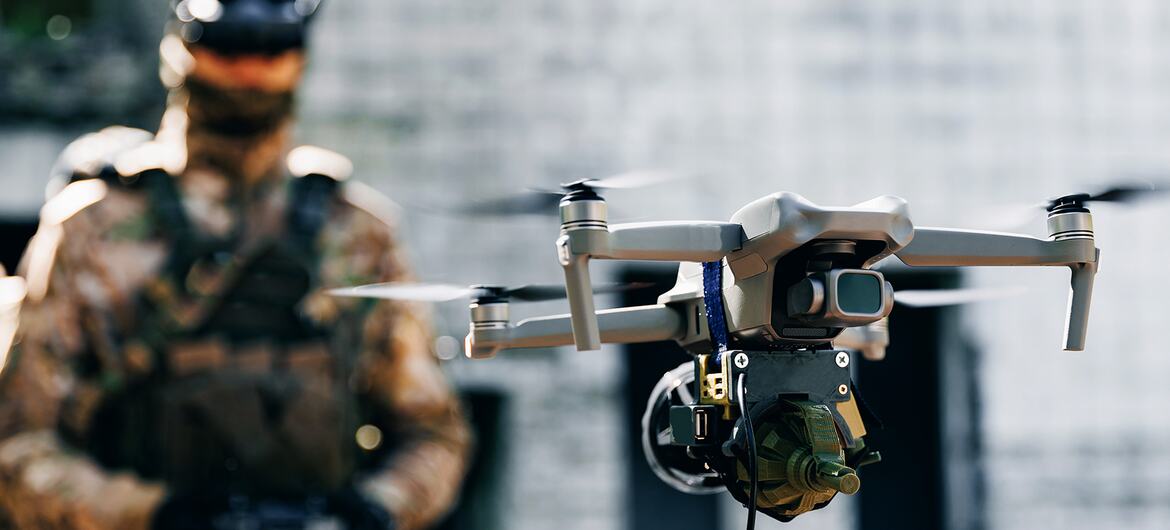
"One of the key justifications in adding artificial intelligence (AI) to weapons systems is that when the environment is denied through jamming and spoofing, and you cannot have a radio link to control a drone, then you are going to rely on AI for that drone to navigate, select and sometimes engage targets, and not have to rely on a connection," he said.
Who sets the rules?
The International Telecommunication Union ( ITU ) allocates radio frequencies to different services, manages interference between countries and sets binding international rules on their use.
"When interference occurs, Member States can report incidents to the ITU, which provides mechanisms for coordination, dispute resolution, and escalating responses," Mr. Mantellassi said.
But the ITU's rules exclude military uses of radio frequencies, so these frameworks largely stop where military activity begins.
"Obviously, there is International Humanitarian Law, which governs armed conflicts, and different types of activities still have to abide by international humanitarian law."
"So, there's a framework that still applies. But it is clearly a little more complicated."
An emerging priority
Mr. Mantellassi said the disruptions, and the responses they provoke, deserve the attention of the disarmament community.
Through its Innovations Dialogue, UNIDIR has in recent years explored AI, quantum technologies and neurotechnologies. Disruption to the electromagnetic spectrum is its latest focus - an issue that matters not only for disarmament, but for public safety too.