
Lithium, nickel, copper, and cobalt are often framed by States and industries as "critical minerals" - a reflection of political priorities rather than actual societal needs. As the demand for these minerals is predicted to grow for energy transition technologies as well as other sectors, such as big tech and the military sector, its supply chains have become a geopolitical battleground. This has governments scrambling to control supply chains, while companies opportunistically pursue extraction, which can infringe on the ancestral lands of Indigenous Peoples, and risk the destruction of vital ecosystems.
We must achieve an ambitious, Paris Agreement-aligned energy transition that safeguards critical ecosystems and centers the rights of Indigenous Peoples and those of local communities. But it requires the right political choices and moral leadership.
"Beyond Extraction: Pathways for a 1.5°C-aligned Energy Transition with Less Minerals", is a collaboration between Greenpeace International and the Institute for Sustainable Futures at the University of Technology Sydney.
The study focuses on nine key energy transition minerals: cobalt, copper, dysprosium, graphite, lithium, manganese, neodymium, nickel, and vanadium.
Scenario analysis was used in this study to explore how different technological and policy pathways can shape future mineral demand from 2024-2050.
The scenarios are:
1) One Earth Climate Model Net Zero (OECM), aligned with the Paris climate goals and set as a base case for the study;
2) Progressive (PRO), and
3) Progressive Accelerated Sodium-ion Battery (PRO-Na-ion).
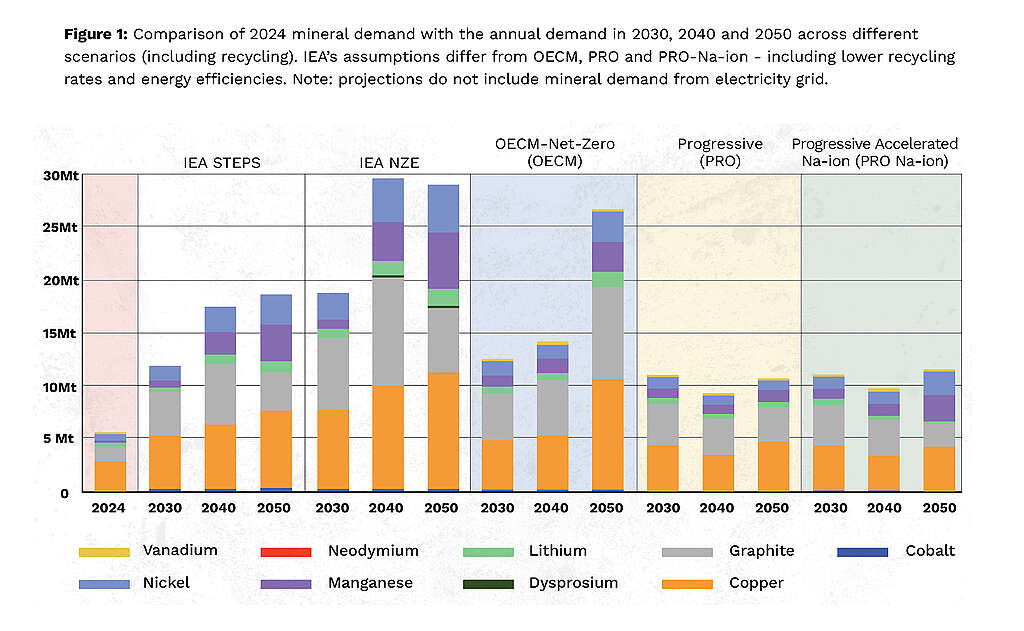
This global research – the first of its kind – shows that we can power an ambitious energy transition without sacrificing crucial ecosystems – whether on land or at sea. More public transportation, ambitious recycling programmes, and battery technology choices all contribute to reducing the mineral demand for energy transition.
In an era of fraying international cooperation and intensifying conflict, this research underscores the importance of coordinated action to protect people and nature from the minerals "rush", and achieve climate objectives. Responsible political leadership must prioritise mineral use for essential energy transition purposes and ensure that rights are respected, and peoples' land access and livelihoods are protected.
Download the report and other materials:
Download the research briefing.
Download the report "Beyond Extraction: Pathways for a 1.5°C-aligned Energy Transition with less Minerals".
Download supplementary documents:
1) development of a restricted areas map and
2) minerals mapping approach and integration (reserve Proxy Area analysis)


