
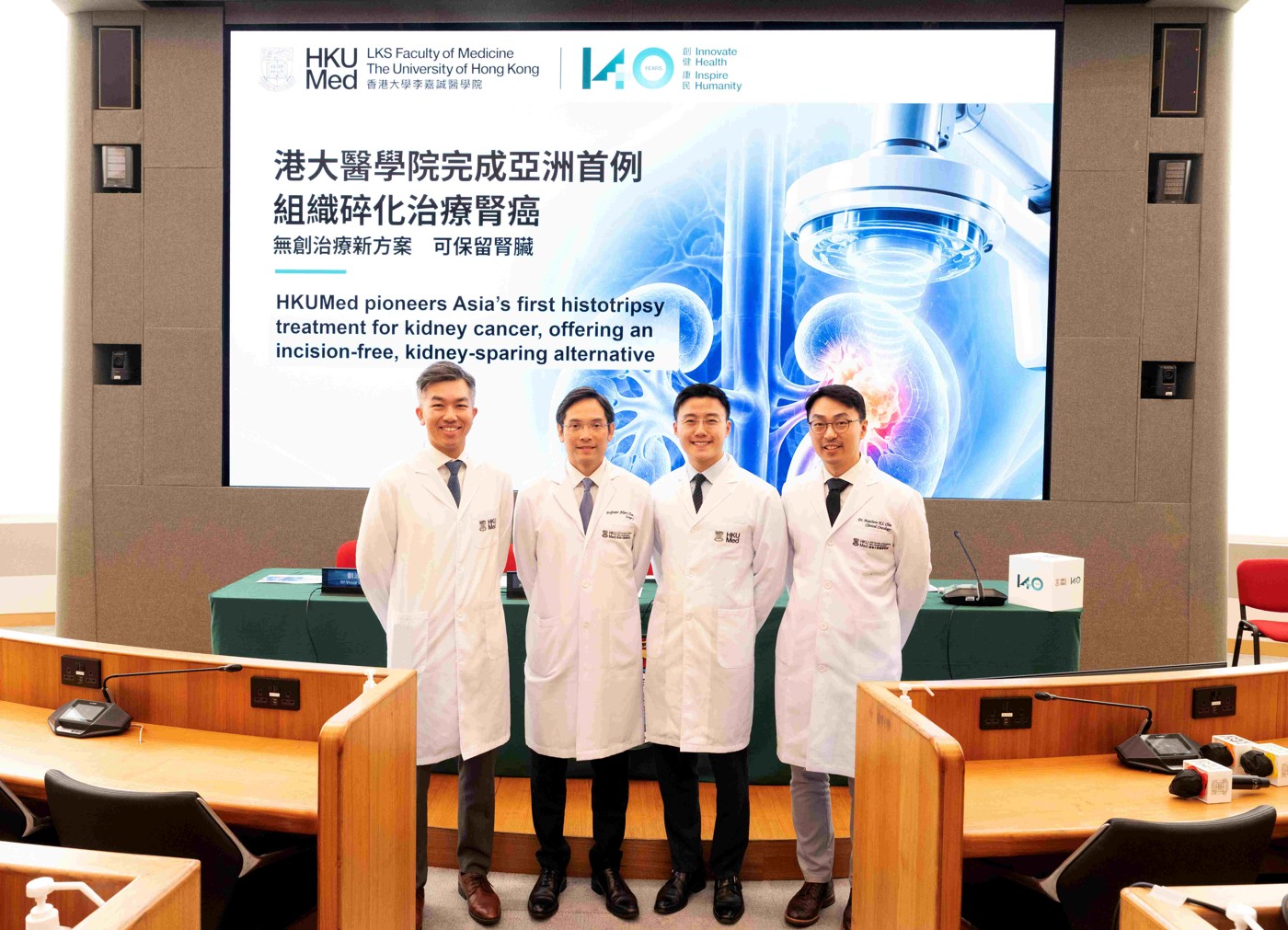
A research team led by the Department of Surgery, School of Clinical Medicine, LKS Faculty of Medicine, the University of Hong Kong (HKUMed), has performed Asia's first histotripsy treatment for kidney cancer. The team successfully carried out this incision-free, kidney-sparing procedure on two patients, who were discharged the following day without any wounds, allowing them to resume their daily activities, while maintaining stable kidney function. This milestone, part of an HKUMed-Gleneagles (Gleneagles Hospital Hong Kong) collaborative clinical trial, marks a significant leading edge for HKUMed in the treatment of renal cell carcinoma (RCC), and provides a strong foundation for the team's future contributions to the international understanding on histotripsy as a non-invasive, kidney-sparing option for kidney cancer treatment.
The HKUMed-Gleneagles collaborative clinical trial
In August 2024, supported by a generous donation from the Li Ka Shing Foundation, HKUMed became the first institution in Asia to introduce histotripsy for treating liver cancer. Building on this experience, the HKUMed-Gleneagles histotripsy clinical trial recently expanded to include kidney cancer, followed by magnetic resonance imaging (MRI) to evaluate treatment effect.
On 13 October 2026, histotripsy for kidney cancer (i.e. primary renal cell carcinoma) was performed for two patients at Gleneagles. The patients, aged 70 and 71, each had a small (approximately 2 cm) kidney tumour, diagnosed by both imaging and biopsy. They both successfully underwent histotripsy, which took less than one hour each. With no wounds and no observable complications, both patients were discharged the following day and resumed daily activities. In particular, one of the patients had major abdominal surgery 10 years prior, making this incision-free treatment option particularly favourable. At the follow-up consultation two weeks after histotripsy, their kidney function was found to be stable.
Histotripsy breaks down tumours with microbubbles
Histotripsy is a non-invasive, non-thermal treatment that involves no skin incisions or radiation. Guided and monitored by real-time ultrasound imaging, focused ultrasound pulses from outside the body create clouds of microbubbles within the tumour. These clouds rapidly expand and collapse, mechanically liquefying and destroying the tumour tissue.
Performed under general anaesthesia, the procedure requires no incisions or needles to reach the tumour, leaving no wounds. Early research suggests that it may also stimulate an anti-cancer immune response.
'Histotripsy is a potentially valuable treatment option for selected patients with RCC. Its main advantages are that it does not involve any skin incisions, and allows patients to return to normal activities quickly,' said Dr John Leung Shung-lai, Clinical Assistant Professor, Department of Surgery, School of Clinical Medicine, HKUMed, and urology lead of the study. 'However, it is important to note that histotripsy for kidney cancer is still investigational. HKUMed remains committed to conducting responsible clinical research to achieve the best possible outcomes for patients.'
Dr Leung added that HKUMed is actively inviting suitable patients to participate in this histotripsy clinical trial. Eligibility depends on criteria such as tumour size and location, and every patient will be carefully evaluated by the clinical team.
A landmark first-in-Asia sets a new benchmark for kidney cancer care
Professor Albert Chan Chi-yan, Clinical Professor and Li Shu Fan Medical Foundation Professor in Surgery, Department of Surgery, School of Clinical Medicine, HKUMed, remarked, 'With a series of first-in-Asia milestones in liver and pancreatic cancer, HKUMed will continue to contribute to the international evidence on histotripsy as a safe, non-invasive and effective cancer treatment. We have shown that innovation and patient safety can go hand in hand. By offering incision-free treatment and sparing healthy tissue, we aim to bring changes to the way how solid-organ cancer could be treated in the future.'
Kidney cancer: a growing health challenge in Hong Kong
Kidney cancer incidence in Hong Kong has increased over the past decade. In 2023, the Hong Kong Cancer Registry recorded 598 new cases of kidney cancer and cancers of other urinary organs excluding the bladder in men, equating to a crude incidence rate of 17.4 per 100,000 males and making it the seventh most common cancer among men. Risk factors include smoking, obesity and high blood pressure. Early kidney cancer often causes no symptoms, but some patients present with blood in the urine, pain in the loin, or an abdominal lump.
About the research team
The study is led by Dr John Leung Shung-lai, Clinical Assistant Professor, Department of Surgery; Dr Matthew Chiu Kin-liang, Clinical Assistant Professor, Department of Clinical Oncology, Centre of Cancer Medicine; Dr Vince Lau Wing-hang, Honorary Clinical Associate Professor, Department of Diagnostic Radiology; and Professor Albert Chan Chi-yan, Clinical Professor and Li Shu Fan Medical Foundation Professor in Surgery, Department of Surgery, all from the School of Clinical Medicine, HKUMed. All procedures were performed at Gleneagles.


