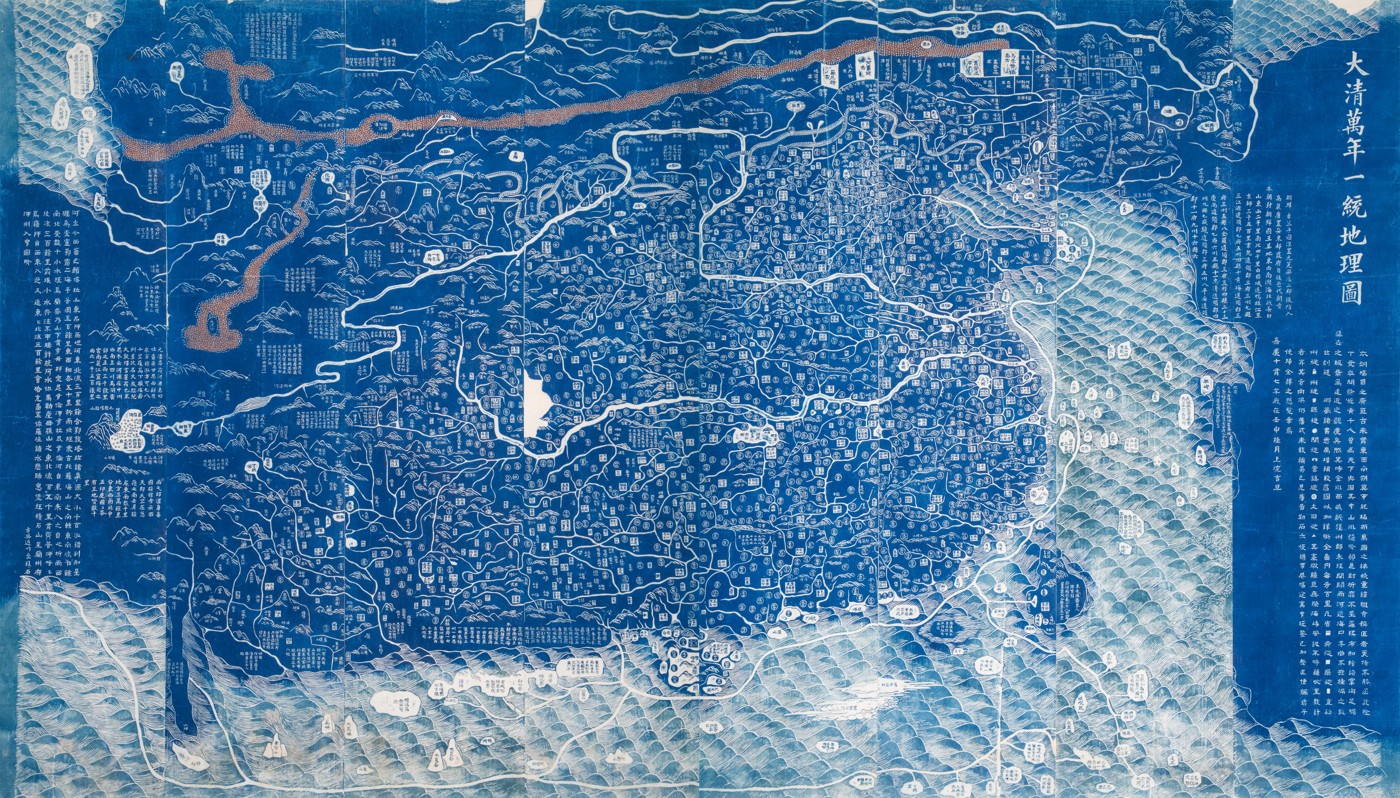
The Faculty of Arts (HKUArts) and the University Museum and Art Gallery (UMAG) of The University of Hong Kong (HKU) will organise an event on 19 November 2026 to celebrate the recent donation of a rare Terrestrial Map of China of the late Qing dynasty from the John and Eunice Yung Collection. The historic map has become part of HKU's collection, serving as a valuable resource for scholars and the public. The event will also mark the official unveiling of its digital twin, demonstrating how emerging technologies can support the preservation, interpretation, and accessibility of delicate cultural heritage.
Terrestrial Map of China of the late Qing dynasty is a significant historical artefact that offers valuable insights into geographical knowledge and cartographic practices of China during the Qing dynasty. Details of the donated map are provided below:
HUANG, Qianren (1694-1771), Da Qing wannian yitong dili tu [Geographical Map of the Everlasting Unified Qing Empire], Printed in a blue colourant, most likely the pigment known as 'Prussian blue', these maps were an early large-scale application of this colourant in China. 'Gusu' [Suzhou]: September 1812
This legendary Geographical Map of the Everlasting Unified Qing Empire is one of the rarest, largest, and most aesthetically magnificent Chinese maps ever made. Maps of this series are generally known as Complete Maps of All Under Heaven. They dominated Chinese cartography during the Jiaqing reign (1796-1820), and their influence persisted through the Daoguang reign (1820-1850). Published in 1812, the seventeenth year of the Jiaqing reign, and drawn by Huang Qianren (1694-1771), the map is of exceptional importance. Huang Qianren updated and expanded an earlier map, Map of the Realm, drawn by his grandfather Huang Zongxi (1610-1695), a great figure of the Chinese Enlightenment. He added more detail and wider coverage, including Jinchuan (now part of Sichuan), Tibet, and Xinjiang. The map's printing technique is also unusual. It is printed in the opposite manner, in the Chinese style of rubbings, whereas typical map printing places the outlines and text on a white ground. The combination of size, colour, and format made these maps unique objects, and their visual impact quickly made them popular in China and Japan.
Guided by Professor John Wong, Associate Dean (Undergraduate), Professor Loretta Kim, Associate Professor and Head of the School of Modern Languages and Cultures, and Professor Ji Li, Associate Professor, Department of History from HKUArts, and supported by Dr Florian Knothe, Director, University Museum and Art Gallery, who provided expertise on the map's historical significance, the project was led by Cole Wong, a Year 4 Bachelor of Arts in Humanities and Digital Technologies student. With technical support from colleagues at the Arts Technology Lab, the project employed advanced imaging, digitalisation, and interactive technologies to create a detailed digital representation of the original artefact. This innovative approach enables close examination of the map while minimising physical handling of the fragile original.
The initiative reflects the University's ongoing commitment to integrating the arts, humanities and technology to develop innovative approaches to cultural stewardship, heritage preservation and knowledge dissemination.
Media representatives are cordially invited to attend the following events on 19 November 2026:
Event Programme
2:00 p.m. - 3:00 p.m.
Donation Ceremony (Invited guests and media representatives only)
Venue: University Museum and Art Gallery, 1/F Fung Ping Shan Building, 90 Bonham Road, Pokfulam, Hong Kong
3:15 p.m. - 4:15 p.m.
Unveiling of the Digital Twin of the Terrestrial Map of China (Invited guests and media representatives only)
Venue: Arts Technology Lab, Room 4.35, 4/F, Run Run Shaw Tower, Centennial Campus, The University of Hong Kong
4:30 p.m. - 5:30 p.m.
Public Lecture and Roundtable Discussion (Open to the public)
Venue: Room 4.36, 4/F, Run Run Shaw Tower, Centennial Campus, The University of Hong Kong
Public lecture and roundtable discussion co-organised by Faculty of Arts, HKU; Institute of Chinese Studies, The Chinese University of Hong Kong; École Française D'Extrême-Orient; Research Centre for Chinese History and Culture, The Hong Kong Polytechnic University and Department of Chinese, Lingnan University, featuring experts in Chinese history.
About the Faculty of Arts (HKUArts)
HKUArts is one of the flagship faculties of the University of Hong Kong (HKU) and is an internationally renowned and leading humanities faculty. It is ranked 1st in Hong Kong and 19th in the world in Arts and Humanities in the QS World University Rankings by Subject 2026. HKUArts' presence amongst the best institutions in the world is evidence of its exceptional record in achieving academic excellence, and it strives to attract and nurture outstanding scholars and students from around the world through excellence and innovation in teaching and learning, research, and knowledge exchange. (https://arts.hku.hk/)
About the University Museum and Art Gallery (UMAG)