
The Houthi armed group on October 18, 2026, used explosives to severely damage a critical road into Yemen's besieged city of Taizz, putting civilian lives and welfare at increased risk, Human Rights Watch said today.
The Hayjat al-Abd road has been the main entry point for food, medicine, and fuel to reach residents of Taizz city, which the Houthis have besieged since 2015. Fighting in the area has primarily been between the Houthis and forces aligned with Yemen's internationally recognized government. The Houthis' deliberate destruction of segments of the road, if intended to disable infrastructure indispensable to civilian survival, would violate the laws of war and amount to a war crime. The attack may also have caused disproportionate civilian harm.
"The Houthi attack on the remaining commercial supply route to besieged Taizz further endangers civilians already struggling with severe shortages of food, water, medicine, and fuel," said Niku Jafarnia, Yemen and Bahrain researcher at Human Rights Watch. "If Taizz residents' access along this vital route is cut off for a prolonged period, they could face even greater risks to their lives and well-being."
Human Rights Watch spoke to eight informed sources in October about two attacks on the road and their aftermath, including civil society workers and a relative of a witness to the October 18 attack. Human Rights Watch also analyzed satellite imagery and verified photographs and a video from sources or posted on social media. In 2024, Human Rights Watch spoke with six Taizz residents about the difficulty of meeting basic needs during the Houthi siege.
Human Rights Watch wrote to the Houthis on October 21 about attacks on the road but did not receive a response.
Control over Taizz has been divided since 2015, when Houthi forces entered the governorate and surrounded its capital, Taizz city, Yemen's third largest city. The city has remained under Yemeni government control, but the Houthis have cut off vital roads connecting it to the rest of the country, notably the port city of Aden, the Yemeni government's current capital.
While the laws of war do not prohibit sieges directed at military objectives, besieging forces are prohibited from using starvation of civilians as a method of warfare and must allow and facilitate humanitarian relief. Human Rights Watch has found that the Houthis' blocking of roads into Taizz has severely restricted civilians' ability to move in and out of the city and impeded the flow of essential goods, including water, and humanitarian access to the civilian population.
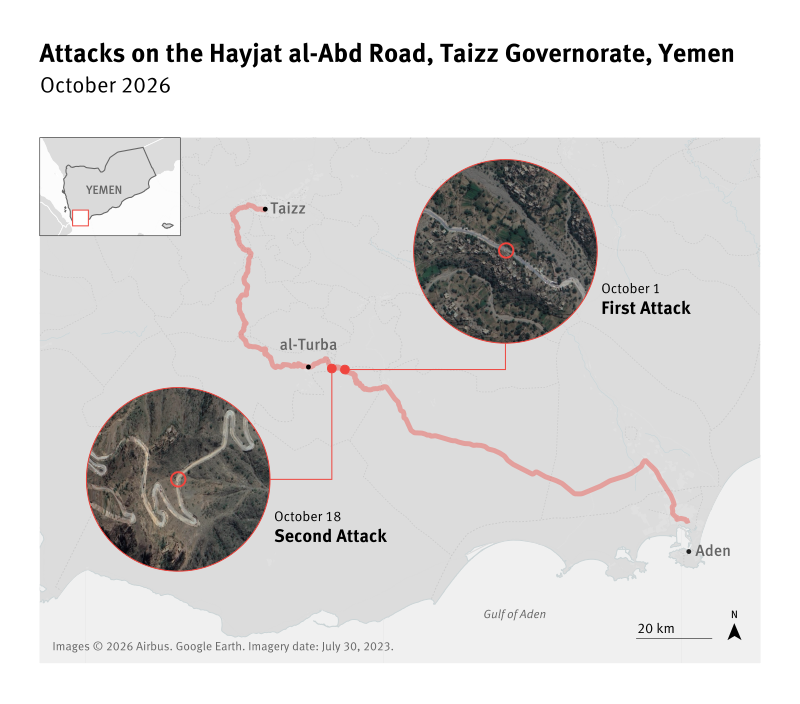
At about 4:00 a.m. on October 18, Houthi forces detonated explosives on the Hayjat al-Abd road in the town of al-Turba, significantly damaging a portion of the road. Residents in the area as well as two other informed sources said that the Houthis had been in control of al-Turba, about 75 kilometers south of Taizz city, since October 4. Since then, there had been no ground fighting in the area, including on the night of the attack. Nor had there been any indications that government forces or other armed groups were trying to re-enter the area, indicating that there was not another group that could have carried out the attack.
Another source said his relative told him: "It was a massive and terrifying explosion-everyone woke up. Rocks reached all the way to my house."
Human Rights Watch verified and geolocated four photographs and a video from sources showing a damaged culvert on the switchbacks of the Hayjat al-Abd road. The damage is consistent with a subsurface detonation of explosives.
Two weeks earlier, apparent Houthi forces had attacked the Hayjat al-Abd road about 85 kilometers southeast of Taizz city. A civil society worker in Taizz who spoke with several people knowledgeable about the attack said that on the night and early morning of September 30-October 1, Houthi forces and Yemeni government-aligned forces fought on several fronts around Taizz. The sources said that Houthi forces infiltrated and reached the Hayjat al-Abd road, placing and detonating explosives in a culvert under the road just past Souq al-Wahati, a local market. The Houthi forces then withdrew.
Two other sources gave similar accounts based on communications with local residents. Human Rights Watch was unable to conclusively determine that Houthi forces carried out the attack.
Human Rights Watch verified and geolocated two additional photographs posted on social media on October 1 showing a damaged culvert on the Hayjat al-Abd road at the village of al-Muharraqah, where the road starts ascending to Taizz city. The damage to the culvert in the images is consistent with a subsurface detonation of explosives. Satellite imagery captured at 6:57 a.m. on October 1 shows damage to the culvert across the full width of the road.
Government forces quickly retook the area after the first attack and later filled the destroyed portion of the road with dirt to allow vehicles to cross. Two sources said that government authorities had largely closed down the road to avoid further attacks on vehicles, though some vehicles continued to pass through.
Since the October 1 attack, all roads into and out of Taizz have largely been blocked by Yemeni government-affiliated and Houthi forces due to hostilities. However, before the second attack, some supplies, including flour, had still been taken to Taizz city on the Hayjat al-Abd road, said two civil society workers in the area.
However, the United Nations World Food Programme (WFP) said on October 14 that they had not been able to access the "more than 600,000 people in Taiz who depend on humanitarian assistance," which was "especially alarming" since most of Taizz's districts are considered to have emergency levels of hunger. The WFP also said that "wheat flour stocks are nearly exhausted" in the city and that "remaining food supplies in local markets may last only a short time if access constraints continue."
Under international humanitarian law, roads are presumptively civilian objects that become military objectives if by their nature, location, purpose, or use, they make an effective contribution to military action and their destruction, capture, or neutralization provides a definite military advantage at the time. Even if the Hayjat al-Abd road qualifies as a military objective, an attack would be unlawfully disproportionate if the expected incidental civilian harm would be excessive in relation to the concrete and direct military advantage anticipated. Given the road's critical role in Taizz city civilians' access to food, water, medicine, and other basic needs, the assessment should account for the reasonably foreseeable consequences of damaging or closing it.
The Houthis should have known, particularly given the UN's repeated warnings, that supplies in Taizz were running out and that further closures after October 1 from attacks on the road could have grave effects for besieged Taizz civilians relying on the road for necessities.
International humanitarian law also prohibits attacking, destroying, or rendering useless objects indispensable to the survival of a civilian population. The October 18 attack disrupted the remaining major commercial supply route to Taizz city. Whether it violated this prohibition depends on whether it was carried out for the purpose of denying civilians access to objects indispensable to their survival.
Serious violations of the laws of war ordered or committed with criminal intent-that is, deliberately or recklessly-are war crimes.
"The fighting in Taizz could have dire consequences for the hundreds of thousands of civilians in need of aid," Jafarnia said. "All warring parties should take care to protect civilians in


