
Green skills are moving from the training room towards classrooms, campuses and institutional practice as TVT trainers, university instructors and labour and skills experts identify concrete ways to prepare learners for Ethiopia's transition towards a greener economy.
Through its Global Skills Programme in Ethiopia, funded by Norway through Norad, the ILO brought together participants from Wolaita Sodo University, TVT institutions and labour and skills offices for four days of learning in Arba Minch from 20 to 23 October 2026.
The training focused on how skills systems can respond to the opportunities and challenges created by the green transition. Participants explored changing occupations and skills needs, green jobs, worker protection, environmental sustainability, green enterprises and the role of TVT in supporting a just transition.
What emerged from the interviews was a strong intention to translate learning into action within institutions, classrooms and communities.
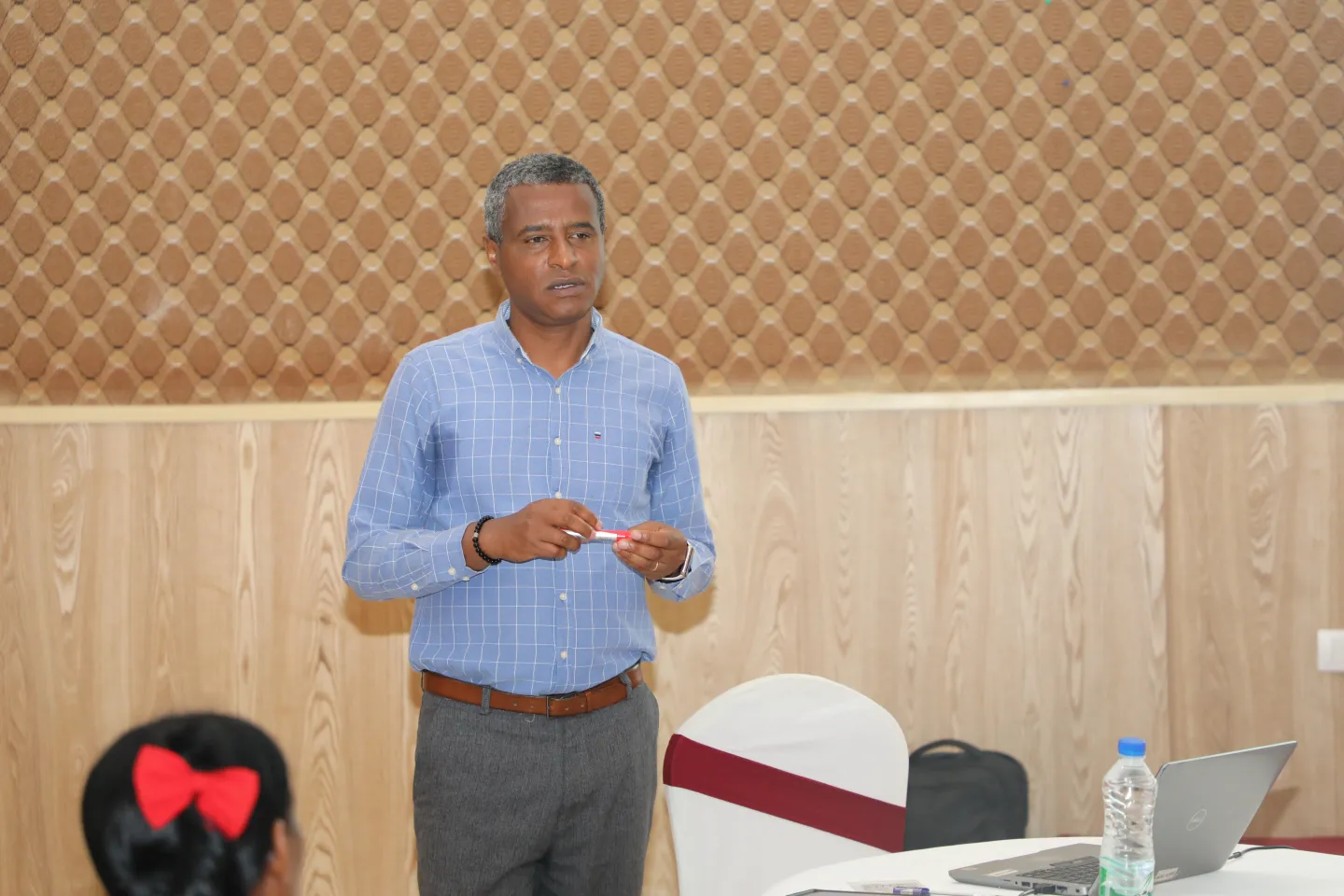
© ILO/Homa M Ejeta
Greening institutions starts with changing attitudes
For Dr Abriham Shumbulo, Director of Community Engagement at Wolaita Sodo University, one of the strongest lessons from the training was that greening needs to reach across the entire institution and beyond.
He identified green skills, green curricula, green research, green institutions, and a greener society and culture as connected areas that need to move together.
"I want to take this beyond the training room. At Wolaita Sodo University, I will work to integrate green skills into our teaching, research and community engagement, while raising awareness among students and staff so that greening becomes part of our institutional culture."
Dr Abriham also plans to use university communication channels, including media and social platforms, to promote wider understanding of green skills and green jobs.
For him, institutional change begins with awareness and attitudes, but it must also be reflected in the way universities teach, conduct research and engage with the communities around them.
Bringing sustainability into teaching and daily practice
For Frehiwot Tamru, Head of Department at Wolaita Sodo University, the training reinforced the need to connect environmental sustainability with both education and everyday behaviour.
"I want our students to learn green skills not only in theory, but through what they practise every day. I will work to integrate sustainability into teaching and practical training, while promoting better waste management and more efficient use of water and energy on campus."
Frehiwot also sees curriculum reform as an important next step. She emphasized integrating green skills and environmental sustainability into curricula and practical training, strengthening collaboration with industry and expanding hands on learning opportunities.
She also highlighted the need to prepare students for emerging green job opportunities and to ensure that people are not left behind as the economy becomes greener.
Her plans show how environmental sustainability can become part of both what students learn and how institutions function every day.
Turning environmental awareness into campus action
For Haymanot Eshetie of the Environmental Science Department at Wolaita Sodo University, the training strengthened the connection between environmental sustainability and daily choices.
"I want to turn this learning into action on our campus. I plan to organize awareness activities, encourage students to identify the environmental impacts of their daily practices, and establish an environmental club that can help students become part of the solution."

© ILO/Homa M Ejeta
Haymanot also plans to share what she learned with family, friends and colleagues, extending the conversation beyond the university.
At institutional level, she highlighted the need to update curricula, strengthen collaboration with industry, expand practical and field based learning and integrate environmental issues across different courses rather than treating them as a separate topic.
Her plans show how green skills can move from awareness into visible campus action, while giving students a direct role in shaping a more environmentally responsible university community.
Greening the institution itself
For Abreham Kuma, Dean of a TVET college, the training highlighted that greening cannot stop with curriculum content.
He identified strategic institutional transformation, green TVET curricula, skills integration and broader societal impact as key areas for action.
"We need to demonstrate greening in the way our institution operates, not only teach it in the classroom. I want to strengthen waste management and water conservation, promote the use of solar energy and green innovation, and integrate green skills across our training programmes."
Abreham also emphasized the importance of environmental awareness among students and staff and of integrating green skills across subject areas rather than confining them to a single course.
His plans show how a TVET institution can contribute to the green transition not only through what it teaches, but also through how it uses resources, organizes training and demonstrates sustainable practices in its own operations.

© ILO/Homa M Ejeta
Skills at the centre of a just transition
The transition towards a greener economy can create new employment opportunities, but it can also change existing occupations, technologies and tasks.
This makes reskilling and upskilling essential to helping workers adapt while enabling current and future workers to benefit from emerging green jobs.
During the four day programme, participants explored the relationship between environmental sustainability and decent work, changing skills needs, green technologies, social dialogue, worker protection, green enterprises and lifelong learning.
The programme concluded with action planning on how green TVT approaches can be mainstreamed into curricula and training materials.
The participants' plans include integrating green skills into teaching and curricula, improving waste and resource management, creating student led environmental initiatives, strengthening practical learning and promoting green research and innovation.
If carried forward, these actions can extend the value of the training beyond the participants themselves, reaching students, colleagues and communities and helping more people develop the skills needed to participate in a greener economy.
About the Global Skills Programme in Ethiopia
The ILO Global Skills Programme in Ethiopia supports efforts to strengthen the country's skills development system so that it becomes more responsive to labour market needs and more inclusive. It also seeks to strengthen links between skills policies, national development priorities and sectoral strategies, contributing to economic diversification and decent employment creation.
The Ethiopia component of the Global Skills Programme is funded by Norway through Norad, the Norwegian Agency for Development Cooperation.


