New modelling estimates climate change was responsible for around two-thirds of the deaths
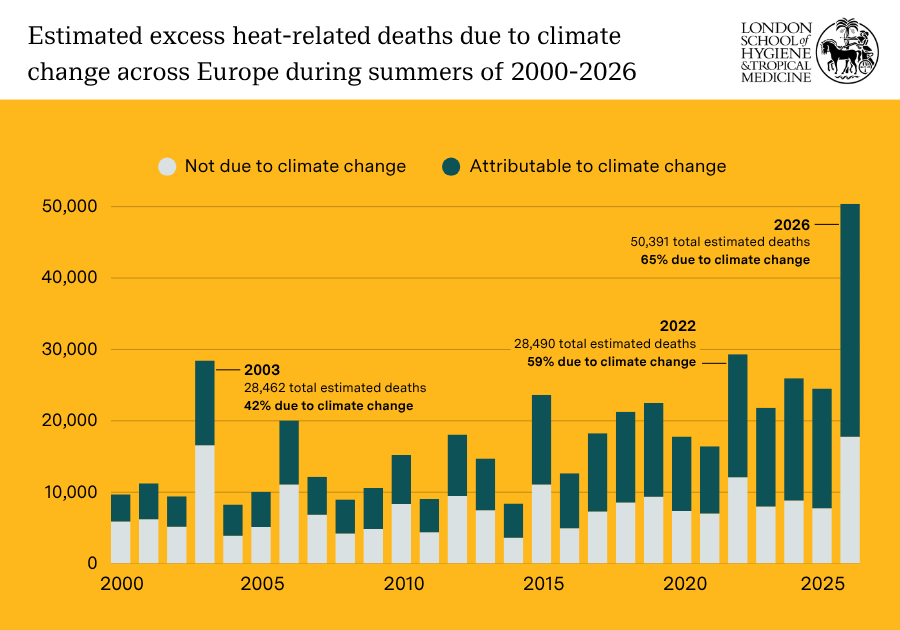
More than 50,000 heat-related deaths are estimated to have occurred in urban areas across Europe during summer 2026, with around two-thirds attributed to human-induced climate change, according to new research led by the London School of Hygiene & Tropical Medicine (LSHTM) and Imperial College London.
The study, published in Nature Health, analysed temperatures and estimated heat-related mortality in 854 urban areas across 27 EU countries, the UK, Norway and Switzerland. Together, these areas account for approximately 40% of the population of the 30 countries included.
The researchers found that summer 2026 had the highest heat-related death toll in since 2000 - almost double that of the summer of 2022, when around 29,000 deaths were attributed to heat, and 2003, when the toll was approximately 28,000.
Nearly one-third of the deaths estimated for summer 2026 occurred between 17 June and 1 July, when average daily temperatures across the region were more than 5°C above the 1991-2020 average.
Southern and western Europe experienced the highest temperatures and estimated mortality rates. Western Europe experienced the largest temperature anomaly, with average temperatures approximately 2.9°C above the 1991-2020 average. On some days, temperatures were as much as 12°C above the seasonal average.
However, heat also had a substantial impact on parts of northern Europe that have historically experienced cooler summers. In the UK, researchers estimated approximately 4,500 heat-related deaths across the 135 urban areas included in the analysis. Older adults were the most affected, but the researchers estimated that around 6,000 of the total deaths within the study occurred among people aged under 65.
Dr Pierre Masselot, Assistant Professor, Statistician and Epidemiologist at LSHTM and co-author on both studies, said: "This summer has been another dramatic reminder that climate change is everybody's problem. It is not just hot regions that are suffering anymore - some parts of Western and Northern Europe are now experiencing extreme heat and historically high health burden. This is affecting the whole population, as shown by the significant death toll among younger age groups.
"It is becoming increasingly clear our cities are poorly adapted to rising heat, and it is critical we improve our efforts towards adaptation. This means cooling the cities through creating more green spaces, reducing pollution and providing health care for affected populations."
The 2026 study was published alongside related research in Nature Health from the same team at Imperial and LSHTM, examining heat-related mortality in the same 854 European urban areas over the summers of 2000 to 2025. The researchers estimated that over 430,000 deaths were caused by heat during that period, and that the proportion of heat-related deaths attributable to human-induced climate change rose from around 40% in 2000 to more than two-thirds in 2025.
The researchers say this trend reflects the effect of greenhouse gas emissions, primarily from burning fossil fuels, which have raised average temperatures and intensified periods of extreme heat.
Dr Clair Barnes, Extreme Weather and Climate Change Researcher at Imperial College London, and lead author on both studies, said: "These numbers are a stark reminder that our hotter, more extreme summers are increasingly having a severe impact on public health.
"It is yet another reminder both of the urgent need to rapidly transition away from fossil fuels to slow the pace of change, but also the imperative of rolling out targeted interventions to protect those who are most vulnerable to the worsening extreme heat."
To quantify the role of climate change in the summer 2026 analysis, the researchers examined daily temperatures experienced in the 854 urban areas between 1 June and 31 August. They used weather observations and climate models to compare temperatures in the present climate, which has warmed globally by approximately 1.4°C, with those expected in a hypothetical climate without human-caused warming.
The two sets of temperatures were then combined with previously published evidence on the relationship between daily temperature and deaths from all causes. This allowed the researchers to estimate heat-related mortality under the conditions that occurred, and the number of deaths that might have occurred in a cooler climate without human-induced warming. The difference between the two estimates was treated as the mortality attributable to climate change.
The retrospective study applied a similar approach to summers between 2000 and 2025, allowing the researchers to examine how the overall burden of heat-related mortality, and the contribution made by climate change, had changed over time.
Dr Garyfallos Konstantinoudis, Assistant Professor at the Grantham Institute at Imperial College London, said: "The relationship between higher temperatures and higher heat-related deaths is well established and statistically robust. It allows us to accurately model and predict the likely mortality impact of summer temperatures on communities across Europe."
The findings are modelled estimates rather than counts of deaths in which heat was recorded as the cause, which makes assumptions about the populations exposed and the relationship between temperature and mortality in each area, based on historical observations. However, estimates produced using this approach have previously been found to be similar to the figures subsequently reported by national health authorities.
The authors say that the findings demonstrate the need to reduce greenhouse gas emissions while strengthening measures to protect populations from heat. These include heat-health warning systems, improvements to homes and healthcare facilities, and urban planning that increases shade and green space.
Publication
Clair Barnes et al. Heat-related urban mortality attributable to human-induced climate change in Europe in summer 2026. Nature Health.
Clair Barnes et al. Heat-related urban mortality attributable to human-induced climate change in Europe from 2000 to 2025. Nature Health. DOI: https://doi.org/10.1038/s44360-026-00209-8
This story is based in part on an original press release from the Grantham Institute - Climate Change and the Environment at Imperial College London.