
The International Labour Organization (ILO) and United Nations High Commissioner for Refugees (UNHCR), the UN Refugee Agency, have signed a Supplementary Understanding to strengthen their collaboration in promoting decent work, sustainable livelihoods and inclusive economic opportunities for refugees and host communities in Ethiopia.
The agreement builds on the longstanding global partnership between the two UN agencies and reinforces their cooperation in Ethiopia, including through the PROSPECTS Partnership. PROSPECTS is a global partnership, funded by the Government of the Netherlands, that aims to improve the access of host communities and forcibly displaced people to education, social protection and decent work. The partnership was launched in 2019 bringing together five international organizations with complementary expertise: UNHCR, ILO, UNICEF, International Finance Corporation (IFC) and the World Bank. This Supplementary Understanding will enhance joint efforts to expand access to market-relevant skills, employment and livelihood opportunities, while strengthening the inclusion of refugees in local economies.
Under the agreement, ILO and UNHCR will work together to strengthen market-oriented skills development, improve access to markets, promote digital inclusion and uphold labour rights. The partnership will also place emphasis on generating evidence, sharing knowledge and learning from approaches that can advance the economic inclusion and self-reliance of refugees alongside their host communities.
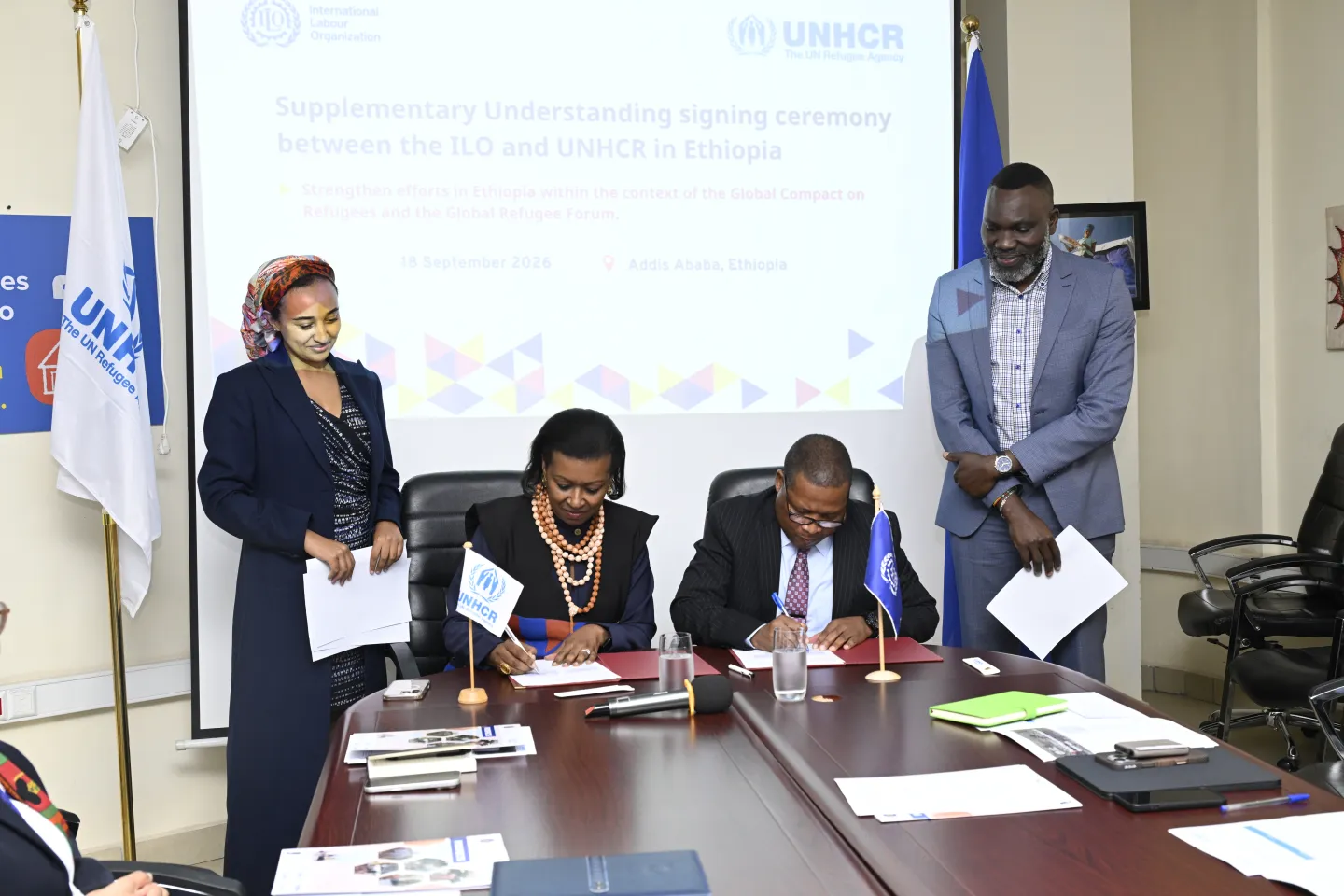
© ILO/Zelalem Alemenew Desta
Speaking at the signing ceremony, Ms. Aissatou M. Ndiaye, UNHCR Representative in Ethiopia, highlighted the importance of connecting refugee protection with opportunities for decent work and sustainable livelihoods.
"Protection must go beyond safety. Without access to decent work and livelihoods, people cannot fully realize their potential. This is where ILO's expertise is essential," Ndiaye said.
The Supplementary Understanding comes as Ethiopia continues efforts to advance the socioeconomic inclusion of refugees and translate policy commitments into greater opportunities for self-reliance, through the Makatet Roadmap which is Ethiopia's is Five-year National Framework on how the country manages its refugee population.
Mr. Khumbula Ndaba, Director of the ILO Country Office for Ethiopia, Djibouti, Somalia, Sudan and South Sudan and Special Representative to the African Union and the United Nations Economic Commission for Africa, said Ethiopia's progress on refugee inclusion provides an important basis for expanding access to decent work.
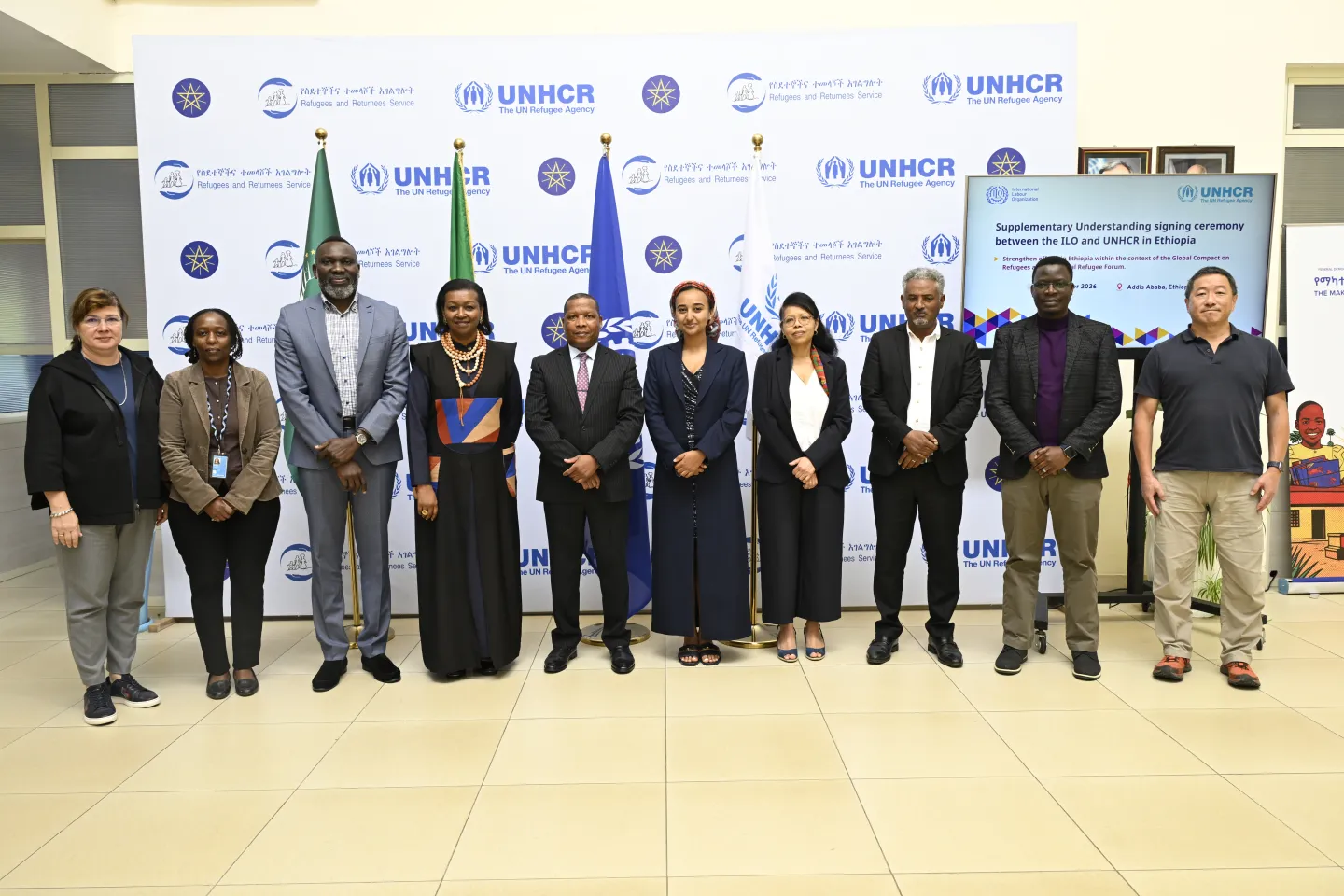
© ILO/Zelalem Alemenew Desta
"The progress made by the Government of Ethiopia towards refugee inclusion provides an important foundation for enabling refugees to access decent work opportunities, develop their skills, contribute to local economies, and enhance their self-reliance," Ndaba said.
"As ILO and UNHCR, we have a shared responsibility to support these efforts through policy dialogue, capacity building, labour market inclusion, and the creation of sustainable economic opportunities for both refugees and their host communities."
The ILO and UNHCR collaboration is already delivering tangible results under the Netherlands-funded PROSPECTS Partnership. Together, the two agencies have advanced innovative approaches to refugee inclusion, including a joint feasibility study on integrating refugees into Ethiopia's Community-Based Health Insurance (CBHI) scheme, the establishment of a Technical Working Group to support health inclusion and the development of the Kebribeyah Inclusion Roadmap, which seeks to transform the refugee camp into an integrated and climate-resilient urban settlement.
ILO and UNHCR have also worked together to strengthen livelihoods and skills development through entrepreneurship training, financial education programmes and the establishment of the Kebribeyah Satellite TVET Centre, which has expanded access to accredited, market-relevant skills training. Through the Youth Network Committee, jointly supported by ILO and UNHCR, young people from refugee and host communities are actively contributing to the design and implementation of development solutions that affect their futures. Since the launch of the PROSPECTS Partnership in Ethiopia, joint ILO and UNHCR interventions have reached more than 524,000 refugees and host community members with a range of socio-economic services.
The strengthened collaboration will bring together the complementary mandates and expertise of the two agencies. UNHCR's protection mandate and operational engagement with refugees will be combined with the ILO's expertise in employment, skills development, labour markets, enterprise development, social dialogue and international labour standards.
The partnership will also support closer engagement with the Government of Ethiopia, employers' and workers' organizations, development partners, the private sector and communities to help translate refugee inclusion commitments into sustainable economic opportunities.
The collaboration contributes to broader efforts to implement the Global Compact on Refugees and commitments made through the Global Refugee Forum by promoting approaches that benefit both forcibly displaced people and the communities hosting them.
Through the Supplementary Understanding, ILO and UNHCR reaffirm their commitment to supporting pathways to decent work and self-reliance in Ethiopia, helping ensure that refugees and host communities can contribute to and benefit from inclusive and sustainable development.


