
Community-engaged research collaborations can create meaningful partnerships that produce impactful work to advance health and wellbeing locally. Recognizing the importance of these kinds of partnerships, the UConn Institute for Collaboration on Health, Intervention, and Policy's (InCHIP) Community Engagement Core and UConn Health Disparities Institute (HDI) held a Community-Engaged Research Forum on May 15 at the […]
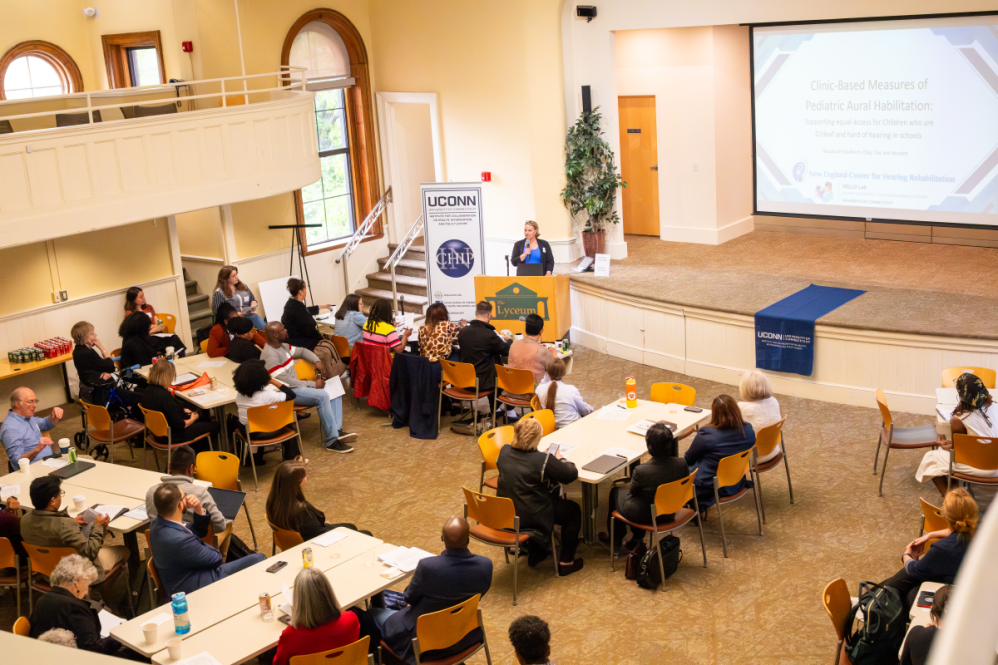
Jenn Cox from the New England Center for Hearing Rehabilitation presents during InCHIP's Community Engaged Health Research Forum on May 15 (Danielle Faipler/UConn Photo)
Community-engaged research collaborations can create meaningful partnerships that produce impactful work to advance health and wellbeing locally.
Recognizing the importance of these kinds of partnerships, the UConn Institute for Collaboration on Health, Intervention, and Policy's (InCHIP) Community Engagement Core and UConn Health Disparities Institute (HDI) held a Community-Engaged Research Forum on May 15 at the Lyceum in Hartford's Frog Hollow neighborhood.
The event brought together more than 50 academic researchers and representatives from community organizations for an afternoon of networking and rapid research pitches to stimulate new university-community research partnerships with a Connecticut focus. At least one project presented through the innovative rapid pitch format will be awarded $10,000 in seed funding.
"InCHIP's leadership in convening researchers and community partners reflects a real commitment to building the collaborative infrastructure needed to advance health equity in our state. Community partnerships are one of the most powerful tools we have to translate evidence into action, and this forum showed how much stronger our work becomes when community wisdom guides the research agenda," says Linda Sprague Martinez, Director of HDI and professor in the Department of Medicine and the Department of Public Health at the UConn School of Medicine.
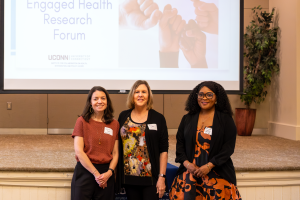
InCHIP's Community Engagement Research Core, led by steering committee co-chairs Kim Gans, professor in the Department of Human Development and Family Sciences, and Kristen Cooksey Stowers, assistant professor in the Department of Allied Health Sciences, along with Caitlin Caspi, InCHIP Associate Director and professor of allied health sciences, opted for the rapid pitch format to reduce barriers to funding for university-community teams.
The idea was developed over the year by the Community Engagement Research Core's Steering Committee, who were motivated by the immediate need to support more teams with the potential to impact local communities across the state.
"It was very gratifying to see so many academic-community teams come together to present from so many different UConn departments and community organizations, and all the important health topics they focused on in their proposed projects. We hope that this forum played a role in getting these teams together and that long-lasting partnerships will result," says Gans.
To streamline the application process, teams were not required to create formal funding proposals, and projects underwent a dynamic review process.
Twelve research teams comprised of at least one UConn faculty researcher and at least one community partner pitched innovative ideas to a panel of five judges. Several projects were pitched by student researchers including Ph.D. students, medical students, and postdoctoral fellows. After hearing the pitches, judges could ask questions and offer feedback directly to applicants.
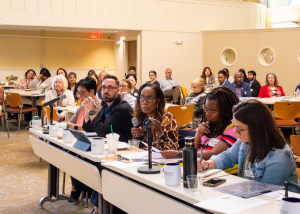
Judges included Christopher Ciarcia, associate director of the UConn Office of Outreach and Engagement; Linda Barry, professor in the Department of Surgery and Public Health at the UConn School of Medicine; Brittney Cavaliere, Chief Strategy Officer at Connecticut Foodshare


