
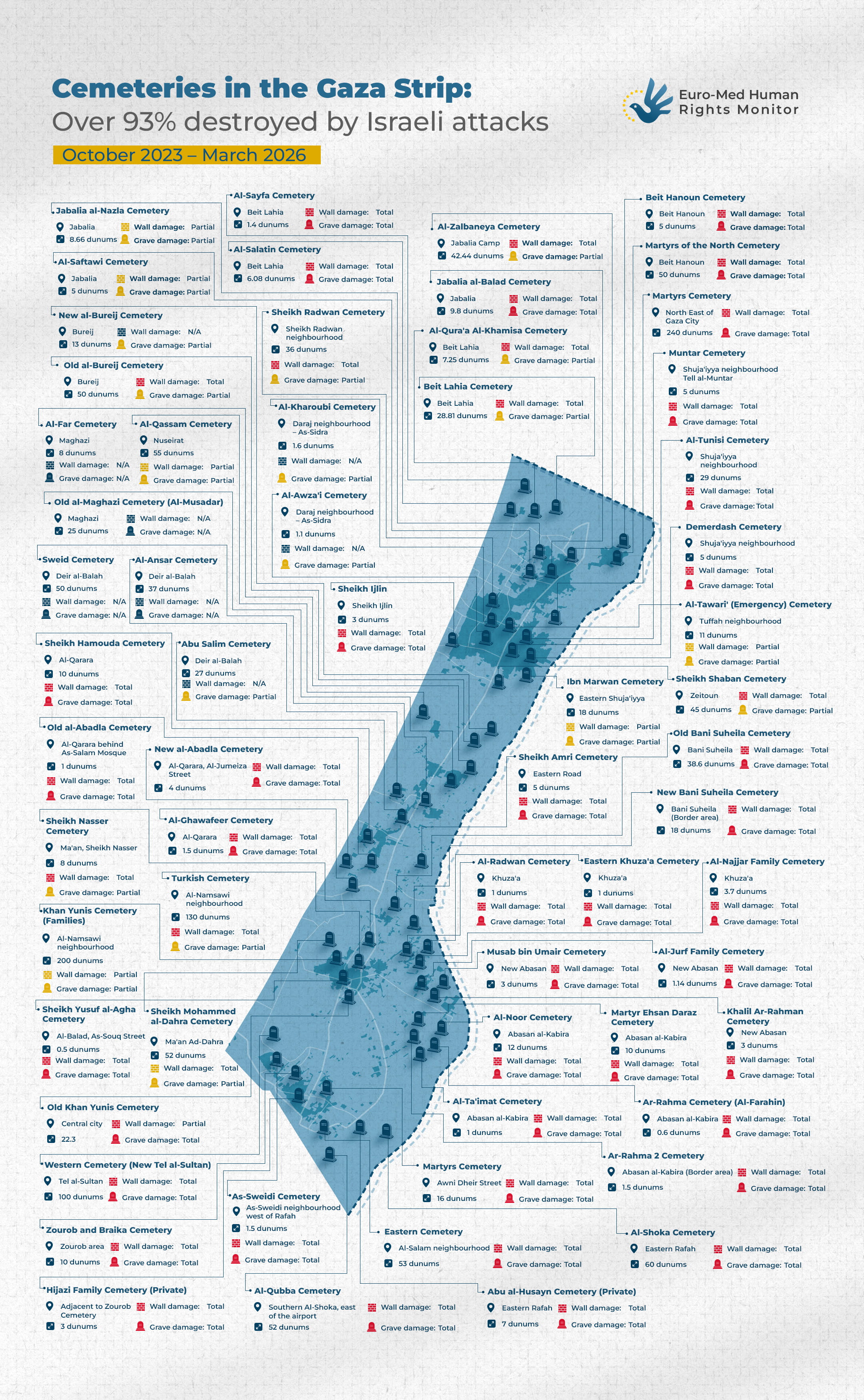
Palestinian Territory – Euro-Med Human Rights Monitor has documented that the Israeli army has destroyed 93.5 per cent of cemeteries in the Gaza Strip, either completely or partially, in the context of the ongoing genocide since October 2023.
The systematic targeting of graves through demolition and bulldozing constitutes a grave violation of international humanitarian law and reflects a deliberate pattern of erasure. These actions violate the sanctity of the dead, erase physical traces, inflict severe psychological and spiritual harm on the living, and ultimately undermine collective memory, severing historical ties between the population, their ancestors, and their land.
The Euro-Med Monitor team analysed data from 62 official cemeteries across the Gaza Strip's five governorates. It found that the Israeli army completely bulldozed and destroyed graves in 39 cemeteries (approximately 62.9 per cent of the total) and partially damaged 19 others (approximately 30.6 per cent). Only four cemeteries, or 6.4 per cent, remain intact.
The widespread destruction of cemeteries in the Gaza Strip was neither incidental to military operations nor justified by "military necessity." Rather, it was a deliberate, planned effort to obstruct the identification and documentation of remains
These findings show that the widespread, direct destruction of cemeteries in the Gaza Strip was neither incidental to military operations nor justified by "military necessity." Rather, it was a deliberate, planned effort to obstruct the identification and documentation of remains and to disrupt any subsequent procedures for identification, examination, or lawful exhumation. This constitutes a clear violation of international humanitarian law, which requires the respectful treatment of the dead, the protection and maintenance of graves, the recording of identity data, and the clear marking of burial sites to enable later identification.
The bulldozing and vandalism have led to the mixing of remains and the destruction of graves, markers, and headstones, making identification of the deceased nearly impossible, given Gaza's limited resources. This deliberately deprives families of their humanitarian and religious right to know the fate and burial sites of their loved ones and to visit them, causing profound and lasting psychological and spiritual harm.
These acts, beyond constituting grave violations of the rules protecting the dead and cemeteries, fall within the scope of international criminalisation when committed as outrages upon human dignity. This includes "outrages upon personal dignity," a term which extends to the treatment of the deceased.
This pattern goes beyond violating the sanctity of the dead; it strikes at the foundations of collective memory, historical continuity, and connection to the land by removing the physical markers of Palestinian generational continuity, in line with systematic policies of erasure and removal.
The geographical distribution of the attacks indicates a widespread strategy of spatial erasure. In Rafah governorate, all official cemeteries have been completely destroyed. In Khan Yunis, all 24 official cemeteries were targeted, with 83.3 per cent completely destroyed and 16.7 per cent partially destroyed. In North Gaza, all ten cemeteries have been destroyed, with half completely and half partially affected.
Similarly, all 11 cemeteries in the Gaza governorate were damaged, with 45.5 per cent completely destroyed and 54.5 per cent partially destroyed. In Central Gaza, four of the eight cemeteries were partially damaged, while the other four remained undamaged.
In many cases, the Israeli army deliberately exhumed graves and converted cemeteries into military barracks under the pretext of searching for the bodies of Israeli detainees. These actions were carried out without documented, verifiable procedures, independent oversight, or a clear chain of custody and handover process. Israeli forces removed hundreds of bodies from their burial sites, mixed remains, failed to return them to their original locations, and provided no identifying or biological data to enable verification or documentation, making the recovery and identification of remains extremely difficult.
In addition to violating the sanctity of the dead, this conduct reflects a pattern of dehumanisation, treating Palestinian bodies as objects to be confiscated, mixed, and concealed rather than as remains of human beings with names, dignity, and rights. It constitutes a compounded violation that strips the dead of dignity, reduces them to unidentified corpses, deprives families of their humanitarian and religious right to know the fate of their loved ones and perform mourning and burial rites, and undermines the preservation of historical and civil records linked to identity and burial.
In a notable case, the Israeli army carried out a focused operation at al-Batsh Cemetery, east of Gaza City, in January 2026. The cemetery was converted into a military barracks, and more than 700 bodies were exhumed under the pretext of searching for the body of an Israeli detainee. The army later withdrew after extensive bulldozing that radically altered the cemetery's landscape, preventing families from locating their relatives' graves despite previously clear headstones and markers.
The widespread destruction of cemeteries intersects with deliberate Israeli efforts to erase evidence of crimes committed by the Israeli army in Gaza. Destroying graves and mixing remains physically obstruct future efforts by international investigative bodies to exhume remains, examine them, verify identities, and determine the actual causes of death. The danger is compounded by documented cases of victims who died as a result of field executions or torture, suggesting that the systematic targeting of cemeteries may be a pre-emptive effort to obstruct criminal justice processes, erase evidence, and secure impunity for perpetrators.
The systematic military targeting of cemeteries constitutes a flagrant violation of customary and treaty-based international humanitarian law, which obligates parties to a conflict to respect the remains of the dead, protect burial sites, refrain from tampering with them, and take feasible measures to facilitate identification and preserve identity data.
Cemeteries are civilian objects and sites of religious and humanitarian sanctity. They are protected from attack or destruction unless that protection is exceptionally and demonstrably lost due to military use, which the widely documented facts do not support.
The deliberate bulldozing and destruction of cemeteries on this scale, along with the tampering with, confiscation of, and mixing of remains, constitute war crimes under the Rome Statute, whether as unlawful attacks against protected objects or as acts amounting to outrages upon personal dignity and the desecration of corpses.
The destruction of cemeteries in Gaza cannot be separated from the genocide, as it targets a group and the material and moral conditions of its survival.
Turning cemeteries into military targets, bulldozing them, mixing remains, and removing grave markers does not merely violate the sanctity of the dead. It strikes three interconnected spheres. First, it undermines proof by obstructing the identification of victims, the determination of causes of death, and the preservation of evidence for accountability. Second, it perpetuates loss by depriving families of dignified burial and mourning while leaving fates unresolved. Third, it erases memory and identity by removing the material signs that embody generational continuity and the group's connection to its land.
This pattern has precedents in genocides and mass killings. Historical records show that Nazi authorities attempted to erase evidence by exhuming and burning bodies and concealing burial sites. International investigations following the Srebrenica massacre in Bosnia found that transferring remains and creating "secondary graves" complicated identification and documentation.
International humanitarian law imposes an independent obligation to respect the dead, protect graves, and document identities, because tampering with them harms families' rights and undermines investigation and accountability. Thus, the systematic targeting of cemeteries becomes a compound tool for entrenching dehumanisation and reinforcing impunity, alongside targeting the group itself.
The International Criminal Court (ICC) must include crimes related to the destruction and desecration of cemeteries, and the tampering with and removal of bodies, in its ongoing investigation into the situation in the State of Palestine. These acts should be treated as standalone war crimes, with a dedicated investigative track and arrest warrants issued against Israeli officials bearing direct or command responsibility, alongside urgent measures to preserve evidence and prevent any tampering or destruction.
Euro-Med Monitor urges the ICC to consider this pattern within the broader context of acts committed against Palestinian civilians in Gaza, as reinforcing the investigation into the crime of genocide in both its material elements and specific intent. It calls on the Court to characterise these acts as genocide and to prosecute those responsible within its jurisdiction.
These findings should be presented before the International Court of Justice (ICJ) as material indicators of a systematic pattern of conduct targeting the Palestinian group and evidencing specific genocidal intent. They justify requests for additional provisional measures requiring Israel to immediately comply with its obligations under the Genocide Convention and international humanitarian law. Such measures should include the immediate cessation of the systematic destruction of burial sites and religiously protected objects, respect for the dead and graves, and guaranteed access for competent civilian authorities to protect and document cemeteries.
The United Nations Human Rights Council (UNHRC) should mandate the ongoing Independent International Commission of Inquiry on the Occupied Palestinian Territory, including East Jerusalem, and Israel, to prioritise a dedicated investigative track into crimes committed against cemeteries and bodies in Gaza. This should include documenting destruction, exhumation, confiscation of bodies, and the mixing of remains, as well as determining individual and command responsibility.
Euro-Med Monitor calls for strengthening the Commission's work with forensic and technical expertise and ensuring unimpeded field access to Gaza. If access continues to be denied, effective alternative documentation methods should be activated, including collecting testimonies and data from outside Gaza, analysing satellite imagery and open-source materials, and documenting affected sites through local teams and independent partners in accordance with evidence preservation and chain-of-custody standards.
A DNA bank should be established in Gaza, along with a central registry for missing persons and unidentified bodies, to facilitate identification, safeguard families' right to know the fate of their loved ones and enable the recovery and dignified burial of remains.
Euro-Med Monitor also calls on international technology companies, remote sensing experts, and relevant organisations to produce high-resolution comparative reports using aerial imagery and digital mapping of cemetery sites before and after October 2023, systematically documenting spatial changes and signs of bulldozing and destruction. These outputs would form a neutral visual record usable as supporting evidence in legal and investigative proceedings, making it more difficult to deny or justify these crimes.
Additionally, UNESCO and international cultural organisations must treat Gaza's cemeteries of historical and cultural value as protected cultural property in armed conflict and activate relevant protection mechanisms, including urgent documentation, public condemnation, and the mobilisation of technical support to prevent further attacks.
Euro-Med Monitor urges the international community, including the High Contracting Parties to the Geneva Conventions, to fulfil their obligations under Common Article 1 by taking practical, deterrent measures, including halting any support or cooperation that contributes to ongoing violations and imposing targeted political and economic sanctions on responsible individuals and entities, including measures related to military trade and relevant technologies, to compel Israel's compliance with international humanitarian law.
The international community must compel Israel to immediately disclose the fate of hundreds of missing bodies and return them with sufficient identifying and biological data, while preserving the dignity of the deceased. Euro-Med Monitor calls for ensuring that civilian authorities in Gaza can rehabilitate damaged cemeteries, resume burial operations in accordance with prescribed rites, and guarantee that burial sites and workers are not targeted.


