
New molecular insights into the link between hepatocellular carcinoma and intratumoral fibrosis could lead to better treatment strategies, report researchers from Institute of Science Tokyo. Through a comprehensive analysis involving clinical data and in vitro and in vivo experiments, they revealed that the SPP1-CD44-Hedgehog signaling pathway is a key driver of fibrosis in liver tumors, hinting at its potential as a therapeutic target.
Understanding the Link Between Liver Tumors and Fibrosis
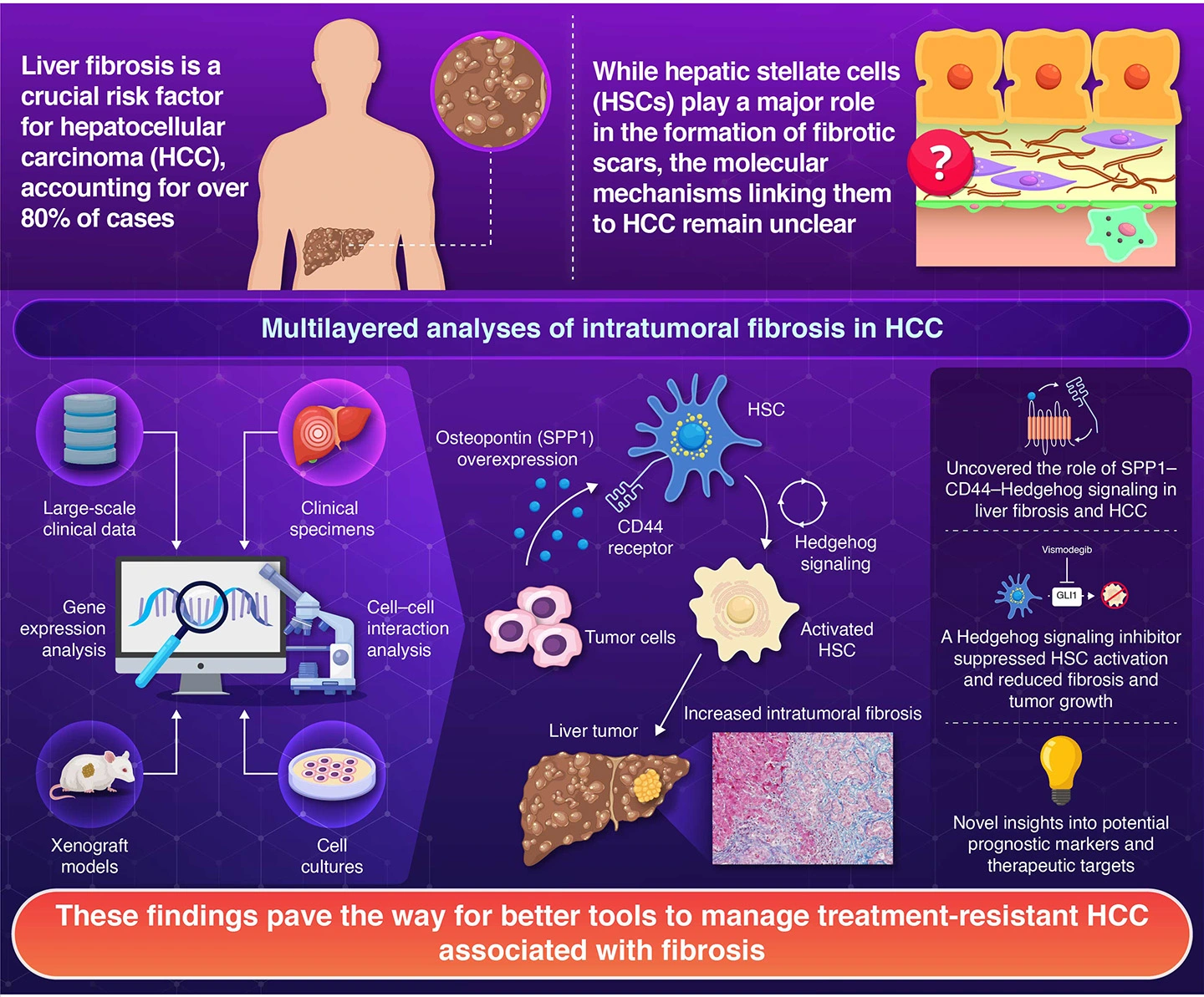
Liver cancer is one of the leading causes of cancer-related deaths worldwide, and its incidence continues to rise alongside obesity and metabolic diseases. The most common form, hepatocellular carcinoma (HCC), usually develops in livers that have already been damaged by chronic inflammation. Experts estimate that more than 80% of HCC cases arise in patients with liver fibrosis, which occurs when repeated injury leads to a buildup of scar-like tissue. These 'scars' are not passive; they form a biologically active environment that can shape how tumors grow, spread, and respond to treatment.
Although fibrosis is linked to worse outcomes in HCC, scientists have struggled to define the precise molecular signals that connect cancer cells with hepatic stellate cells (HSCs)-the cells responsible for forming scar tissue. Without a clear understanding of their interplay, efforts to target fibrosis in the context of liver cancer have encountered limited success.
In a recent study made available online on December 28, 2025, and published in Volume 117, Issue 3 of the journal Cancer Science on March 2, 2026, a research team led by Professor Shinji Tanaka, along with Assistant Professor Shu Shimada, Lecturer Yoshimitsu Akiyama, Assistant Professor Megumi Hatano, and graduate student Atsushi Nara from the Department of Molecular Oncology, Graduate School of Medical and Dental Sciences, Institute of Science Tokyo (Science Tokyo), Japan, in collaboration with the Department of Hepatobiliary and Pancreatic Surgery and the Department of Human Pathology from the same institute, addressed this knowledge gap. Through a series of multilayered analyses involving large-scale clinical data, single-cell RNA sequencing, cell culture experiments, and mouse models, the researchers painted a comprehensive picture of the molecular events linking liver tumors and fibrosis.
First, the team identified a protein that was prominently and consistently overproduced in cases of HCC with advanced fibrosis. "Comprehensive gene expression analysis of 372 HCC tissue samples and immunohistochemical analysis of 103 clinical specimens revealed that osteopontin, also called SPP1, is specifically overexpressed in highly fibrotic HCC and is strongly associated with poor prognosis," explains Tanaka. Further experiments showed that liver cancer cells engineered to overproduce SPP1 grew faster and formed larger tumors in mice, and that these tumors also contained more fibrotic tissue compared to controls.
To understand the underlying mechanism, the team examined how cancer cells interact with HSCs at the molecular level. Through cell co-culture experiments, the researchers found that SPP1 released by tumor cells activated HSCs and promoted their migration. Further molecular analyses revealed that SPP1 binds to a receptor called CD44 on HSCs, triggering the Hedgehog signaling pathway and increasing the expression of a key protein called GLI1. Notably, when the researchers treated mice with vismodegib-a clinically approved Hedgehog pathway inhibitor-they observed reduced HSC activation, less fibrosis, and slower tumor growth.
Together, these results provide valuable insights into how liver tumors actively shape their surroundings, driving the onset and progression of fibrosis to support their own growth. The study thus opens the door to targeted treatment strategies for managing highly fibrotic HCC. "Collectively, our findings suggest that SPP1-CD44-Hedgehog signaling plays a central role in promoting intratumoral fibrosis and HCC progression and may serve as both a prognostic factor and a therapeutic target," says Tanaka, looking toward the future.
Reference
- Authors:
- Atsushi Nara1,2, Shu Shimada1*, Yoshimitsu Akiyama1, Megumi Hatano1, Yusuke Chino3, Suguru Miyazawa1,2, Hanako Tamura1,2, Daisuke Asano2, Yoshiya Ishikawa2, Hiroki Ueda2, Shuichi Watanabe2, Eriko Katsuta2, Keiichi Akahoshi2, Kenichi Ohashi3, Minoru Tanabe2, Daisuke Ban2, and Shinji Tanaka1,2*
- Title:
- Targeting SPP1-CD44-Hedgehog Axis Elicits Therapeutic Effects in Hepatocellular Carcinoma by Suppressing Intratumoral Fibrosis
- Journal:
- Cancer Science
- DOI:
- 10.1111/cas.70296
- Affiliations:
- 1Department of Molecular Oncology, Graduate School of Medical and Dental Sciences, Institute of Science Tokyo, Japan
2Department of Hepatobiliary and Pancreatic Surgery, Graduate School of Medical and Dental Sciences, Institute of Science Tokyo, Japan
3Department of Human Pathology, Graduate School of Medical and Dental Sciences, Institute of Science Tokyo, Japan


