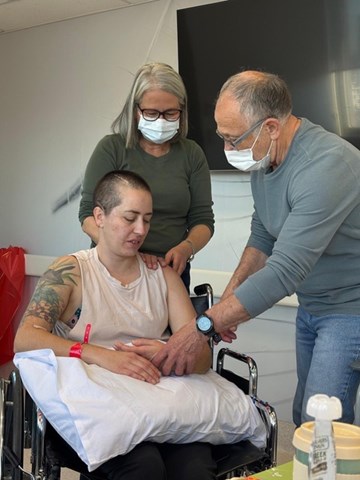
An Illawarra veterinarian and mother of two is alive today because she trusted her instincts when something didn't feel right.
Nicole Defina-Miller was just 37 years old when she woke in the early hours of the morning with an excruciating headache.
"I rolled over to check the time and realised my left arm and leg weren't moving with me. At first, I thought I'd slept in a strange position, but then I noticed the headache was getting worse and worse," Nicole said.
"I went to wake my husband Graham, but my words were slurred, and then I realised I couldn't feel the left side of my face. I managed to say: call an ambulance, I think I'm having a stroke."
Having previously trained as a first aid officer, Nicole immediately recognised the F.A.S.T. (Face, Arms, Speech and Time) signs of stroke and called for help.
At hospital, doctors confirmed a ruptured blood vessel aneurysm had caused a bleed on the right side of Nicole's brain. Nicole underwent a six-hour emergency craniotomy procedure, where a section of her skull was removed to relieve the pressure.
Nicole woke from an induced coma three days later to begin a long and challenging recovery journey. After two months in hospital, she returned home, where she continues intensive rehabilitation more than a year on from her stroke.
"I want people to know stroke can happen to anyone, not just the elderly. I was fit and active, trained three or four times a week in a boxing gym and ran regularly. I had never smoked and was a healthy weight," Nicole said.
"My life isn't over because I had a stroke, it's just different. I'm so grateful I woke up that day. if I had have taken a Panadol and gone back to sleep, I may not be here today.
"My boys have been my biggest cheerleaders, telling me I'm doing a great job with my exercises. Hopefully one day for them this will be a distant memory rather than the significant life disruption it feels like right now."
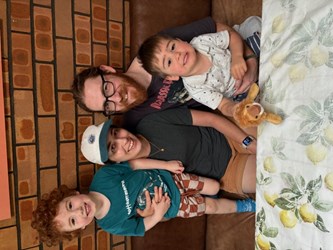
Nicole is among the 140,000 survivors of stroke living in New South Wales. She is sharing her story during National Stroke Week which runs from 3 to 9 August. This year's theme is 'F.A.S.T. heroes' and recognises the everyday champions, who knew how to recognise a stroke, acted quickly and helped save lives.
Stroke Foundation Chief Executive Officer, Dr Lisa Murphy, says everyone can be a hero by learning and sharing the F.A.S.T. stroke message.
"You don't need a cape to be a hero, you just need to know the signs of stroke by learning the F.A.S.T. acronym and calling triple zero (000) when stroke strikes. It can save a life."
"F is for face - is their face drooping? A is for arms - can they lift both arms? S is for speech - is their speech slurred? And T is for time - time is critical. Call 000 immediately," Dr Murphy said.
"When a stroke strikes, it attacks up to 1.9 million brain cells per minute so there's absolutely no time to waste. You must act fast and call triple zero (000) for ambulance to help."
National Stroke Week is Stroke Foundation's annual awareness campaign. You can support the campaign by sharing or creating your own social media post on any platform. Learn and share the F.A.S.T. signs of stroke and call triple zero (000) straight away if you suspect a stroke.
National Stroke Week is proudly supported by Major Sponsors: EMVision, Wellumio, and Supporting Sponsors: AbbVie and Pure Australia.