
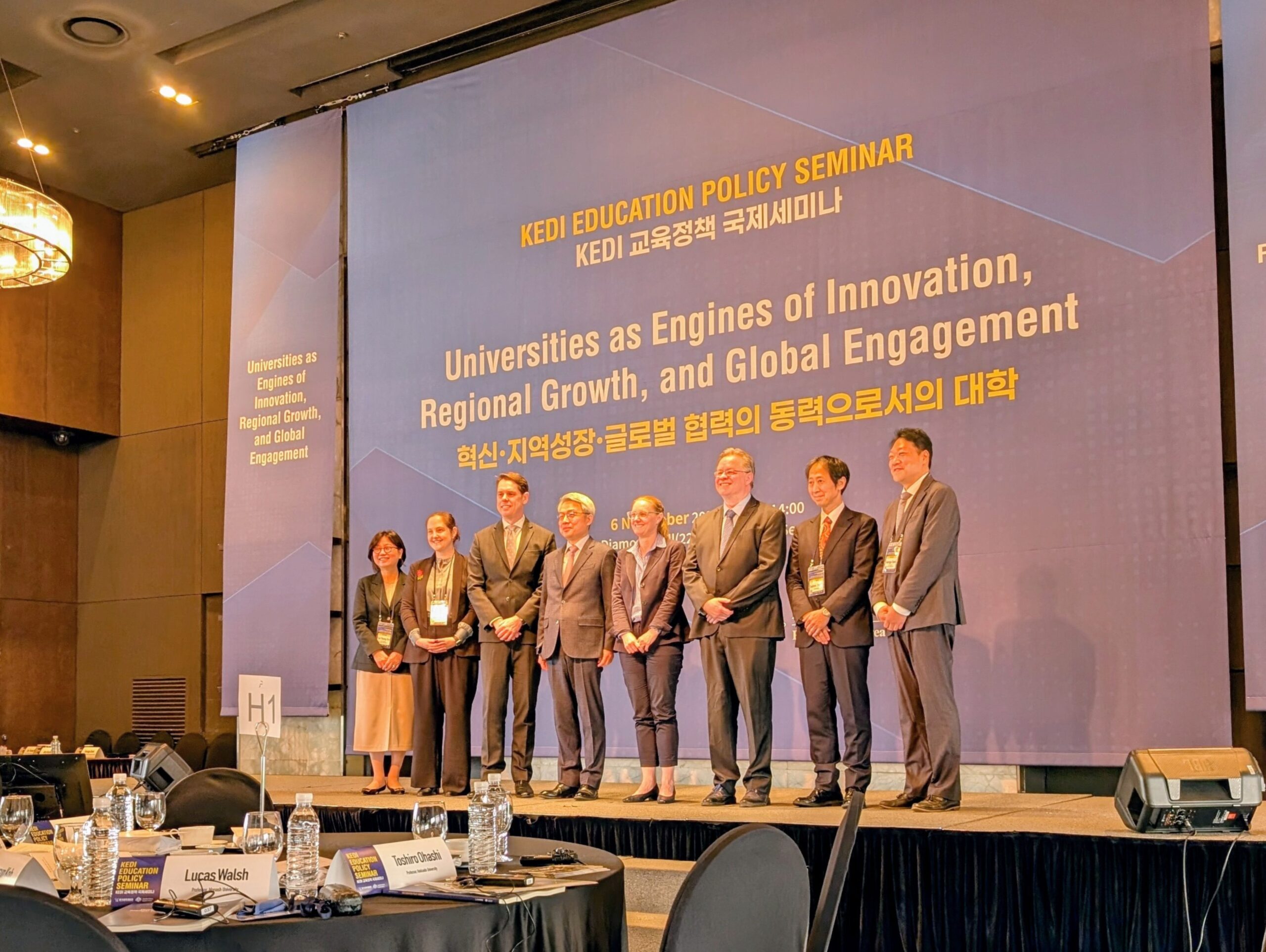
HU shared its good practices in international partnership at a Korea-Australia seminar
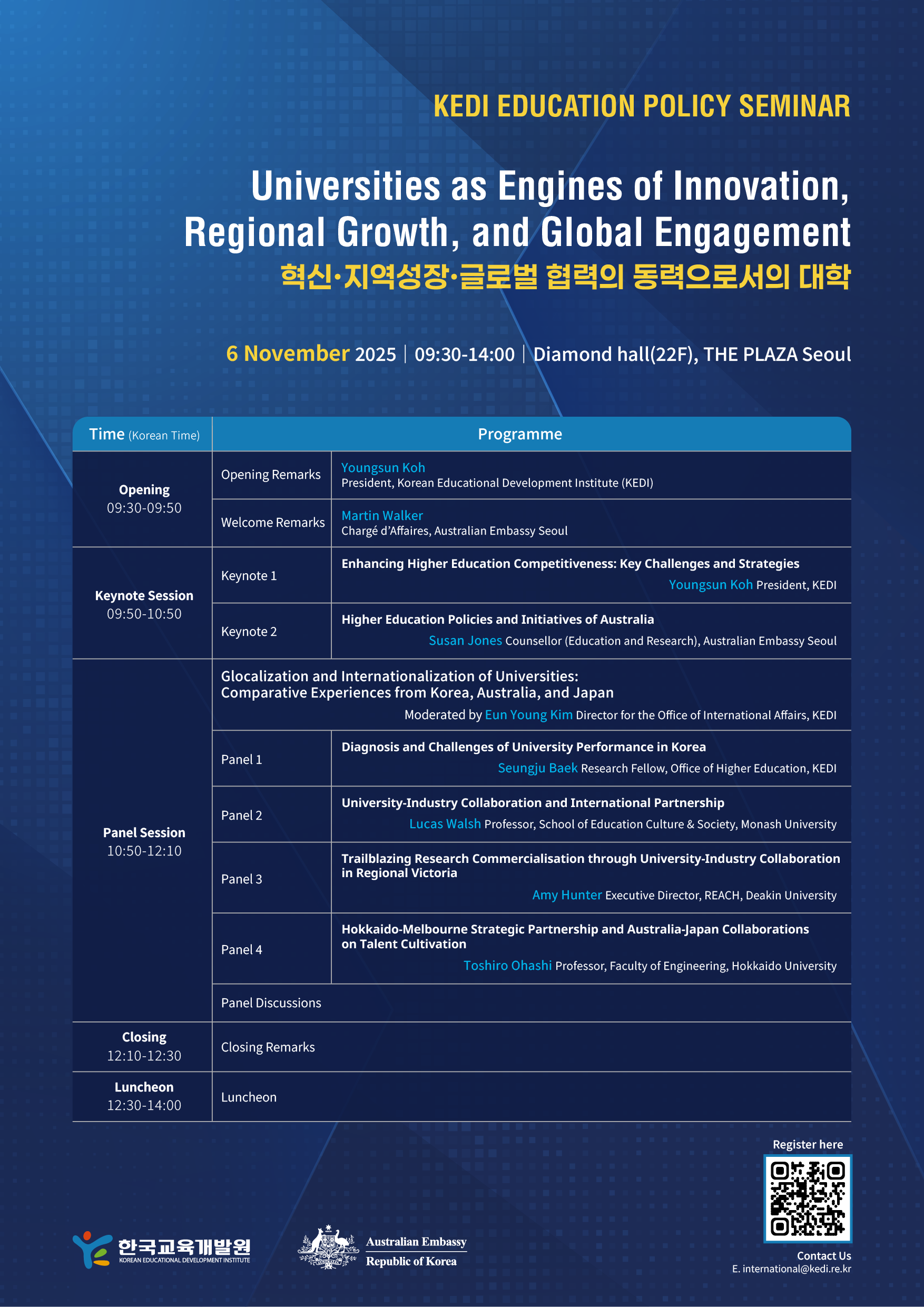
On 6 November 2025, the Korean Educational Development Institute (KEDI), in collaboration with the Australian Embassy in Korea, hosted the KEDI Educational Policy Seminar, titled "Universities as Engines of Innovation, Regional Growth, and Global Engagement." Held in Seoul, South Korea, the event aimed to discuss research collaborations between Korean and Australian universities. It invited Hokkaido University (HU) to share its ongoing inter-university collaborations with the University of Melbourne (UoM) as a best practice example of Australian and Japanese university cooperation.
Since 2021, HU and UoM have acknowledged their cooperation as a Strategic International Partnership. They have also further expanded and deepened their research collaborations with a jointly budgeted Research Workshops Fund and a joint PhD program. This time, Professor Toshiro Ohashi from the Faculty of Engineering and Senior Academic Specialist Taena Uemura from the Office for International Collaborations joined the event and discussed the advantages and challenges of global partnerships with other participants.
The presentation shared a growing record of the annual staff and student mobility between HU and UoM, which increased from less than 80 to over 800 people within three years, leading to external grant acquisition and the arrangement of co-taught modules. Professor Ohashi also introduced the Emerging Research Leaders Exchange Programme (ERLEP) by the Engineering Academy of Japan (EAJ) and Australian Academy of Technological Sciences & Engineering (ATSE), in which he has taken a leading role as an alumnus of the Program.
KEDI explained the current state of higher education in South Korea, including:
- research capacity tracking, referring to the CWTS Leiden Ranking;
- the employability of graduates from public and private universities in metropolitan and regional areas;
- the possibility of a tuition fee increase to secure the budget of universities;
- ongoing communication with the Korean Ministry of Education to secure government subsidies;
- financial disparity between regional universities and research-intensive universities in metropolitan areas;
- and the advantaged position of students from high-income households in entering top universities.
Professor Lucas Walsh, Director of the Monash Centre for Youth Policy & Education Practice (CYPEP), shared Monash University's educational collaborations in Korean Studies and its joint appointment of academic staff with South Korea's K-Bio Lab Hub, an Incheon-based biotech incubator and innovation hub. Executive Director Amy Hunter from the Recycling and Clean Energy Commercialisation Hub (REACH), Deakin University, introduced REACH's research support ecosystem, which provides continuous support to early-career researchers before and after their transfer to other universities within the framework.
The seminar received questions and comments not only from regional universities but also from private secondary schools in Seoul. Regional growth and global engagement both require sustainable government funding. The seminar was an excellent opportunity for sharing insights and exploring possible trilateral cooperation to enhance the global competitiveness of higher education.
(Text and images provided by the Faculty of Engineering and Office for International Collaborations)


