Dr Nora Devoe's parents were convinced their daughter was destined to become a medical doctor. A sharp mind meant any career pathway was open to the talented teenager. There was one hitch, however.
A year into her medical studies, Dr Devoe realised there was a different kind of healing she wanted to bring about. The patient? The world's forests.
That decision quickly landed her at the forefront of forestry decision-making, first in the USA and then around the world. Forests are often contested spaces, with people disagreeing over what sustainable management means and whose interests come first.
Over the years, Dr Devoe demonstrated a talent for mastering the scientific facts about the life of trees while integrating the broader ecological, cultural and economic life of forests.
'It's a delicate balancing act,' she said. 'The future of humans depends on the ecological integrity of the planet. Trees are the answer, but people are more important. So, my focus was to find ways in which we sustain forests even as we allow forests to sustain, educate and enrich us.'
Dr Devoe has now retired as ACIAR's Research Program Manager, Forestry. As she steps into retirement, she may yet unleash one of her signature bold moves. Concerned about the state of the forestry profession in Australia, she is considering a return to teaching to help rebuild the technical capacity Australia needs to address its A$3-5 billion forest and wood products trade deficit.
A career digest
Following an initial degree in physical sciences, Dr Devoe obtained a Master of Forest Science in forest ecology and a PhD in silviculture from Yale University. Her early career saw her return to her home state of Hawai'i as a research forester. Among her achievements was the establishment of a system of Micronesian mangrove reserves as part of conservation efforts aimed at assisting subsistence farmers.
Dr Devoe moved on to USAID in the South Pacific. There, she redesigned a project development process to make it more effective and outcome focused.
'A key conservation achievement in this period related to the critically endangered Carpoxylon palm, which is endemic to Vanuatu,' she said. 'We developed a small-scale forestry-based industry for local people. This allowed them to earn cash by collecting, processing and selling palm seed internationally. Buyers included conservation-minded botanical organisations such as Kew Gardens in the UK.'
This phase saw Dr Devoe gain experience across research, management, staff training, and the writing of legislation and policy development, along with implementation.
In the following years she moved further into development. This included confronting the tension between forest use by Indigenous people and exclusionary models of conservation - countering eviction plans for Indigenous people in Sumatra, Indonesia, who lived in areas designated to become national parks.
Dr Devoe then moved to New Zealand where she took up an academic position at the School of Forestry at the University of Canterbury. There, she worked with Māori forest owners to achieve a forestry-rights settlement that recognised tino rangatiratanga, the sovereignty of Māori over their land. She also trained a generation of New Zealand foresters in natural forest management while continuing upland rainforest research in the northern Pacific.
Upon moving to Australia, Dr Devoe worked with state, territory and Commonwealth forest agencies - including in carbon trading in the Northern Territory and commercial hardwood production in Victoria and Western Australia - before joining ACIAR.
ACIAR highlights
Dr Devoe's tenure at ACIAR spanned 2018 to 2025. Her work consistently emphasised the ecological integrity and social dimensions of forestry. She has championed community forestry, sustainability, and the integration of ecological and economic goals.
Among the projects Dr Devoe is most proud of is a restoration project in the Solomon Islands. Faced with ecosystems that had been heavily logged in the past, the Livelihoods in Forest Ecosystem Recovery (LIFER) project (FST/2020/135) tackles how best to restore forests in ways that sustain ecosystems while supporting rural livelihoods.
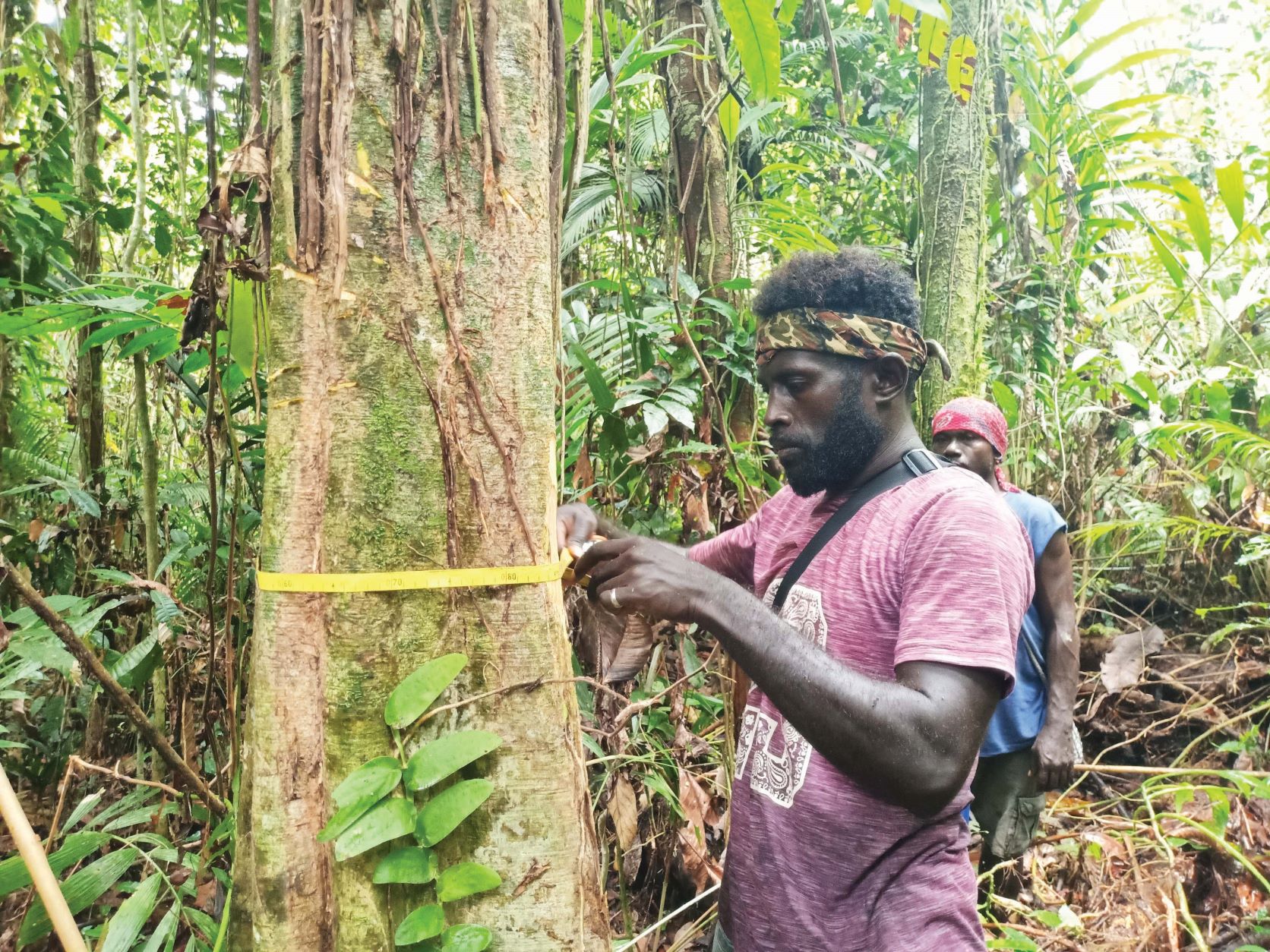
'Communities and customary owners are fully engaged in research efforts that test and compare different options,' said Dr Devoe. 'The aim is to achieve flourishing ecosystems that are economically viable for the landholders.'
In Laos, another restoration project - Forest restoration for economic outcomes (FST/2020/137) - explores the idea of 'assembly rules': the natural patterns that shape how plants and animals return to an area after disturbance. By understanding these patterns, the project looks at how natural recovery can be guided and accelerated to restore both economic and ecological benefits. The aim is to help Laos maintain and expand its forest cover by making forests a competitive alternative to agricultural land uses.
A third highlight for Dr Devoe has been the Coconut and other non-traditional forest resources for the manufacture of Engineered Wood Products project (FST/2019/128), which is finding ways to transform old coconut palms - often considered waste - into high-value engineered wood products. Traditional sawmilling methods are ineffective for processing the narrow, soft-centred trunks of senile coconut trees but ACIAR, with Dr Devoe's guidance, has partnered with researchers, industry and forestry departments in Fiji and the Pacific Community (SPC) to trial spindleless lathes. This technology peels coconut stems into usable veneer sheets that can be made into products expected to have market appeal for builders, furniture makers and hotel resorts.
At ACIAR, Dr Devoe's leadership was marked by a commitment to collaborative research, capacity building and the development of young professionals. She cites mentoring and supporting emerging foresters as one of the most rewarding aspects of her role.
As Dr Devoe now moves into retirement, her thoughts remain with those who will take up the challenge of stewarding the world's forests and furthering equitable development. Her advice is to acquire core scientific skills, including studies in forestry, ecology and agroeconomics, coupled with social sciences and languages. An effective forester works collaboratively, she emphasised, cultivating the capacity for listening, observing, sharing and waiting.