Does feeding less protein over a longer period not only reduce nitrogen losses, but also affect methane emissions? Researchers at Wageningen University & Research (WUR) investigated this in a multi-year study with dairy cows, funded by the Vereniging Diervoederonderzoek Nederland (VDN), LVVN and the Melkveefonds.
The dairy sector faces a major challenge to reduce its environmental impact. Lower protein levels in the ration can lead to lower nitrogen excretion, particularly via urine, and therefore to lower ammonia emissions. At the same time, it is important that this does not come at the expense of animal performance or lead to unwanted side effects, such as higher methane emissions. This part of the research therefore focused specifically on nitrogen metabolism and methane excretion when feeding low-protein rations over a longer period.
In the study, 64 dairy cows were followed during two full lactations of at least 44 weeks each. The cows received rations with different protein levels, with realized average crude protein contents of 133, 143 and 154 g CP/kg DM for the low, medium and high protein groups (see also our earlier news article). The protein levels of all three groups were therefore below the Dutch practical average of 161 g CP/kg DM (CBS, 2024). The outcomes should therefore be interpreted in the context of a relatively low protein level. Throughout the entire lactation, feed intake, milk production and methane emissions were measured continuously. In addition, manure and urine samples were collected in early and mid-lactation to obtain a complete picture of nitrogen excretion alongside nitrogen intake.
Lower protein levels reduce nitrogen excretion, especially via urine
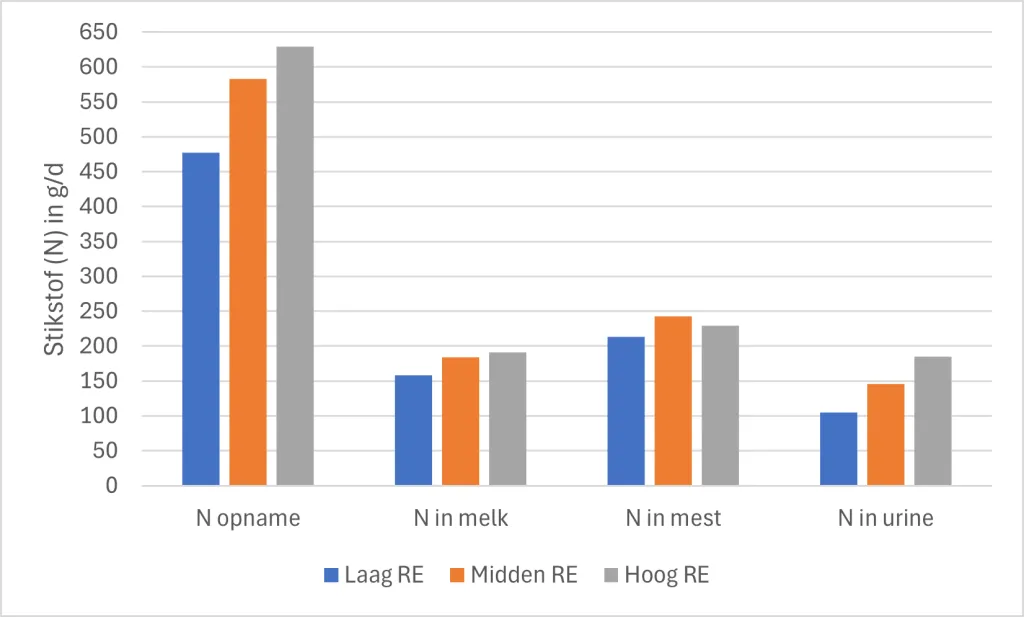
In our previous news article, we showed that reducing crude protein from 154 to 143 g/kg DM is possible without a significant loss in milk production or feed intake, whereas a further reduction to 133 g/kg DM clearly reduces both feed intake and milk production. Regarding nitrogen intake, cows in the low-protein group consumed less nitrogen in both lactations than cows in the medium- and high-protein groups. Over the entire first lactation, nitrogen intake averaged 462 g/day for the low-protein group, compared with 548 and 590 g/day for the medium- and high-protein groups (Figure 1).
Nitrogen excretion via milk also decreased in the low-protein group. As a result, nitrogen use efficiency for milk production was highest in the low-protein group (34.8%) and lowest in the high-protein group (31.9%). This pattern was repeated in the second lactation, indicating that the results were consistent across multiple lactations. The largest differences were found in nitrogen excretion via urine. In the first lactation, urinary nitrogen excretion averaged 105, 146 and 185 g/day for the low-, medium- and high-protein groups, respectively (Figure 1). The same pattern was observed in the second lactation. In contrast, nitrogen excretion via manure did not differ significantly between the groups. This confirms that lower protein levels mainly lead to a strong reduction in nitrogen excretion via urine, contributing to lower ammonia emissions.

No additional methane with less protein - up to a certain point
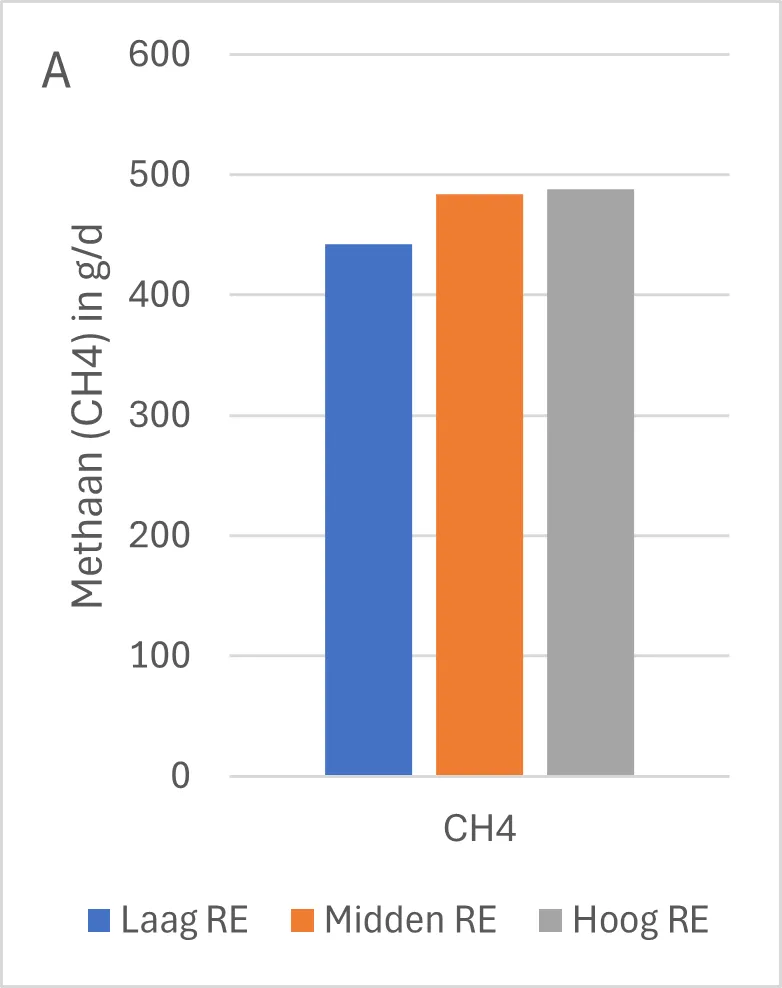
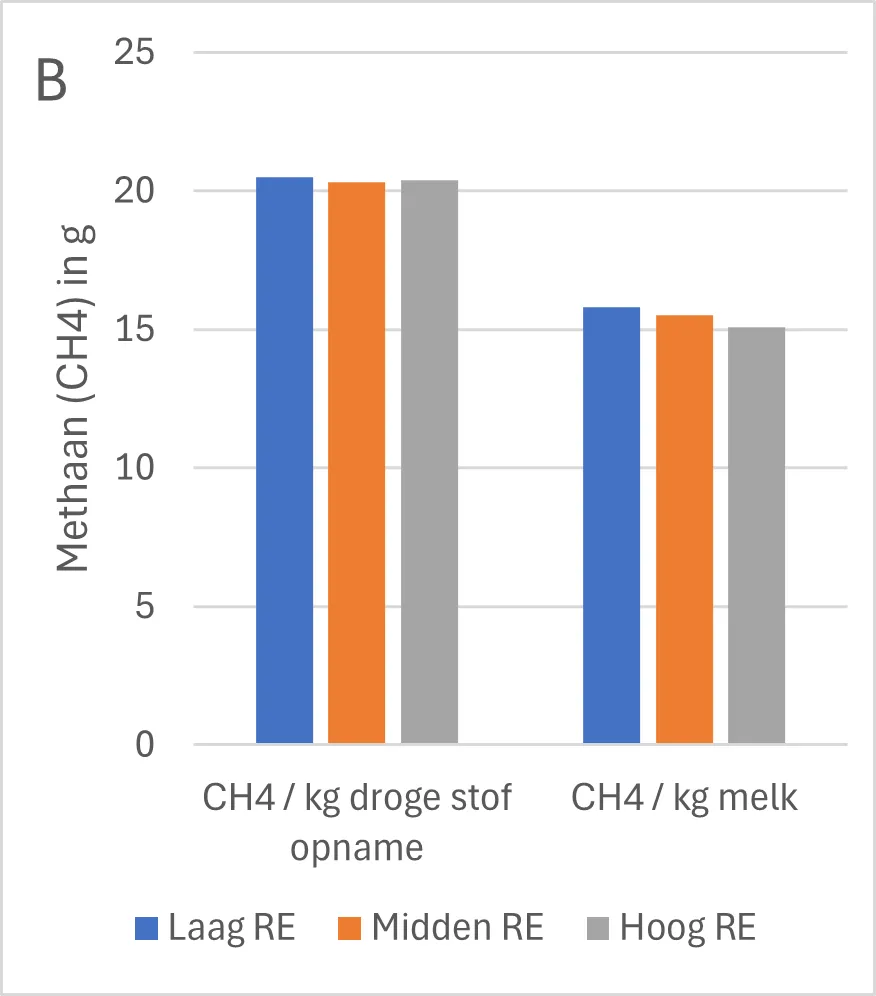
Total methane excretion in the first lactation was lowest in the low-protein group (442 g/day), compared with the medium- and high-protein groups (484 and 488 g/day; Figure 2a). However, when methane was expressed per kilogram of milk or per kilogram of feed intake, these differences disappeared because the low-protein group also had reduced milk yield and feed intake. As a result, methane production per unit of milk or feed remained comparable between the different protein levels (Figure 2b).
The results paint a promising picture: lowering the protein content of the ration leads to a clear reduction in nitrogen excretion, particularly via urine, without increasing methane emissions per kilogram of milk. Reducing protein to 143 g CP/kg DM can be achieved without reducing feed intake or milk production, whereas a further reduction to 133 g CP/kg DM does lead to lower feed intake and milk production. Long-term feeding of lower protein levels up to 143 g CP/kg DM therefore offers prospects for a more sustainable dairy sector, allowing environmental benefits to be achieved without introducing new climate drawbacks or losses in productivity.
Figure 1. Nitrogen (N) intake and excretion of dairy cows fed rations with different protein levels of 133 (Low CP), 143 (Medium CP) and 154 (High CP) g CP per kg dry matter.
Figure 2 (A and B). Methane (CH₄) production in total (A) and relative to milk production and feed intake (B) of dairy cows fed rations with different protein levels of 133 (Low CP), 143 (Medium CP) and 154 (High CP) g CP per kg dry matter.