
A partnership between UConn Avery Point and Mystic Seaport Museum inspired Gabriel Brisson's '26 (CLAS) future career in maritime studies.
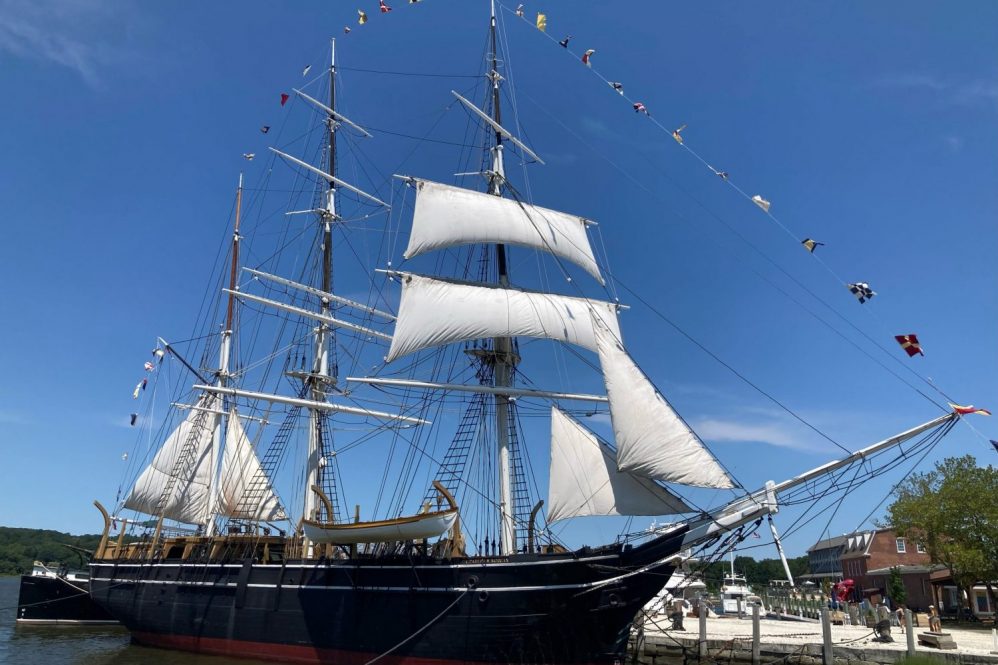
The Charles W. Morgan located at Mystic Seaport Museum. (Photo courtesy of Mary K Bercaw Edwards)
Upon his graduation from UConn Avery Point in May, Gabriel Brisson '26 (CLAS) is putting his maritime studies degree and passions to use at Mystic Seaport Museum(opens in new tab), where he has worked this summer in their archival collections and interpretation department.
At his internship, Brisson supports a breadth of work that focuses on preserving local Connecticut and New England history.
"I thoroughly enjoyed my classes and learning about maritime studies," says Brisson. "Working at Mystic Seaport Museum is not only important, but even more interesting."
Home to over 650 historic watercraft, including four National Historic Landmark vessels, Mystic Seaport Museum welcomes visitors, students, and scholars to preserve and interpret America's maritime experience. And, for more than 25 years, Mystic Seaport Museum and the UConn Maritime Studies Program(opens in new tab) have worked as partners.
The partnership provides maritime studies majors with museum membership, allowing them to conduct research and make frequent field trips, according to Mary K. Bercaw Edwards(opens in new tab), professor of English and former director of the Maritime Studies Program.
"To UConn's benefit, we get access to the museum and its resources, and to the museum's benefit, we have student and faculty experts in various aspects of maritime culture to draw upon when putting together programs or hiring," says Bercaw Edwards, who serves as part of the museum's interpretation department during the summer.
As a leader in preserving historic American maritime materials, Mystic Seaport Museum has had to adapt to the rise in digital content from historic collections. As those digital materials continue to grow, long-term preservation has become central to the museum's work.
"Knowing that the work I do is making history accessible and helping so many researchers is rewarding," says Brisson.
When he is in the Collections Research Center, Brisson organizes and prepares files and documents for storage. From transcripts to manuscripts to historical interviews about New England maritime history, he digitizes materials so they can be easily accessed online.
Ensuring that every digital material is organized correctly and easily accessible in the database is a meticulous but crucial part of that work, Brisson says. The online database benefits researchers, educators, and students, as all of this historical information is available for research and discovery through Mystic Seaport Museum.
When he is not sorting through a variety of historical documents, Brisson can be found on the front lines of Mystic Seaport Museum as an interpreter for various exhibits.
"From Brickwrecks(opens in new tab) to Monstrous(opens in new tab) to my personal favorite, the Charles W. Morgan(opens in new tab), I'm talking with visitors about our exhibits and research, while being able to answer any questions," he says.
Brisson says his CLAS education thoroughly prepared him to step into this role of working directly with the public.
While Brisson was completing a wide range of interdisciplinary coursework, the history courses he took at Avery Point focused on maritime studies, sparking an interest that led him to change his major.
As he continued studying maritime history and building on the skills he gained through classes and hands-on experiences, one course stood out because it connected him directly to Mystic Seaport Museum, one of the driving forces behind his enthusiasm for his major and field.
"I took a course called Sailors' Skills for the Interpretation of the Maritime Humanities, where I learned knot tying, identifying ships, rigging, and other aspects of seafaring. At the end of the semester, we spent a week sailing aboard the schooner Brilliant,(opens in new tab)" says Brisson.
Brisson's time at sea inspired him to pursue a maritime archaeology track, and the partnership gives maritime studies students hands-on opportunities to apply what they learn at Mystic Seaport Museum.
"We're interested in offering the experiential side of learning, and this partnership has an impact on students because of the materiality of everything," says Edwards. "They can read about what it's like to be a sailor or what happens with fisheries or the effect of climate change on the world's oceans. But when they go to the museum, where they can try pulling on lines or laying out trawl lines for fish, it's just a great hands-on experience."
Several UConn Avery Point professors also work at the museum, giving students access to expertise and experience they would not get in a classroom.
These connections have proved valuable for Brisson. Since graduating, he has worked alongside familiar faces like Bercaw Edwards while gaining hands-on experience in the place that first sparked his interest in maritime studies.
The internship has also deepened Brisson's interest in archiving, a skill he hopes to continue developing in his future career. For Bercaw Edwards, that is exactly why partnerships like this matter.
"I was inspired by Gabe's intellectual curiosity and his genuine interest in things. I was very excited when he wanted to do this internship," she says. "When I see stories like Gabe's, it always makes me happy because students get to our campus and then they take a general education course and suddenly are like, 'Wow, this is really cool,' and they see all the things that can be done with maritime studies."


