
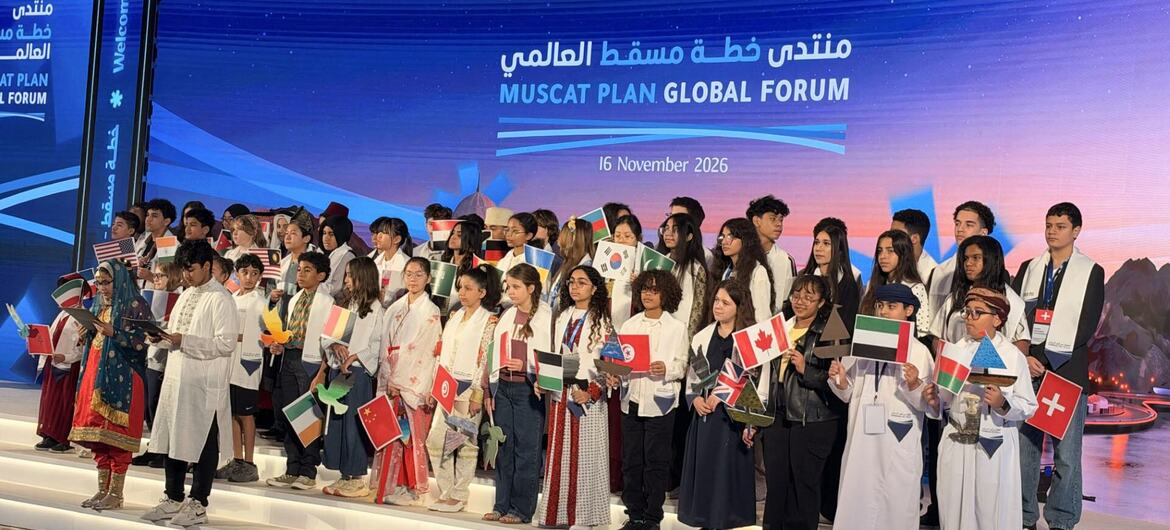
Children from across the world sent a message of peace from the Omani capital Muscat on Monday, calling for an end to hatred, respect for diversity and the protection of human rights.
Their message closed the two-day Muscat Plan of Action Forum, held on the International Day for Tolerance , marked by the UN every 16 November.
"Peace begins in our hearts, and in our belief that we all belong to one humanity," the children said, describing understanding as the bridge between peoples and coexistence as the foundation for a safe and prosperous future.
They pledged to build bridges of solidarity, stand up for children's rights, protect the planet and act as ambassadors for peace in their own communities.
On the forum's second day, UN officials, religious and traditional leaders and experts discussed how to turn the goals of the Muscat Plan of Action - launched at UN Headquarters in New York in June - into practical programmes and partnerships.
Difference is not the problem
Mohamed bin Said bin Khalfan Al Mamari, Oman's Minister of Endowments and Religious Affairs, said the plan aims to strengthen the role of religious and traditional leaders and Indigenous Peoples in preventing conflict and combating hate speech.
"Difference in itself does not create conflict, just as similarity does not guarantee peace," said Mr. Al Mamari.
Peace "is not merely the absence of violence or the cessation of conflicts and wars," he continued, but needs a system built on justice, trust and security.
The minister called for stronger local mediators, a better link between early warning and institutional response and a bigger role for women and young people.
Words before violence
Chaloka Beyani, the UN Special Adviser on the Prevention of Genocide, said tolerance is the basis for peace, human rights and coexistence, warning that discrimination and exclusion can escalate into incitement to violence and crimes against humanity.
He pointed to the 1994 Genocide against the Tutsi in Rwanda and the 1995 Srebrenica genocide as examples of where rhetoric fuelling marginalization and hatred can lead.
"Hate speech and intolerance feed each other in a vicious circle," said Mr. Beyani, urging action at an early stage, before words turn into hostility or violence.
Metropolitan Emmanuel of Chalcedon, of the Ecumenical Patriarchate of Constantinople, warned that atrocity crimes can be preceded by years of rhetoric that strips people of their identity and casts them as a threat.
Imams, priests, rabbis and community leaders can spot tensions early and confront inflammatory speech, he said.
Egypt's Minister of Endowments, Osama Al-Azhari, called for an "acquaintance of civilizations" in place of conflict, citing the Quranic verse: "And We made you into peoples and tribes that you may know each other."
Settling disputes the traditional way
Queen Gladys Mbuya of Cameroon, a lawyer and human rights defender, described how a traditional leader resolved a dispute between Indigenous Bororo herders and farmers whose crops were being destroyed by livestock.
After a full-day meeting at his palace, both sides agreed that the herds would be kept off cultivated land and the farmers would put up fences.
Traditional mediation looks for solutions acceptable to everyone, rather than simply punishing the party at fault, said Queen Mbuya.
Five-year roadmap
The forum closed with the presentation of a global framework for putting the Muscat Plan into practice between 2027 and 2032.
It rests on three tracks:
- cooperation, including an annual progress meeting in Muscat;
- capacity building, through training in local languages;
- and communication, including a global platform for sharing experience in mediation and peacebuilding.


