
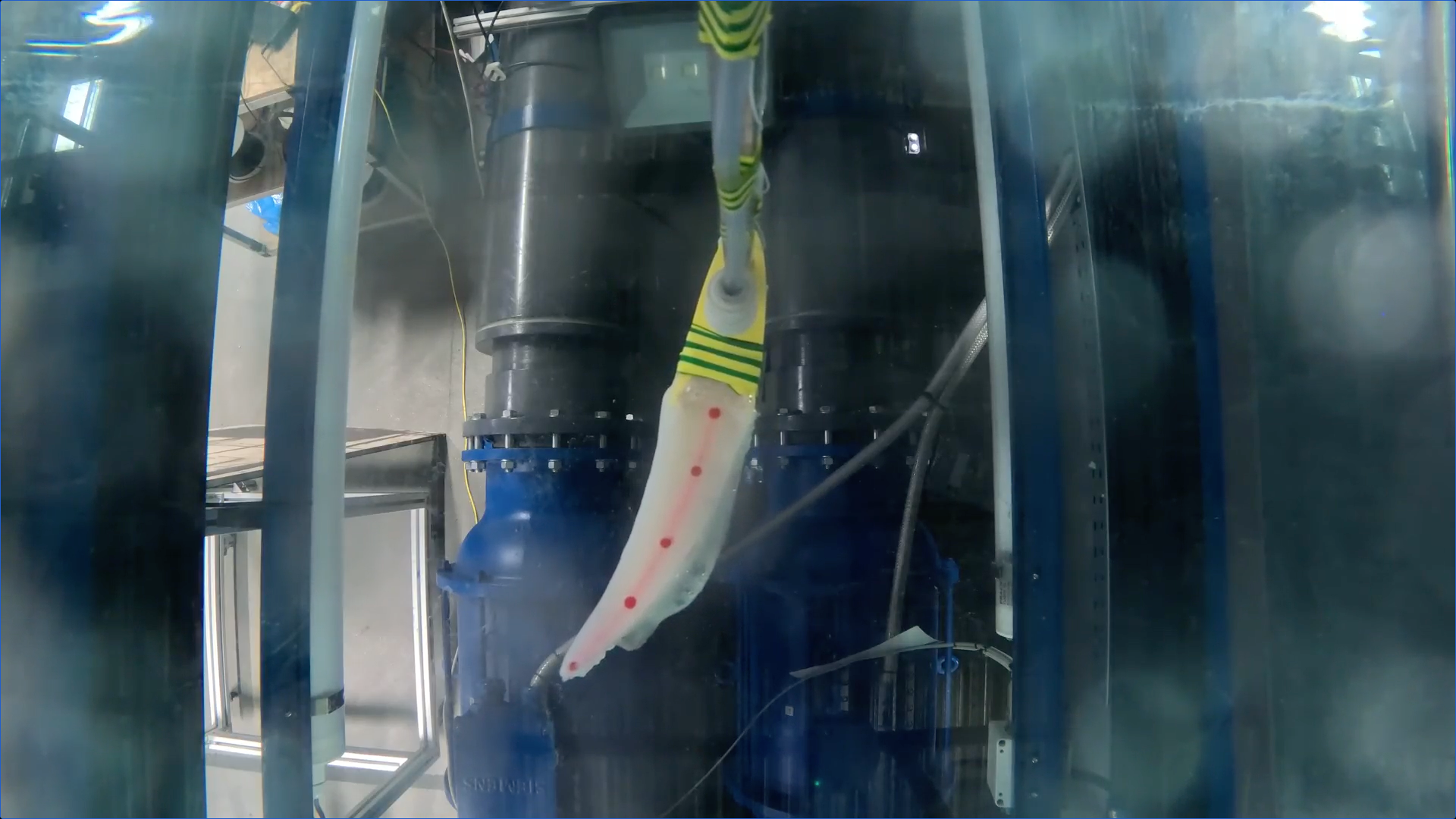
Researchers have taken inspiration from nature to create a robotic wing that can sense and adapt to changes in water to deliver unparalleled stability.
Drawing on the adaptive movements of birds and fish, the wing senses disturbances in the flow of water and automatically changes its shape to adjust to these.
The team, led by the University of Southampton, hope the soft robotics and e-skin they've pioneered could help close the gap in manoeuvrability and efficiency between robots and animals.
In tests, the wing reduced unwanted uplift impulse, the jolt from a sudden underwater current, by 87 per cent compared to the rigid wings found on today's autonomous underwater vehicles (AUVs).
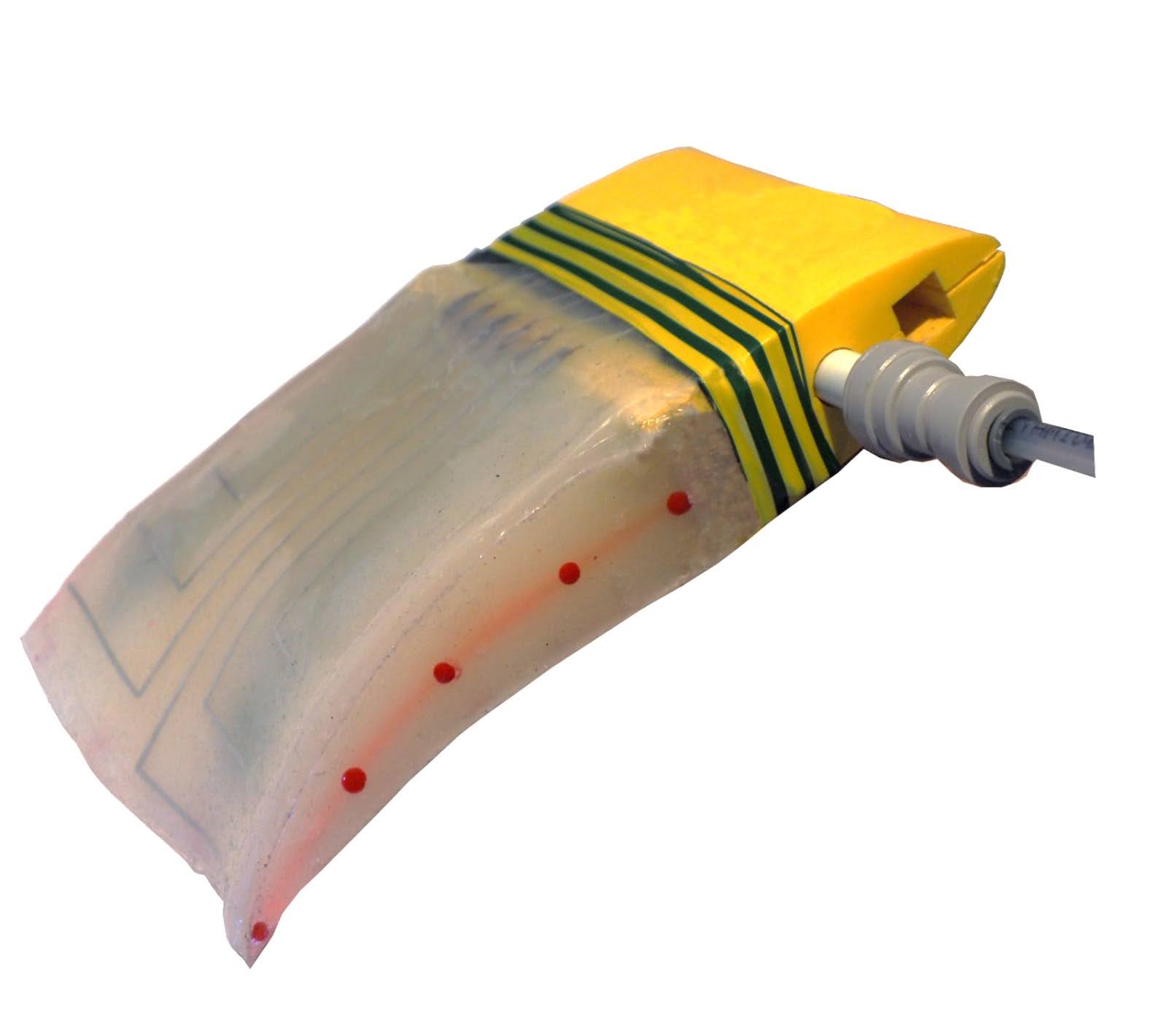
The results, presented in the journal npj Robotics, show the new wing also responds up to four times faster than similar soft wings, and consumes five times less energy than systems which use thermal energy to change shape.
Unlike the graceful, flexible bodies of fish and birds, the rigid bodies and wings of AUVs struggle when buffeted by sudden currents and waves, expending lots of energy to counteract these forces.
To address this challenge, the team of engineers looked to harness the power of proprioception - the body's internal sense of position, movement, and force.
Using proprioception, birds sense changes in air flow through their feathers, while fish use their lateral line system and fin rays to feel changes in water flow.
The team from Southampton, Edinburgh and Delft (Netherlands) developed an innovative e-skin that can sense subtle changes caused by water currents. It consists of flexible liquid metal wires encased in silicone. These act like nerves, sending signals as the wing bends.
The body houses two tubes which are hydraulically pressurised to change the wing's stiffness and camber in response automatically.

"Instead of building 'tougher' robots designed to fight the ocean's power, we are moving toward smarter, softer machines that work in synergy with the environment," says Leo Micklem, lead author on the paper who carried out the work at the University of Southampton and is currently at Portland State University.
To test the new wing, researchers subjected it to disturbances of different shapes and magnitudes and compared the results against a standard rigid wing design and a basic soft wing design without proprioceptive abilities.
The results were staggering. The wing's ability to stabilise itself was roughly double that of a barn owl's during glide, although direct comparisons should be interpreted with caution.
The huge improvements in stability, responsiveness and efficiency could pave the way for more agile, safer robots that use much less energy to stay stable in turbulent conditions.
Professor Blair Thornton, a coauthor on the paper from the University of Southampton, commented: "Ocean environments are dynamic and unpredictable, so robots must continually sense what is happening around them and respond accordingly. Emerging approaches have demonstrated efficient propulsion using soft materials, but integrating these materials for sensing and control brings soft robots closer to the adaptive systems needed to operate reliably in natural underwater settings."
The team note challenges in scaling up the technology, integrating it with the rigid components of an AUV, and ensuring robustness in real-world operations, but also suggests that more powerful actuators could enhance stability even further.
Harnessing proprioception in aquatic soft wings enables hybrid passive-active disturbance rejection is published in npj robotics and is available online.


