
PULLMAN, Wash. - Entomologists have discovered a new species of mining bee that has an unusually tight relationship with cenizo, the official state shrub of Texas.
Silas Bossert, assistant professor in Washington State University's Department of Entomology, worked with colleagues in Texas and Kansas to identify and describe the new mining bee, Andrena cenizophila. Published in the Journal of Melittology, their findings offer new insights into the diverse group of native pollinators.
The new bee species' name, "cenizophila," means lover of cenizo, the native Texas purple sage, also known as Texas Ranger. Field observations and analysis of pollen found on specimens revealed that Texas Ranger is likely the bee's sole pollen source.
"To our knowledge, this bee is the only mining bee in the world that is specifically focused on this one particular kind of shrub," said Bossert, lead author of the study. "The only pollen that we found on this bee is from flowers of purple sage."
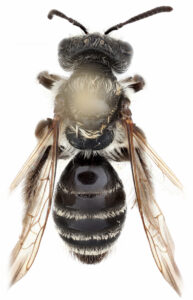
Found in southwestern Texas and the central state of Coahuila in Mexico, this solitary, ground-dwelling bee is less than an inch long. Melittologist Jack Neff of the Central Texas Melittological Institute first collected the bee decades ago, but he and other experts had not classified and named it until now.
"Jack realized he couldn't identify it as anything known," Bossert said. "It didn't match any of the existing subgroups. Without genetic information, we weren't sure where it fit."
To find its place in the mining bee family tree, researchers performed detective work on the bee's DNA, body parts, and use of floral resources. Bossert broke off three legs from a female specimen to extract DNA and sequence its genome.
Features including antennae, body shape, and the male reproductive organ, combined with genetic information, placed the specimen as most closely related to a central Mexican mining bee.
In its native habitat, Texas purple sage bursts into a mass bloom that lasts about a week following rains. These blooms can happen multiple times throughout the year, but the peak is in late spring.
"Andrena cenizophila needs to get all the food for its brood during the main bloom," Bossert said. "That tight window is very unusual for a bee. What does it do during the rest of the year?"
A bee systematist, Bossert studies how bee species are related. Getting those relationships right is vital for properly naming, cataloging, and understanding species.
"The names we give to organisms should reflect their evolutionary history," Bossert said.
Taxonomic housekeeping, as he calls it, helps bring order to our understanding of the natural world.
At 1,800 species and growing, the mining bees are one of the largest genera of animals on Earth.
WSU's M.T. James Entomological Collection, a museum of more than 3 million arthropods, will now house two of the new mining bee's paratypes - representative specimens used and mentioned in the original description of the species.
"These are among the most valuable specimens, the originals used to describe the species," Bossert said.
Should other researchers collect a similar insect, they will be able to compare it with these paratypes to help with identification. Other specimens will be deposited in the entomology collection of the Smithsonian Institution.
"Congratulations to Dr. Bossert and his partners for their discovery," commented Raj Khosla, Cashup Davis Family Endowed Dean of WSU's College of Agricultural, Human, and Natural Resource Sciences. "I am excited to see this newly described species join the James Collection at WSU, where entomologists are combining new technology with traditional techniques to help us better know the world we share with insects."
With as many as 200 new bee species described annually, Andrena cenizophila is not alone in its novelty. And mysteries remain. Researchers have yet to find a cenizophilanest. Learning how the bee develops and feeds its young could reveal more about the life cycle of this unique pollinator.
"There's still a lot to be discovered," Bossert said.


